Updated on August 18, 2026. Bringing a drone to Serbia takes a bit more preparation than within the European Union. The country does not automatically apply the EASA EU framework: before you leave, check formalities, airspace restrictions, and any required authorizations with the Serbian authorities. For a simple leisure flight, the right approach is to plan your route, keep the drone in sight, and avoid improvising near Belgrade, an airfield, a border, a military site, or a gathering.
This guide provides a reliable method to travel and film without turning a great shot of the Belgrade Fortress or the Danube gorges into an administrative problem. Rules and maps can change: final confirmation should always come from the Serbian Civil Aviation Directorate and, when airspace is involved, from SMATSA, the air navigation service provider.
Quick answer: can you fly a drone in Serbia?
Yes, but not everywhere and not without checks. Serbia regulates unmanned aircraft under its national rules. So do not assume your French registration, your A1/A3 certificate, or habits learned in the EU are enough on their own. They are still useful for flying responsibly, but they do not replace local requirements.
- Plan a daytime flight, in direct visual line of sight, and away from bystanders.
- Check the exact area and any temporary restrictions before every takeoff.
- Avoid airport areas, military facilities, critical infrastructure, and border zones without explicit approval.
- For an organized shoot, a heavy drone, an urban flight, or a specific scenario, request the necessary authorizations before you travel.
Practical CTA: before you start packing, reread our guide to cross-border travel with a drone. It helps you separate good pilot practices from what must be confirmed in the country you’re visiting.
Registration and authorizations: do not automatically transpose EASA rules
Serbia is not a member state of the European Union. So treat an operator registration obtained in an EASA country as a preparation document, not as permission to fly in Serbia. Depending on the drone, its use, its weight, the area, and the type of filming, a local procedure may be required.
In practice, gather before you leave: proof of ownership, spec sheet and takeoff weight, serial number, liability insurance if you have it, your accommodation details, and a very concrete description of the project. If your shoot is professional, commercial, event-related, or done with a crew, contact the Civil Aviation Directorate early enough and keep any written reply with you.
To understand the operator and training concepts that apply in the EU—and avoid confusing them with Serbian authorization—also see our feature on mandatory drone registration in Europe and the one dedicated to remote pilot training.
Where is flying prohibited or risky?
The main travel risk is not poor piloting; it’s taking off in a sensitive area without realizing it. The surroundings of airports and airfields, heliports, military facilities, sensitive official buildings, border posts, and certain infrastructure sites should be treated as areas to avoid unless an official source confirms otherwise. Restrictions can also change temporarily during public events or security operations.
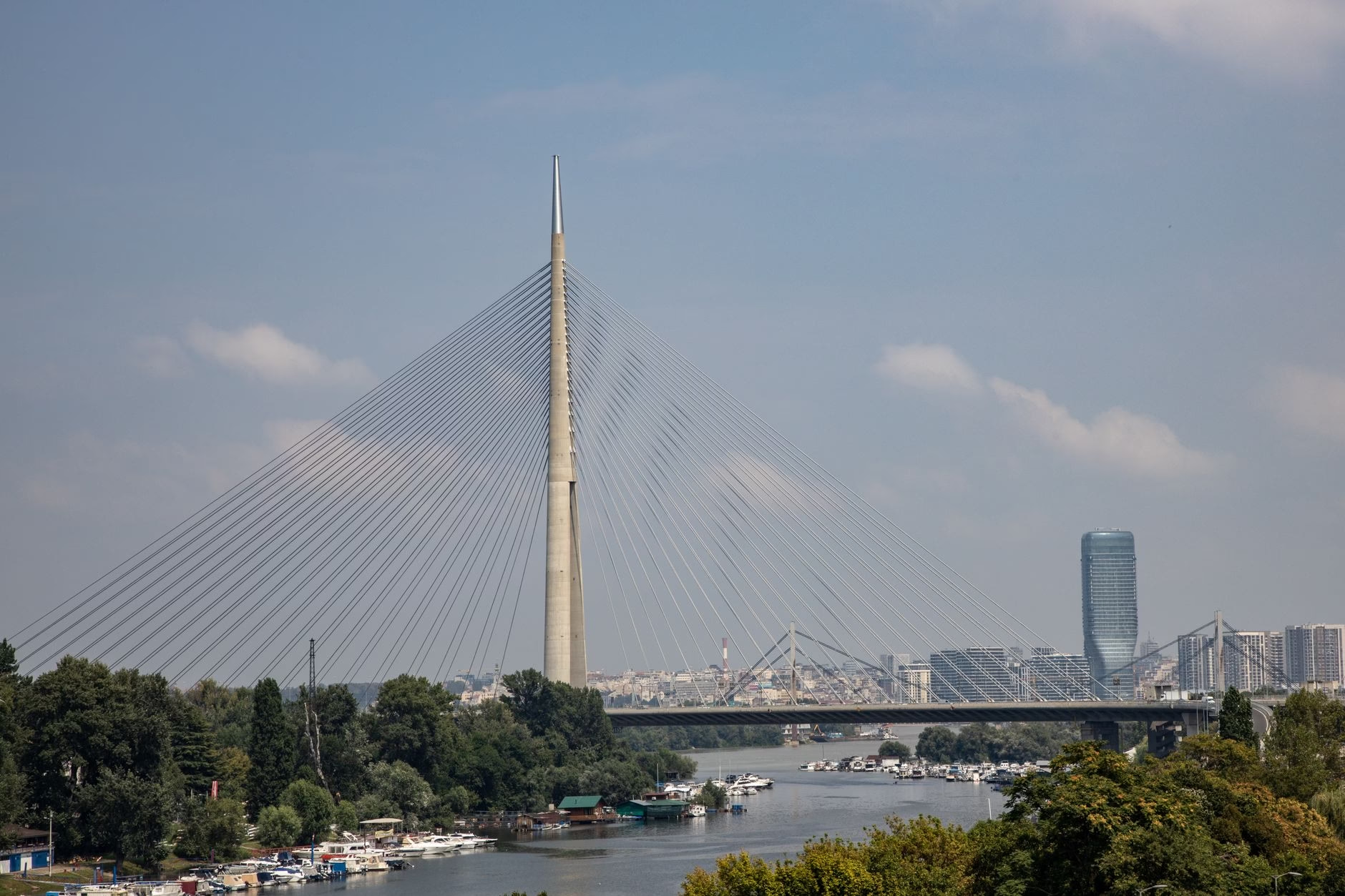
Belgrade calls for extra caution: a dense city, air traffic, institutional buildings, and many busy public spaces. Even when takeoff seems technically possible, flying over people, traffic, or private property is not a good idea. Look for an authorized, low-traffic takeoff point with a clear flight path and an immediate landing option.
For parks, natural sites, monuments, and tourist locations, airspace authorization does not replace the site manager’s rules. An area may be compatible with the airspace yet forbid takeoff, landing, or commercial use of images. So also ask for approval from the owner or the relevant administration.
Safety CTA: our drones and airports guide explains the safety habits to keep—even outside the EU: a manufacturer map is never flight authorization.
Filming, photography, and respecting people
A spectacular shot does not justify flying close over passers-by or intrusive filming. Avoid filming identifiable people without a clear reason, do not fly over terraces, gardens, or homes, and ask for permission for an organized session. For a commercial publication, a clip, a brand, or a production crew, plan ahead for both airspace authorizations and the rights linked to the locations and the people filmed.
The principles detailed in our article on privacy and drones remain solid practical guardrails: distance, consent when needed, and thoughtful sharing of images.
Crossing the border with your drone: the useful checklist
- Before booking: email the Civil Aviation Directorate if your project goes beyond a simple, isolated leisure flight; describe the location, dates, drone model, and how the images will be used.
- On the plane: put lithium batteries in your carry-on baggage, protected against short circuits, and check your airline’s watt-hour limit.
- At customs: keep proof of purchase, the serial number, and the equipment value; it makes it easier to show it’s your personal gear temporarily imported.
- On site: check notices and maps on the day of the flight, observe the area for a few minutes, and walk away if the zone is ambiguous.
- After the flight: do not publish images that would unnecessarily expose a sensitive location, an identifiable person, or a security operation.
Penalties and Mistakes to Avoid
The consequences of an unauthorized flight depend on the context: checks by police or aviation authorities, flight stopped, possible confiscation of equipment, a fine, and in sensitive cases, more serious follow-up. The risk increases sharply near an airport, a defense facility, a border, or during an official event. Never try to “test” an area that looks grey in an app.
The most common mistakes are straightforward: assuming EASA rules apply automatically, confusing the owner’s permission with airspace permission, taking off from a tourist site without approval, or flying in a city because the drone is light. A mini drone reduces some risks; it does not make a sensitive place available.
Tips before takeoff in Serbia
Choose open rural locations, outside built-up areas and far from any aeronautical or strategic infrastructure. Do a first short flight, keep a battery margin to land without pressure, and keep the drone within your field of view. If a local resident, site staff, or an authority asks you to stop, land immediately and ask who to contact to get a formal answer.
To explore the rules that shape the regional context, see our drone laws hub, our guide to drone regulations in Europe, and the neighboring guide on drone laws in Montenegro. They do not replace Serbian checks, but they help you plan your trip more methodically.
Official sources to check before flying
- Civil Aviation Directorate of the Republic of Serbia (CAD): UAS rules, procedures, and contacts.
- SMATSA: aeronautical information and airspace.
- EASA – Civil drones: a reference to understand the EU framework, which is not, by itself, permission to fly in Serbia.
- IATA – lithium batteries: a reminder of air transport principles, to be supplemented with your airline’s rules.
Transparency: this article is for information only and contains no affiliate links. It does not replace written confirmation from the Serbian authorities or from the operator of the site where you want to fly.
Frequently Asked Questions
Is my French registration enough to fly in Serbia?
No—do not treat it as Serbian authorization. It documents your practice in the EU, but local requirements must be confirmed with the Serbian Civil Aviation Directorate.
Can I fly in Belgrade with a small drone?
A small drone does not make urban flying automatic. Density, bystanders, sensitive sites, and airspace constraints require a precise check before any takeoff.
Do I need authorization to film a tourist site?
Very often, you at least need to check the site manager’s rules. Depending on the area and the project, airspace authorization or filming permission may also be required.