Do you dream of capturing breathtaking landscapes without breaking the bank or dealing with stifling regulations? In this article, we’ll help you choose the best drone for beginner aerial photography so you can safely take your first shots. You’ll discover the highest-performing models under 250 grams, technical features like 3-axis stabilization, and essential safety precautions to ensure a smooth flight from your very first outing.
- How to choose the best photo drone for beginners?
- DJI Mini 4K: the entry-level champion
- Autel EVO Nano+: Security with obstacle detection
- Potensic ATOM: a serious and complete challenger
- FIMI Mini 3: Low-light performance
- DJI Mini 3: the ideal tool for social media
- Regulations and basic safety rules
- Practical tips for successful aerial photos
How to choose the best photo drone for beginners?
After defining your desire to gain altitude, you need to understand that the choice of the first device is based on very specific technical and legal criteria.
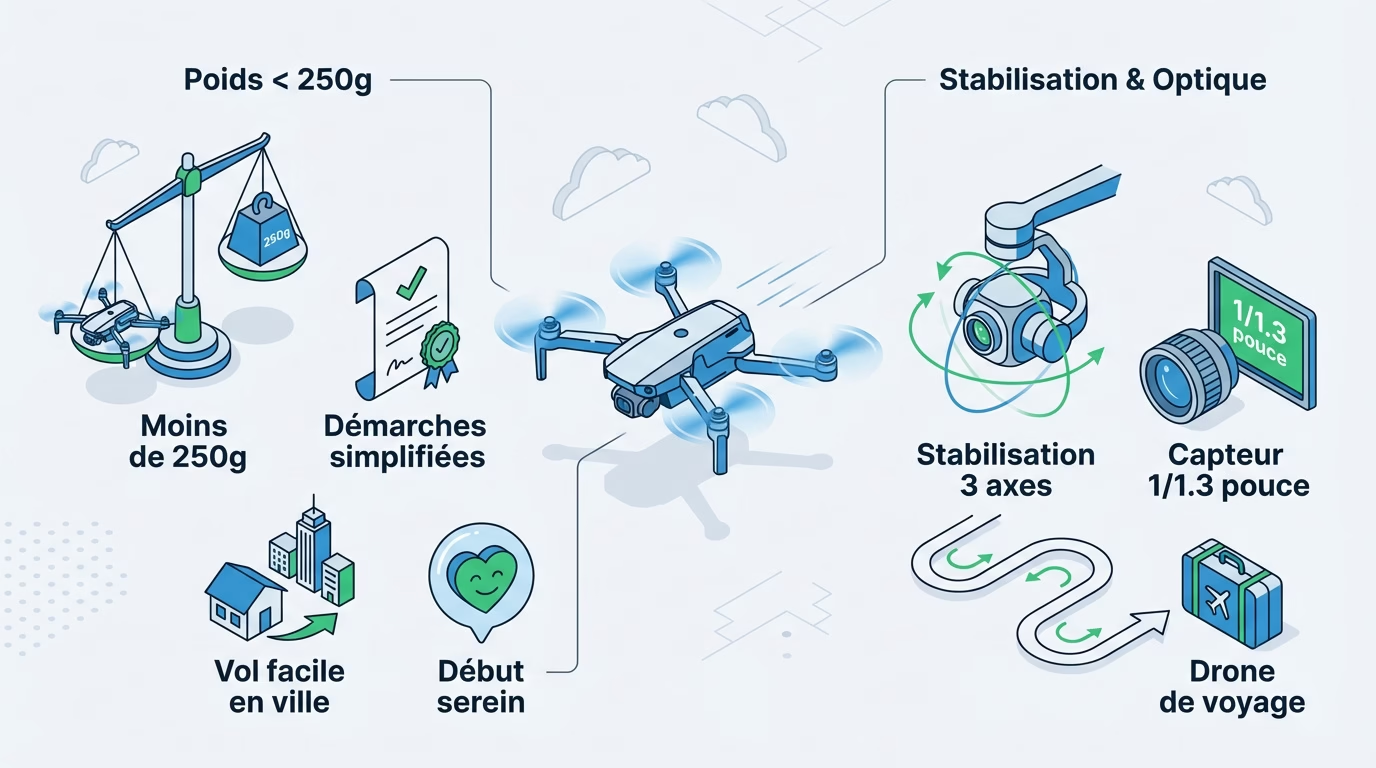
The weight of 250 grams: a strategic threshold
Category C0 is ideal for you. It greatly simplifies the administrative procedures. You can therefore fly without undergoing extensive training initially.
You benefit from increased flight freedom. Flying over populated areas is simpler than with heavier models. It’s much less restrictive on a daily basis.
It’s a rational choice. You can start calmly and completely legally.
Mechanical stabilization and optical quality
It’s essential to check for a three-axis gimbal. Without it, your videos will shake in the slightest breeze. This is what guarantees truly sharp footage.
Carefully compare the sensor sizes. A 1/1.3 inch model is perfect. It captures light efficiently for beautiful images.
Check out how to choose your first DJI drone for travel . It’s a great starting point.
DJI Mini 4K: the entry-level champion
If budget is your top priority without wanting to sacrifice resolution, one model clearly stands out from the current pack.
The DJI Mini 4K stands out as the best value for money currently available. For under €300, you get high-performance Ultra HD resolution. It’s the ideal tool for beginners to get a drone for aerial photography without breaking the bank.
The reliability of the OcuSync O2 transmission is immediately reassuring. You won’t risk losing the video signal up to 10 km away. It remains intuitive, stable, and truly safe to use, even for a beginner.
We also appreciate the 31-minute flight time. That’s more than enough to learn the basics of framing and have fun. All that’s left is to take off and capture your first panoramas.
Need more sensors for added peace of mind? Take a look at the DJI Mini 5 Pro for beginners to compare with the higher-end range.
Autel EVO Nano+: Security with obstacle detection
For those who fear a crash on their first outing, other manufacturers offer impressive technological safety nets.
This model incorporates a three-way obstacle detection system: front, rear, and below. This is a rare feat for a drone weighing less than 250 grams. So you can fly with complete peace of mind.
The 1/1.28-inch CMOS sensor is a real gem. It captures vibrant colors and superb dynamic range, even under overcast skies. Your photos will have an effortlessly professional look.
Want to see its strengths at a glance? Here’s what it’s got inside:
- Featherweight at 249g
- High-performance RYYB sensor
- Fast autofocus
- Stable SkyLink transmission
It’s the ideal tool for beginners learning to fly drones for aerial photography. It remains extremely reassuring during complex flights, such as in the middle of a dense forest.
Potensic ATOM: a serious and complete challenger
Let’s think outside the box with an alternative that challenges the hierarchy established by the giants of the sector.
The Potensic ATOM stands out as a credible alternative for any beginner’s aerial photography drone. It features a 3-axis stabilized gimbal and 4K resolution, all at a truly competitive price.
| Criteria | Potensic ATOM | Direct Competitor |
|---|---|---|
| Video resolution | 4K 30fps | 4K 30fps |
| Type of gondola | 3-axis mechanical | 2-axis or digital |
| Weight | <249g | <249g |
| Indicative price | Less than €400 | Over €450 |
We appreciate its highly effective visual tracking function. It allows you to film a moving subject without even touching the radio’s joysticks.
Tip: Opt for the “Fly More” pack for its exceptional compactness. It’s an ultra-practical choice for traveling light without sacrificing battery life.
FIMI Mini 3: Low-light performance
Aerial photography doesn’t end at sunset, and this model understands that perfectly. The FIMI Mini 3 shines with its ability to handle low-light scenes. Its AI ISP processor processes the image to effectively reduce digital noise.
Need to get back in the air quickly? Take advantage of fast charging via the USB-C port. This is a truly invaluable convenience during your intensive travel sessions or daily outings.
For those looking for a beginner’s drone for aerial photography, this model is a solid alternative to the DJI Neo for stable images . It offers rare versatility for its size.
Don’t hesitate to fly even if there’s a light breeze. Its level 5 wind resistance is impressive. The drone remains stable despite its pocket size.
DJI Mini 3: the ideal tool for social media
For creators of vertical content, a specific model has transformed the way they film for Instagram or TikTok.
Here you benefit from a true vertical shot. The gimbal physically rotates 90 degrees to film. This preserves the full 4K resolution without any cropping.
Need to get equipped quickly? Here’s an interesting option to discover for your projects. In short: Buy Antigravity A1 .
Battery life is a huge strength of this model. With the Plus battery, you can get up to 51 minutes of flight time. That’s perfect for taking your time and fine-tuning your settings.
Still undecided about the size? Take a look at this comparison: DJI Neo vs Mini 3. It’s the perfect guide for beginners looking for a drone for aerial photography.
Regulations and basic safety rules
Owning a high-performance machine is one thing, but knowing where and how to use it legally is another.
Check-in and authorized flight zones
You must register as an operator on the AlphaTango portal. Even for a beginner’s drone for aerial photography weighing less than 250g with a camera, this free registration is mandatory in France.
Always consult the interactive map on Géoportail before taking off. This essential tool displays restricted areas and prohibited red zones. The Dronecast app also helps to check local airspace.
Never fly over public spaces in urban areas; that’s the golden rule. Respecting the privacy of others remains non-negotiable during your filming sessions.
Survival reflexes in case of an in-flight emergency
Stay calm if you lose the GPS signal. Immediately switch to visual manual piloting to regain control. A quick reaction can often prevent an unnecessary crash or aircraft drift.
The Return to Home (RTH) function is a great safety feature for bringing the drone back to its starting point. However, be careful of obstacles such as trees or cables located in the automatic return path.
Tip: Always follow this simple check routine before each takeoff for peace of mind while flying:
- Check the condition of the propellers
- Calibrate the compass regularly
- Monitor the battery level
- Always keep the drone in sight
Practical tips for successful aerial photos
Now that you’re all set, let’s move on to the creative part to transform your flights into true works of art.
Choosing the ideal weather conditions and location
Carefully monitor the wind strength before taking off. For a 249g drone, avoid flying in winds exceeding 25 km/h. This is safer for your device.
Always choose large, open spaces for your first training sessions. A field without trees or power lines is ideal. This minimizes the risk of collisions during your practice sessions.
Seek out the golden hour light for your photos. Sunrise or sunset offers long shadows, making the colors on the ground look beautiful and warm.
Use smart modes for a professional finish
Use QuickShots to easily create dynamic sequences. These automated modes, like Dronie or Circle, do the work for you, delivering cinematic results with minimal technical effort.
Use the rule of thirds to structure your aerial images. Don’t always place the horizon in the exact center of the frame. This immediately adds dynamism to your compositions.
Need to compare the capabilities of each model? Check out this comparison of the latest DJI drones to discover their advanced composition options. It’s a great way to progress with your drone for beginner aerial photography.
Choose a model weighing less than 250g with a 3-axis gimbal for smooth, stress-free filming. Register on AlphaTango and launch during a calm, golden hour. Quickly master your beginner aerial photography drone and finally capture breathtaking images!
FAQ
What is the best drone for starting out in aerial photography without spending too much?
If you’re looking for the best value for money to get started, the DJI Mini 4K is an excellent choice. For under €300, you get Ultra HD 4K resolution and very reliable OcuSync video transmission, which is reassuring for beginners to avoid losing the signal.
It’s a very intuitive device that weighs less than 250 grams, which greatly simplifies administrative procedures. With its 31 minutes of battery life, there’s plenty of time to learn the basics of framing and test automatic modes like QuickShots.
Do you need a diploma or training to fly a small photo drone?
For drones weighing less than 250 grams, such as those in category C0, online training is not mandatory, although it is strongly recommended to ensure you are familiar with safety rules. However, as soon as your drone has a camera, you must register as an operator on the AlphaTango platform.
Once registered, you receive an operator number which you must affix to your aircraft. It’s a simple process that allows you to fly with peace of mind while respecting French civil aviation law.
How to avoid crashing your drone during your first few outings?
Safety is paramount to avoid damaging your new equipment. We recommend choosing a model with an obstacle detection system, such as the Autel EVO Nano+ or the DJI Mini 4 Pro, which act as true technological safety nets.
Before taking off, always check the condition of your propellers and calibrate the compass. It is also essential to practice in a wide-open space, free of trees and power lines, and to keep the drone in sight at all times to react quickly in case of a problem.
Which drone should I choose to post beautiful images on Instagram or TikTok?
For vertical content creators, the DJI Mini 3 is the ideal tool. Its unique feature is its rotating gimbal, which allows for true portrait mode filming at a 90-degree angle without any loss of image quality. It’s perfect for filling smartphone screens.
In addition to this feature, it offers superb image quality thanks to automatic HDR and boasts a record-breaking battery life of up to 38 minutes. This is a real plus for taking the time to fine-tune your settings and get the perfect shot for your social media.
Is it possible to take night photos with a drone for beginners?
Yes, some models perform very well even in low light. The FIMI Mini 3, for example, has an “AI Super Night Video” mode that helps reduce digital noise in dark images. It’s a great option if you like capturing the atmosphere of late afternoon.
Another option is the Autel EVO Nano+ with its high-performance sensor that delivers vibrant colors even in overcast conditions. To take great photos in low light, try flying during the “golden hour,” just before sunset, to enjoy stunning contrasts.