
When it comes to capturing unforgettable memories or producing powerful content for networks, two names come up a lot in 2025: the Insta360 X5 and the DJI Osmo Pocket 3. Two powerful cameras with very different promises: on the one hand, a 360° camera capable of filming in 8K with infinite cropping possibilities; on the other, a small, stabilized camera with a 1-inch sensor, designed for vlogs and quick shooting.
So, which one should you choose? If you’re a content creator, a traveler, a sportsman or just a lover of beautiful images, this comparison will help you make the right choice according to your style. And if you’ve fallen for the X5, you can find out more at this official linkyou’ll receive a free Insta360 accessory with your order! 🎁

Two opposing philosophies: 360° or 1-inch sensor?
The Insta360 X5 and the DJI Osmo Pocket 3 embody two very different visions of content creation. The first is all about the freedom of framing after the shot, thanks to 360° video in 8K and the famous invisible boom that simulates an unmanned drone shot. The second, more classic in its approach, relies on a large 1-inch sensor, fast autofocus and mechanical stabilization to produce sharp, cinematic, ready-to-use videos.
The Insta360 X5 appeals to creative people who want to capture everything at once, and choose the best angle afterwards. It’s the perfect solution for filming a scene without worrying about framing as you take it. For its part, the DJI Osmo Pocket 3 will appeal to vloggers, solo videographers and creators who like to frame precisely as they shoot, with natural rendering and attractive background blur (bokeh).
In short: the X5 is an immersive Swiss Army knife, while the Osmo Pocket 3 is an immediate precision camera. The rest of this comparison will break down their strengths and limitations point by point, to help you make the right choice.

Insta360 X5 vs DJI Osmo Pocket 3: image quality in 2025?
When it comes to image quality, both cameras have solid arguments, but in different registers.
The Insta360 X5 is equipped with two 1/1.28″ sensors capable of shooting in 8K at 30 fps in 360°, with excellent rendering even in low light thanks to PureVideo technology and its 3 AI chips. Active HDR mode in 5.7K at 60 fps captures dynamic scenes with rich colors and balanced contrast, without sacrificing fluidity. All this with total freedom of cropping in post-production: you shoot it all, you choose later.
The DJI Osmo Pocket 3relies on a 1-inch sensor, much larger than the average pocket camera, offering superb light management, beautiful natural bokeh, and 4K video at up to 120 fps. It also offers a D-Log M profile for those who want to calibrate their images like pros. The result is immediately usable, ideal for quick-to-publish content.
👉 To sum up:
- Insta360 X5: perfect for capturing an entire environment in very high resolution, with cropping and creative angles at will.
- DJI Osmo Pocket 3: excellent for filming well-framed subjects with a cinematic look, straight out of the box.

Insta360 X5 vs DJI Osmo Pocket 3: audio quality and capture formats
Audio is often the poor relation of compact cameras, but these two models make a real effort to offer usable sound without an external microphone.
Side Insta360 X5features 4 built-in microphones and several intelligent audio modes: wind noise reduction (low or high), voice amplification, 360° spatial audio, and stereo mode for natural sound reproduction. The AI algorithm coupled with the new multi-layer windscreen guarantees clean sound even in windy environments. For creators who add voice-overs or want full 360° immersion, this is a big plus.
The DJI Osmo Pocket 3 offers a decent-quality stereo microphone, and above all native support for DJI Mic wireless microphones. Thanks to the Do-It-All Handle system, you can easily connect Bluetooth or wired audio accessories. The result: clear, crisp sound, ideal for interviews or no-holds-barred vlogs.
Format level :
- Insta360 X5 records in H.265 or H.264, with .insv files for 360° and .mp4 for flat videos.
- Osmo Pocket 3 produces .mp4 files in H.264/H.265 with AAC audio, ready for editing in any software.
🔎 Verdict: for immersive capture or shots where ambient sound counts as much as the image, the X5 has the edge. For direct frontal pickup with a tie mic or quick recording, the Pocket 3 remains more practical.
Insta360 X5 vs DJI Osmo Pocket 3: stabilization and fluidity, which stands up better?
Stabilization is a decisive criterion when filming in motion. And on this point, Insta360 X5 and DJI Osmo Pocket 3 each have their own secret weapon.
The X5 uses the famous FlowState stabilization, a software technology boosted by AI, coupled with 360° horizon lock. No matter how you hold the camera, the image remains perfectly straight and fluid, even when running or moving violently. This is impressive, especially in 360° mode, where you can crop afterwards without ever losing stability.
Pocket 3, on the other hand, relies on a 3-axis mechanical stabilizer. The result: natural, cinematic fluidity, right at the point of capture. No need for software processing, the image glides along as if on rails. This is particularly appreciated for vlogs, moving stills and travel shots.
In a nutshell:
- Insta360 X5 excels in dynamic environments, sports and outdoor activities with unpredictable movements.
- Osmo Pocket 3 is perfect for smooth, steady shots, documentary-style or clean vlogs.
🏆 For invisible, versatile stabilization, the X5 is impressive. For immediate, cinematic fluidity, the Pocket 3 remains formidable.
Insta360 X5 vs DJI Osmo Pocket 3: autonomy, storage and transfer, which is the most practical?
When shooting in 8K or 4K 120 fps, battery and storage management become crucial. Both cameras have made progress, but with different approaches.
The Insta360 X5 features a large 2400 mAh battery, offering up to 180 minutes of autonomy at 5.7K 30 fps (in optimal conditions). Fast recharging via USB-C (9V/3A with PD 3.0) restores 80% of the battery in just 20 minutes. It accepts microSD cards up to 1TB, in UHS-I V30 format, and features the Quick Reader, a super-useful accessory for transferring files without draining the battery or using Wi-Fi.
The DJI Osmo Pocket 3offers a more compact 1300 mAh battery with approximately 120 minutes of 4K recording time, depending on settings. Its rapid recharging allows it to reach 80% in around twenty minutes. It incorporates a USB-C OTG socket, but often requires Handle Do-It-All to activate certain advanced functions (Wi-Fi, audio, etc.). It also supports microSD cards up to 1 TB.
📥 Transfers :
- The X5 shines with its Quick Reader (SD card → USB-C or Lightning direct).
- Pocket 3 remains simple via the DJI Mimo app, but a little more dependent on its accessories to go further.
✅ Verdict:
- X5 = marathon autonomy + ultra-fast transfer + ecosystem designed for long sessions.
- Pocket 3 = effective use in the field, but with limitations over time without additional accessories.

Insta360 X5 vs DJI Osmo Pocket 3: which camera is more practical for travel?
When you go on a road trip, trek or even just a city trip, size and ease of use count as much as image quality. So, which of these two cameras will best accompany you to the ends of the earth?
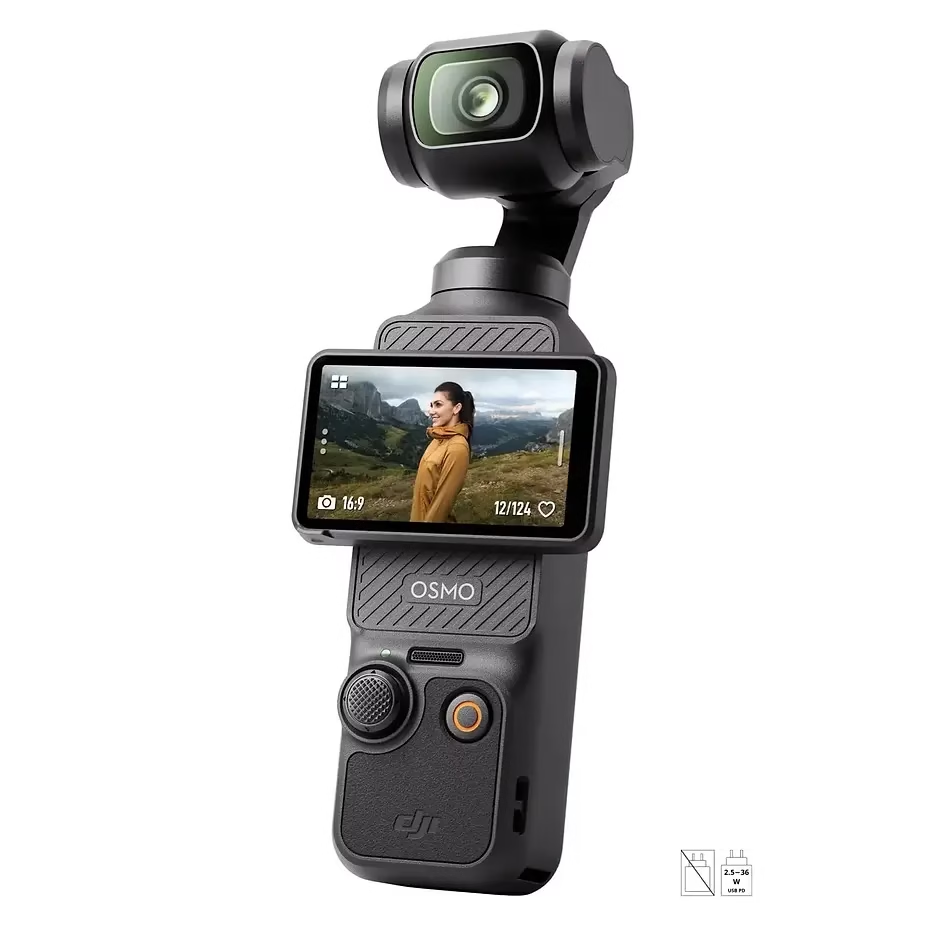
The DJI Osmo Pocket 3 has a clear advantage when it comes to compactness. It literally fits in a pocket (hence the name), weighs less than 180 g and lights up in seconds with its 2-inch rotary touch screen. It’s perfect for vlogging on the fly, discreetly taking your camera out into a busy alley, or filming a quick shot without attracting attention. All with true mechanical stabilization. It’s the ultimate pocket camera.
The Insta360 X5is a little heavier at 200 g, but it captures everything around you, even when you don’t know exactly where to point the lens. It’s ultra-convenient if you don’t want to miss a spontaneous scene. The “Me” mode even lets you capture a video framed on you with no one to film. And when you’re on the move, the invisible selfie stick gives you amazing drone-style shots, without any flying accessories!
✈️ Verdict:
- DJI Osmo Pocket 3 is unbeatable for discretion, speed and compactness in vlog or documentary mode.
- Insta360 X5 is perfect for capturing the atmosphere, the environment, and making “wow” shots without a drone or operator.
Insta360 X5 vs DJI Osmo Pocket 3: which offers the most creative possibilities?
Beyond raw image quality, what differentiates two cameras in 2025 is their creative potential. And on that point, Insta360 X5 and DJI Osmo Pocket 3 offer two very different experiences.
The X5 is all about freedom after the shoot. Thanks to 360° capture, you can choose your framing in post-production, rotate the camera in any direction, follow a subject, create “drone” shots, apply effects such as TimeShift, Bullet Time, or Motion ND, all directly in the Insta360 application. The “Shot Lab” mode offers some thirty predefined effects – with AI – to create stylish videos in just a few minutes, without having to be a professional editor. It’s a real toolbox for TikTok, Instagram or YouTube.
Pocket 3 plays the efficiency card when it comes to camera output. With its color profiles such as D-Log M, it is aimed at creators who want to calibrate manually for professional rendering. The DJI Mimo application, via LightCut, also offers automatic editing based on your clips, but with less cropping freedom than the X5. The Pocket 3’s strength lies in its ability to shoot, cut and publish.
🎨 Conclusion :
- Insta360 X5 = unlimited creativity, 360° effects, post-shoot framing → ideal for designers who like to experiment.
- DJI Osmo Pocket 3 = direct cinema quality, pro profiles → perfect for videographers who ride old-school.
Insta360 X5 vs DJI Osmo Pocket 3: price and value for money, which one’s really worth it?
Let’s move on to a decisive criterion: price. The two cameras are in a fairly similar price range, but offer very different experiences.
The DJI Osmo Pocket 3 is priced at €539 for the standard model. For this price, you get an ultra-compact pocket camera with mechanical stabilization, 1-inch sensor, rotating screen, and a ready-to-publish rendering without complex assembly. If you want to go one step further, the Creator Combo (approx. €679) adds the DJI wireless microphone, multifunction grip and other useful accessories.
The Insta360 X5is priced at €589. It offers 360° video capture in 8K, 1/1.28″ sensors, an impressive 180 min battery life, and above all unlimited creativity thanks to post-shot cropping. And bonus: by clicking this linkan Insta360 accessory is offered.
🔍 Value for money :
- Osmo Pocket 3: perfect for those who want an efficient, simple, no-fuss camera with a great image right out of the box.
- Insta360 X5: the choice of creators who want to shoot everything and then crop it, with unprecedented angles and creative power unique in the world of consumer video.
🏆 If you’re looking for the most versatile camera, ready to follow you into any environment with incredible effects, the X5 is well worth the extra €50.

Insta360 X5 vs DJI Osmo Pocket 3: the final verdict at a glance
To help you make your choice quickly, here is a table comparing the two models:
| Features | Insta360 X5 | DJI Osmo Pocket 3 |
| Price | 589 € | 539 € |
| Sensor | Dual 1/1.28 | 1 inch |
| Maximum video | 8K 360° at 30 fps | 4K at 120 fps |
| 360° mode | Yes (unlimited cropping) | No |
| Stabilization | FlowState + Horizon Lock 360 | 3-axis mechanical gimbal |
| Audio | 4 microphones + spatial audio | Stereo + DJI Mic compatibility |
| Autonomy | Up to 180 min | Approx. 120 min |
| Sealing without casing | IP68 up to 15 m | IPX8 up to 10 m (with housing) |
| Editing / Creativity | Shot Lab, AI effects, free cropping | LightCut, D-Log M |
| Recommended use | Multi-angle creators, immersive vlogs | Vlog frontal, travel light |
And you, are you more creative freedom or instant efficiency?
The DJI Osmo Pocket 3 shines for its simplicity, instant cinematography and pocket format, making it ultra-practical for everyday use. It’s an excellent choice for vloggers, travel reporters or those who want to capture moments with elegance and speed.
The Insta360 X5is for those who want to go even further: shoot all around them, crop afterwards, add spectacular effects and push the boundaries of video creation. For just €50 more, you open up a whole new dimension of possibilities – and with an accessory offered via this link, it’s an investment well worth making.
👉 So, are you ready to capture it all… or do you prefer to stay focused?
❓ FAQ – Insta360 X5 vs DJI Osmo Pocket 3
Which camera offers the best image quality?
The two cameras shine in different applications. The X5 captures everything in 360° in 8K with the option of cropping, ideal for dynamic scenes. The Pocket 3 shoots in 4K at up to 120 fps with a 1-inch sensor, perfect for cinematic shots framed right from the shot.
What about sound? Do we need an external microphone?
Not necessarily. The X5 has 4 microphones and AI sound processing, ideal for 360°. The Pocket 3 offers a good stereo mic and compatibility with the DJI Mic for professional sound, especially for vlogging.
Which camera is easiest to use when travelling?
The DJI Osmo Pocket 3 is more compact, discreet and quicker to draw. Perfect for on-the-spot shots. The X5 is larger, but can capture the whole scene and even simulate a drone shot with its invisible boom.
Which model has the longest autonomy?
The X5 can film for up to 180 minutes with its large battery, and features a quick transfer system (Quick Reader). The Pocket 3 lasts around 120 minutes, but often requires accessories to go further.
When it comes to creating content for networks, which is the most creative?
The X5 is ultra-versatile, with effects such as Bullet Time, TimeShift and post-production cropping. The Pocket 3 aims for immediate efficiency with a cinematic rendering without retouching.
What’s the best value for money?
The Pocket 3 is more affordable (€539) and ready to use. The X5, a little more expensive (€589), but much more powerful and delivered with an accessory offered via this partner link.

-1-150x150.avif)



Leave a Reply