Updated on August 11, 2026. This article contains affiliate links: if you buy through these links, droneandcam.com may receive a commission at no extra cost to you.
A cage is often the first accessory added to a mirrorless camera, but do you really need to surround the entire body? Between a full cage and a SmallRig half cage, the right choice depends less on the number of mounting points and more on how you shoot. The former prepares a true rig; the latter aims to maintain the original compactness and handling. Here is how to decide without buying more metal than necessary.
The verdict in a few seconds
Choose a half cage if you shoot light, handheld, and mostly need a handle or a microphone. Opt for a full cage if your camera regularly hosts a monitor, SSD, top handle, magic arm, or tripod plate. A full cage offers more expandability; a half cage is generally more pleasant for a mobile setup.
Summary
- What distinguishes a full cage from a half cage
- When a SmallRig half cage is the most logical choice
- When a full cage becomes essential
- Comparison Table
- Points to check before ordering
- Which solution fits your profile
Full cage or SmallRig half cage: what’s the difference?
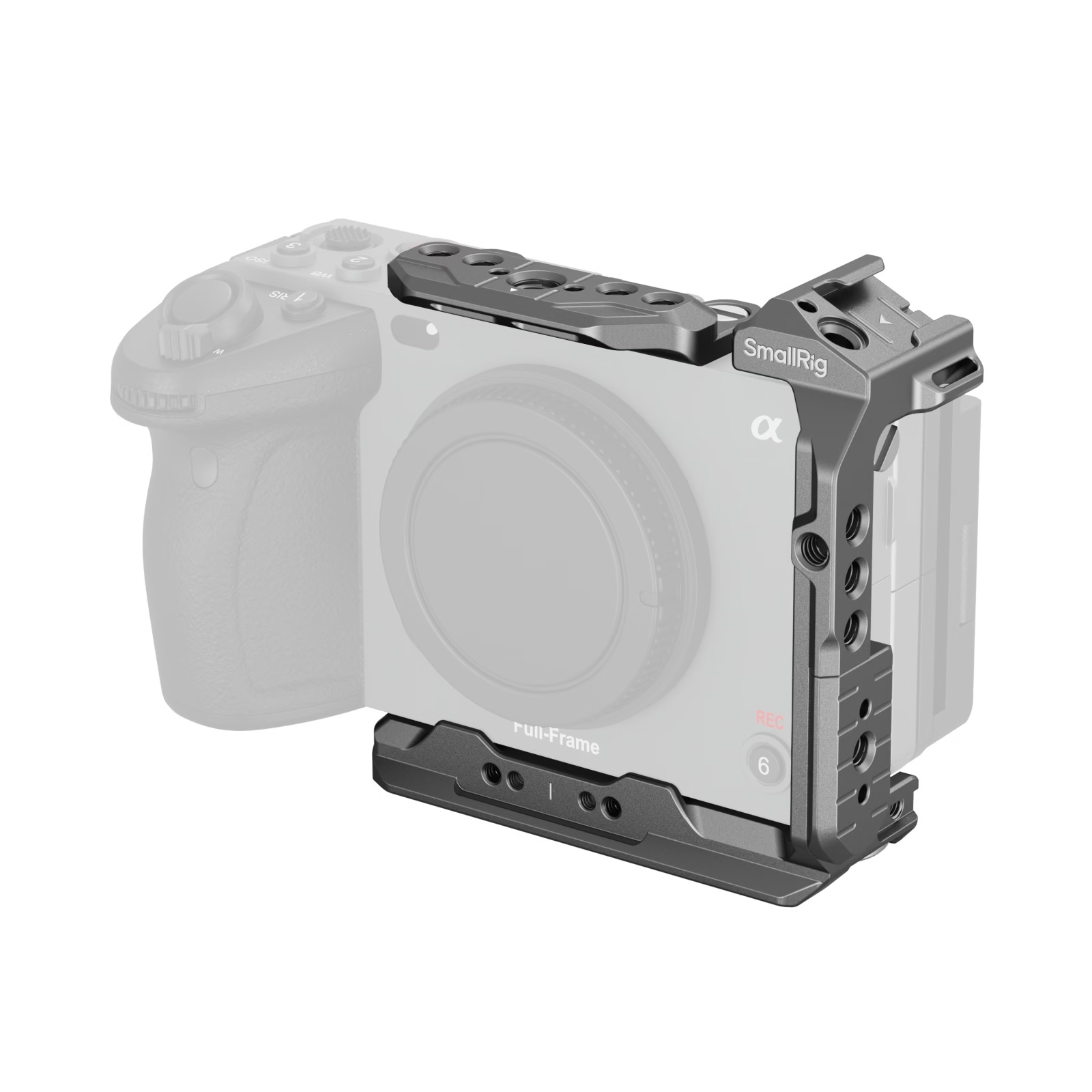
A full cage attaches around the camera body while maintaining access to controls, ports, and the battery. Its purpose is to add mounting points: 1/4″-20 threads, sometimes 3/8″-16 with anti-rotation holes, a cold shoe, and occasionally a NATO rail or quick-lock system. It allows you to build a coherent rig and then expand it.
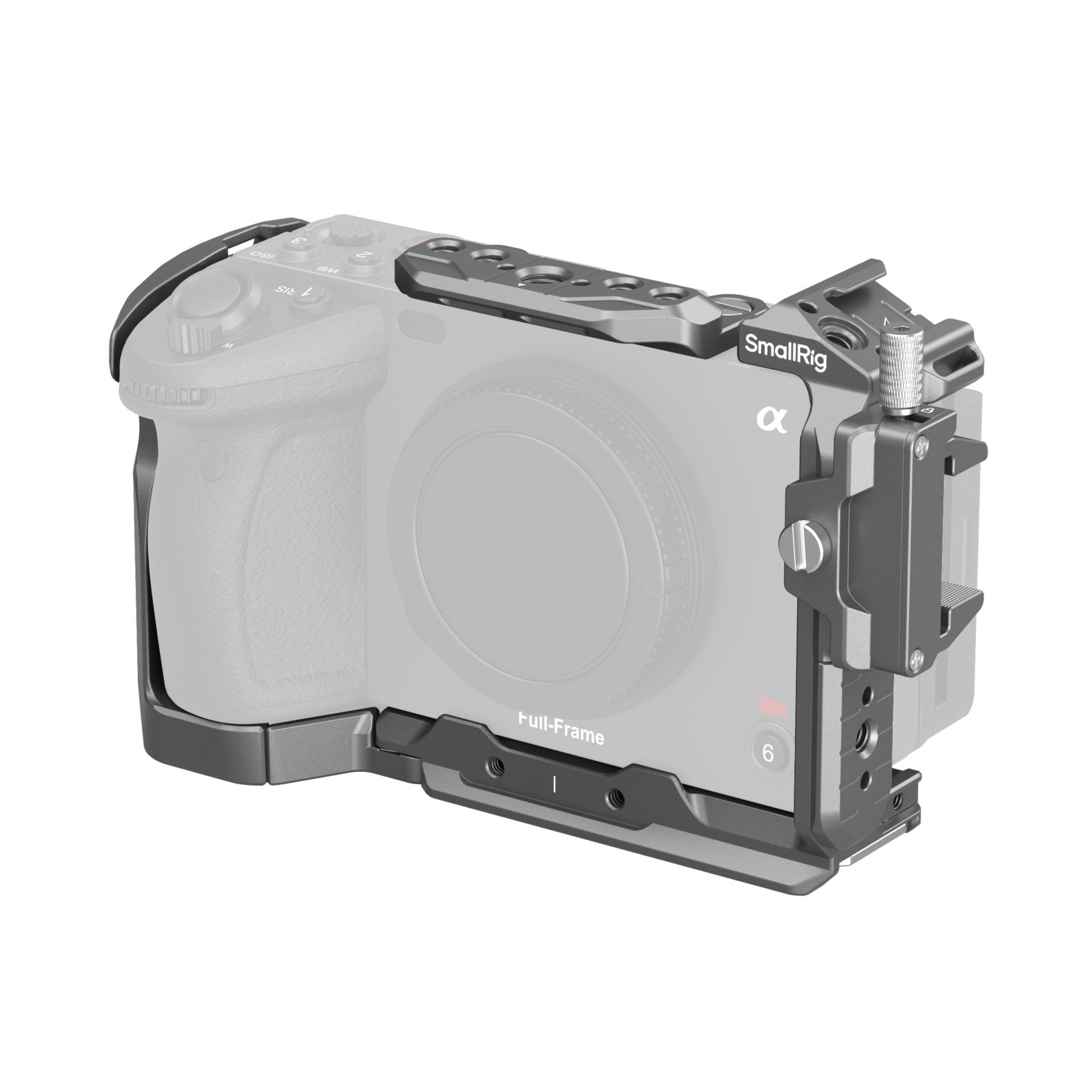
A half cage, on the other hand, covers only part of the camera—often the left side and the bottom. The right-hand grip remains more open. The benefit is clear for photography, reporting, or vlogging: the camera better retains its silhouette and balance. In exchange, there is less space to distribute multiple accessories and less mechanical protection around the body.
When should you choose a SmallRig half cage?
The half cage is particularly relevant if you only mount one or two accessories. A creator using a compact mic, a small light, or a side handle doesn’t necessarily need a full frame. It also prevents the cage from interfering with your usual grip, which matters on compact bodies.
It is also the simplest choice for switching between photo and video. You leave the strap, buttons, and screen fully accessible while gaining useful mounting points. For a Sony FX3 or FX30, our guide on rigging a Sony FX30 with SmallRig clearly shows the benefit of not weighing down the camera from the start.
On the other hand, a half cage isn’t a magic solution for every use. If the monitor, video transmitter, and SSD end up stacked in the same spot, the rig becomes unbalanced. In this case, moving straight to a full cage is often cleaner and more comfortable.
Why choose a full cage?
A full cage makes sense as soon as you want to distribute the load. A top handle improves low-angle shots and movement, a monitor avoids straining to see the screen, and a quick-release plate makes it easier to switch between tripod, gimbal, and handheld shooting. With a cage that surrounds the camera, every element has a more logical placement.
This format is also preferable for recurring shoots: interviews, documentaries, events, or recordings where the setup needs to stay assembled. SmallRig full cages are designed for specific camera bodies; always check exact compatibility, especially when two camera generations have differently placed ports or doors. For Sony cinema models, also check our SmallRig cage comparison for FX3 and FX30.
Half cage vs. full cage: a useful comparison
| Criterion | Half cage | Full cage |
|---|---|---|
| Handling | Very close to the bare camera body | Good, but bulkier |
| Accessory mounting | 1 to 2 light accessories | Full and expandable rig |
| Weight and footprint | Minimal | More significant |
| Ideal use | Vlogging, travel, hybrid photo/video | Interviews, cinema, monitor, SSD |
| Switching to tripod/gimbal | Possible depending on the plate | Simpler with a dedicated plate or system |
| Overall budget | More affordable | Increases with handles and supports |
Checks to make before buying
- The exact camera reference: a dedicated cage is not interchangeable by default between two similar models.
- Access to ports: ensure that HDMI, USB-C, memory card, and battery remain usable with your cables.
- Your priority accessory: mic, monitor, handle, SSD, or tripod don’t require the same mounting points.
- The mounting system: an Arca plate, a NATO rail, or a proprietary system can simplify assembly but must match the rest of your gear.
- Balance: a light and balanced rig gives better results than a cage overloaded with accessories.
The listings in the official SmallRig catalog remain the source to consult for dimensions, compatibility, and box contents. Names and mounting systems evolve; check the listing for your specific device just before ordering.
Which SmallRig cage for your shooting style?
You shoot while traveling or vlogging: go for a half cage and a single truly useful accessory. A compact mic or a side handle is often enough. You’ll maintain the spontaneity that makes a light mirrorless camera so appealing.
You make interviews and YouTube videos: a full cage is the more durable choice. It allows you to cleanly mount a monitor, a mic, and a top handle without any DIY workarounds. If you shoot with DJI stabilization, our SmallRig accessories for DJI RS 4 can complete this setup.
You are a beginner: don’t buy a full kit by reflex. Start by identifying the actual pain point: lack of a handle, missing mounting points, or the need to switch quickly to a tripod. A half cage might be the most economical answer; you can upgrade later if your shoots demand it.
Price, compatibility, and SmallRig range
The price varies mainly based on the targeted camera body and the included elements: a cage alone remains more affordable than a kit with a top handle, side handle, and quick-release plate. Compare the package contents rather than the price alone, and avoid paying for a mounting system you’ll never use.
Verdict: light first, full when the rig justifies it
The SmallRig half cage is the right choice to preserve a camera’s mobility while adding just what is needed. The full cage becomes more relevant as soon as multiple accessories need to stay installed, or if your shoot requires a stable and repeatable configuration. The best purchase isn’t the one with the most gear: it’s the one that precisely solves your shooting constraint.
Frequently Asked Questions
Does a half cage protect the camera?
It can limit contact on the area it covers, but its main role is to add mounting points while keeping the camera manageable. For a heavy rig, a full cage distributes accessories better.
Can you mount a cage on a gimbal?
Yes, but you must check the total weight, gimbal arm clearance, and the mounting plate. A half cage is often easier to balance than a full rig.
Do you need a cage dedicated to your device?
Yes. A dedicated cage respects the position of the camera’s buttons, doors, and ports. Always check your camera’s precise reference and the manufacturer’s compatibility list.