
Tired of sacrificing image quality to keep your pack light on challenging climbs? The upcoming DJI Mini 5 Pro is shaping up to be the long-awaited solution, promising to combine the lightness of a featherweight camera with the power of a professional sensor. Find out now if its rumored features, such as LiDAR and enhanced battery life, will truly make it your best ally for capturing those summits.
- The DJI Mini 5 Pro in brief: what we think we know
- A phantom drone? Let’s clarify the situation.
- Weight: the number one argument for hikers
- “Pro” image quality for the peaks: the 1-inch sensor dissected
- Mountain safety: LiDAR and obstacle detection are game changers
- Autonomy and range in alpine conditions
- Optimizing your backpack: the ideal flight kit for trekking
- Wait or buy? The Mini 5 Pro versus the competition
The DJI Mini 5 Pro in brief: what we think we know
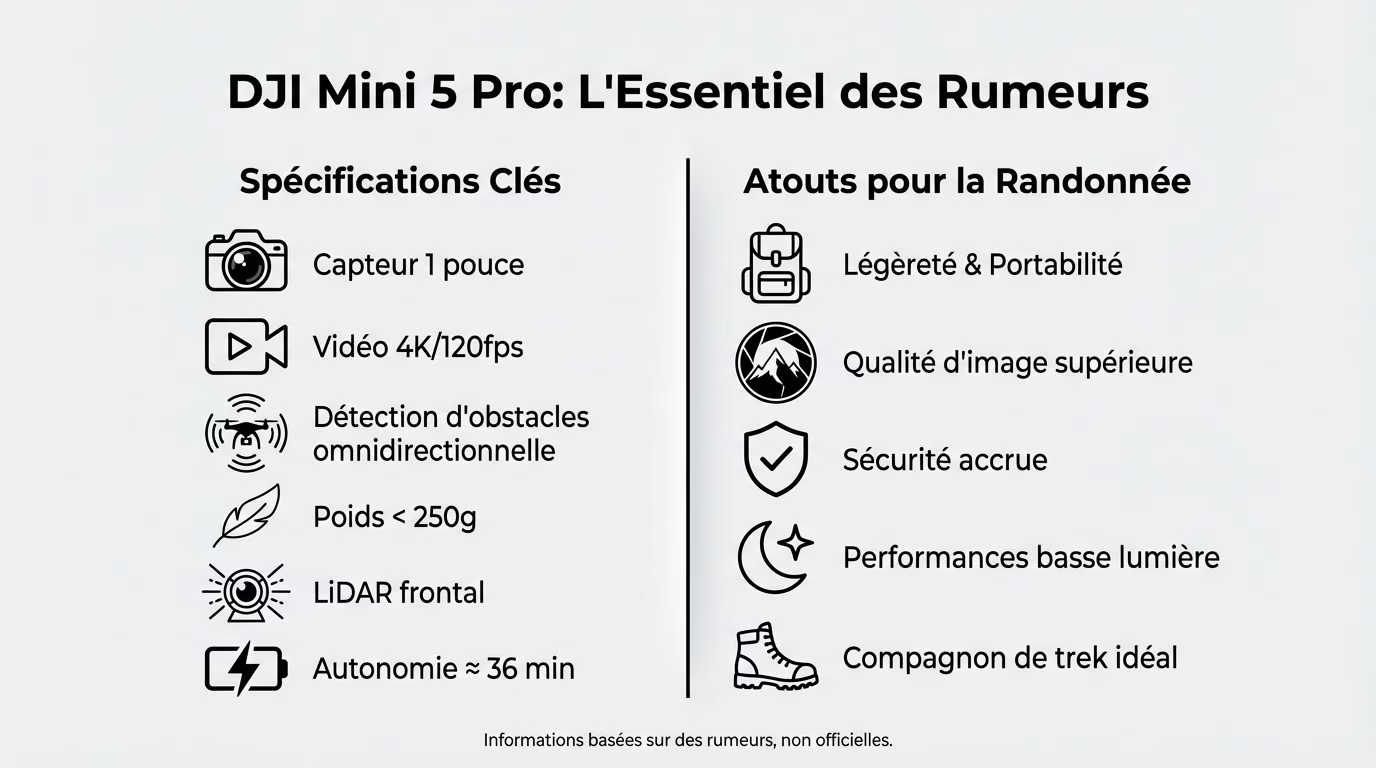
Specifications that are generating a lot of buzz
For now, the DJI Mini 5 Pro is playing hide-and-seek without an official announcement, but leaks are already painting a fairly accurate picture. Expectations are high: a 1-inch sensor, 4K video at 120 fps, and omnidirectional obstacle detection. If this is confirmed, this model would be positioned well above its usual category.
The key advantage? Its weight remains under 250g. This is the key to obtaining CO2 certification in Europe and guaranteeing maximum portability, a non-negotiable criterion for hiking.
Other rumors suggest a front-facing LiDAR scanner for improved low-light flight safety and a flight time extended to approximately 36 minutes. However, take this information with a grain of salt until anything is officially confirmed.
The verdict for the hiker in a hurry
If this drone, with its numerous advantages, comes to fruition, it will quickly become indispensable for mountaineering. You would have the winning combination: absolute lightness, superior image quality, and enhanced flight safety.
Thanks to the 1-inch sensor and the supposed LiDAR, capturing sunrises or sunsets at altitude would become child’s play, even when light is lacking.
On paper, it’s the almost perfect trekking companion for your future adventures. To make sure you don’t miss out when it’s released, keep an eye out here: View the DJI Mini 5 Pro on Amazon and Buy the DJI Mini 5 Pro on the official website .
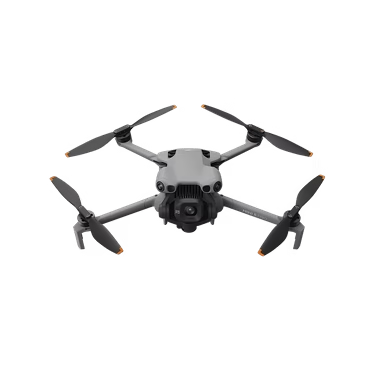
DJI Mini 5 Pro
The next generation ultra-compact drone from DJI. High-quality video, advanced stabilization, intelligent tracking and enhanced security — all in a lightweight and portable format.
Discover more on DJI →A phantom drone? Let’s clarify the situation.
The infamous 404 error page
Are you looking for the DJI Mini 5 Pro and getting a 404 error on the DJI website? This isn’t a technical bug. It simply means the official page isn’t live yet. The product hasn’t been officially released.
Don’t worry, this is a classic scenario before the arrival of a highly anticipated product. Searches start flying long before the page is even created. These “gaps” simply confirm that the anticipation is enormous.
So where does the information come from?
But where did the information about the 1-inch sensor or the 249g weight come from? It came from leaks, listings seen on Amazon, and web analyses. Retailers sometimes make mistakes in their publications.
Even if it’s not official, these leaks are often accurate. It’s standard practice in the industry. With these detailed spec sheets, you rarely see smoke without fire.
We’re analyzing this data to see if this drone performs well in the mountains. It’s the best way to prepare, while awaiting final confirmation from DJI.
Weight: the number one argument for hikers
Less than 250 grams: regulatory freedom
With an expected weight below the critical 250g mark, this drone would fall directly into category C0 in Europe. This is excellent news for us. For what ? Because it significantly reduces administrative constraints: no complex training required and many more areas legally accessible.
For hikers, this is a game changer. It guarantees that you can spontaneously pull out your DJI Mini 5 Pro in front of a beautiful landscape, without having to spend twenty minutes poring over local regulations.
This peace of mind is a true luxury. Out in nature, you just want to enjoy the moment and focus on your images, not stress about the legality of the flight.
The impact on the backpack
In practical terms, on the ground, every gram counts. A 249g drone slips into a side pocket of a backpack without ever unbalancing the load or weighing down the shoulders.
The difference is striking compared to heavier models like those in the Mavic 3 or Air series. On a day hike with elevation gain, the reduced bulk transforms the experience: you no longer hesitate to take it with you.
This lightness is not just a marketing gimmick. It is the essential characteristic that makes using a drone for trekking truly viable and enjoyable over the long term.
An obvious choice for traveling light
For trekkers and minimalist travelers, equipment choice always comes down to the performance-to-weight ratio. With its lightweight design and technical promises, this drone looks unbeatable in this regard.
This is a fundamental criterion when wondering how to choose your first DJI drone for travel , and this new model seems to tick all the boxes for those who refuse to be weighed down.
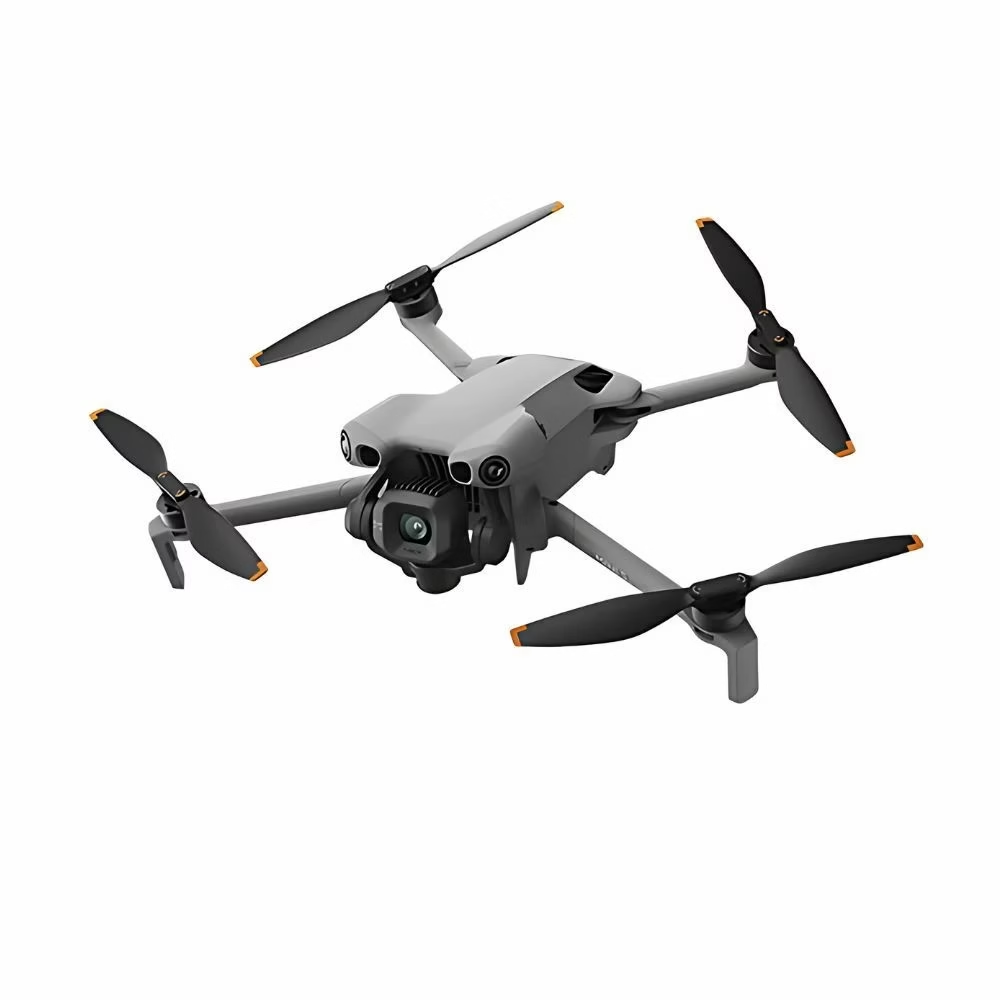
DJI Mini 5 Pro
DJI’s new high-end compact drone: exceptional video quality, 3-axis gimbal, intelligent tracking and latest generation sensors.
See the DJI Mini 5 Pro“Pro” image quality for the peaks: the 1-inch sensor dissected
1-inch sensor: what difference does it make?
There’s a lot of talk about this 1-inch sensor. Simply put: it captures more light than a smaller model. This is the fundamental physical requirement for producing a clean image at altitude.
With the F1.8 aperture, you gain performance right from dawn. The dynamic range takes a leap forward. You can capture details where other drones usually see nothing.
Using a DJI Mini 5 Pro for hiking and mountaineering guarantees balanced images. No more blown-out skies over snow or overexposed valleys in your shots.
Managing the extreme contrasts of the mountain
You know the scenario: a dazzling mountaintop and a dark forest below. A nightmare for small sensors. The 1-inch sensor and 14-stop HDR combination is perfectly suited to handle this stark contrast.
Creators will love the D-Log M profile. It’s a very flat rendering that stores a maximum of information. Color calibration is necessary afterward, but the result is stunning.
If you’re intimidated by post-processing, HLG is the solution. You get extended HDR dynamic range right away, without spending hours on the computer.
4K/120fps video for epic slow motion
The advantage of 4K at 120 frames per second? Creating perfectly smooth slow-motion footage. It’s the ideal tool for enhancing movement and adding grandeur to landscapes.
Imagine the water of a mountain stream or a hiker on a ridge in slow motion. It immediately creates a cinematic effect. Every movement becomes more intense and clearer.
With the potential 225° gimbal rotation, the native vertical format would be perfect. Ideal for posting on social media without losing quality or cropping the image edges.
DJI Mini 5 Pro
The next generation ultra-compact drone from DJI. High-quality video, advanced stabilization, intelligent tracking and enhanced security — all in a lightweight and portable format.
Discover more on DJI →Mountain safety: LiDAR and obstacle detection are game changers
A beautiful image is good. Returning with your drone is better. Let’s see how this newcomer could improve flight safety.
Omnidirectional detection, a necessity
Imagine flying between the dense fir trees of an alpine forest. Omnidirectional detection is like having eyes in the back of your head. The drone scans the front, the back, the sides, the top, and the bottom. In the mountains, with unpredictable rocks and changing terrain, this is vital to avoid a silly crash.
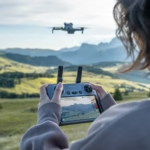
With modes like ActiveTrack 360°, the drone becomes virtually autonomous. It follows you during your hike while navigating the trail’s obstacles on its own. It’s amazing: you walk, it handles the complex piloting. No more stressing about framing or crashing.
Front-facing LiDAR: seeing in low light
LiDAR is the new technology that intrigues everyone. It’s a laser radar that calculates distances instantly, and its biggest advantage? It works perfectly even in extremely low light conditions.
Think about returning from hikes at dusk or flying through dense undergrowth. Where traditional cameras fail, LiDAR takes over to secure your DJI Mini 5 Pro.
This is a major step forward in security, something we’ve been waiting for with this format. Until now, this cutting-edge technology was reserved for much larger and more expensive machines. Security has taken a giant leap forward.
Security comparison: Mini 5 Pro (rumored) vs Mini 4 Pro
This table summarizes the security improvements we expect to see compared to the Mini 4 Pro. Even though the latter is already excellent, the bar could be raised even higher with these new specs.
Take a close look at the LiDAR line in the comparison below. The addition of this sensor, coupled with enhanced omnidirectional detection, promises much smoother flights in challenging conditions. That’s where everything hinges.
| Characteristic | DJI Mini 4 Pro | DJI Mini 5 Pro (expected specs) |
|---|---|---|
| Obstacle detection | Omnidirectional (optical) | Omnidirectional (optical + front-facing LiDAR) |
| Low light performance (detection) | Limited (up to 10 lux) | Improved (up to 1 lux thanks to LiDAR) |
| Topic tracking (ActiveTrack) | ActiveTrack 360° | ActiveTrack 360° (more reliable in complex environments) |
| Pilot assistance system | APAS 5.0 | APAS 6.0 (hypothetical, more responsive) |
Autonomy and range in alpine conditions
36 minutes of battery life: theory vs. reality
On paper, the DJI Mini 5 Pro is expected to have a theoretical battery life of around 36 minutes. This attractive figure is measured under ideal conditions, at a constant speed and without the slightest breeze.
But the mountains are anything but a laboratory. The biting cold and altitude drastically reduce the device’s actual battery life. The battery drains much faster than expected when exposed to the elements.
To avoid any disappointment, aim for 20 to 25 minutes of actual flight time. This is a reasonable amount, but it’s crucial to keep this safety margin in mind during your outings.
The impact of the cold and wind
Cold weather is the number one enemy of Li-Po batteries, reducing their overall capacity. If the temperature is too low, the drone may even refuse to take off as a safety precaution.
The wind forces the engines to work harder, which consumes a lot of energy. We expect a resistance level of 5 (12 m/s), but gusts at altitude often bring surprises.
So, how can you avoid losing your drone? There are simple steps you can take to counteract these weather effects and ensure the safety of every flight:
- Keep the batteries warm in an inside pocket before use.
- Allow the drone to warm up for 1 minute in hover before taking off.
- Monitor the battery level and anticipate returning earlier than usual.
- Avoid flying if the wind exceeds the manufacturer’s recommendations.
O4+ transmission: a robust signal for valleys
The OcuSync 4+ (O4+) transmission system is a major asset. Its strength lies in a theoretical range of 20 km and incredible robustness against interference.
In the mountains, you don’t need to fly 20 km. But this power guarantees a stable video signal even behind a rock or in a valley, which is much more useful.

Optimizing your backpack: the ideal flight kit for trekking
Standard pack or Fly More Combo?
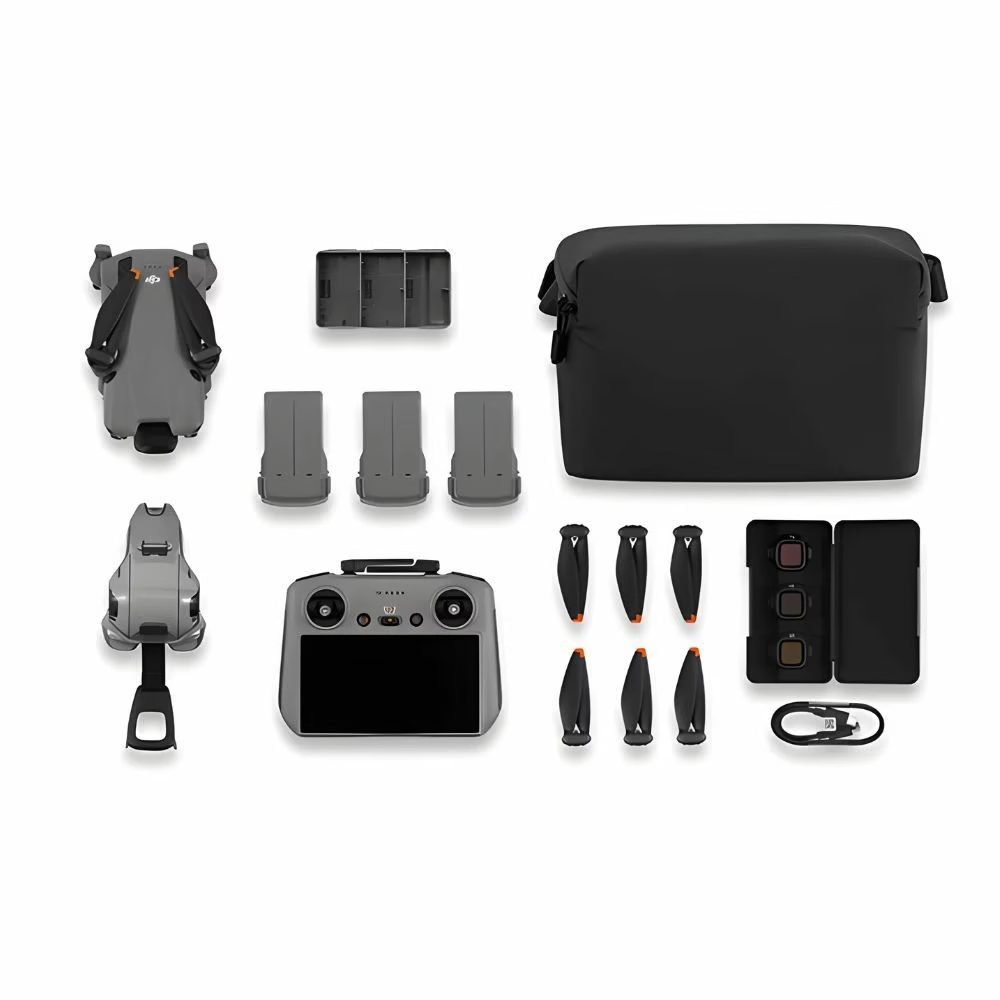
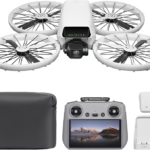
The standard package is very basic: drone, single battery, and remote control. It’s lightweight, but the battery life quickly becomes frustrating in the mountains. The Fly More Combo changes everything with two additional batteries, a hub, and propellers. It’s a bit heavier, but essential for making sure you don’t miss a thing.
Let’s be clear: for hiking, this is the only logical choice. The added weight is negligible compared to the flight time saved. Don’t ruin a climb due to lack of energy.
Accessories that make all the difference
Let’s talk about ND filters. They’re essential for managing intense light at high altitudes and respecting the 180-degree rule. Without them, your images will appear jerky. They’re the secret to a professional look.
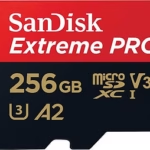
With 4K at 120 fps, the files are large. A fast, high-capacity card is absolutely essential. Choosing the right microSD card for the DJI Mini 5 Pro is crucial. One wrong transfer speed, and the entire session is lost.
My minimalist trekking kit
Here’s my personal setup for traveling light without sacrificing anything. This is the kit I slip into my bag for peace of mind:
- The drone and its remote control (RC 2 with integrated screen, preferably).
- Three batteries in total (the one for the drone + the two for the combo).
- The set of ND filters (ND8, 16, 32 are a good start).
- Two microSD cards of 128GB or 256GB.
- A small, foldable take-off ramp (very useful on tall grass or snow).
All this gear fits perfectly in the Fly More Combo bag, which you can slip into your main backpack. It’s the best compromise between lightweight design and maximum performance for capturing your summits.
Wait or buy? The Mini 5 Pro versus the competition
Compared to its predecessor, the Mini 4 Pro
The Mini 4 Pro is already a powerhouse for hiking. It’s lightweight, reassuring in flight, and produces stunning images. The real question is whether the new features of the 5 Pro justify waiting (and paying more). The biggest anticipated improvement is clearly the 1-inch sensor. For those who swear by pure image quality, the wait is worthwhile. For everyone else, the current model remains a solid choice. Our DJI Mini 5 Pro vs. DJI Mini 4 Pro analysis explores this dilemma in detail.
And what about the other alternatives?
There’s more to life than DJI. Other brands are trying to carve out a niche in the ultra-portable market. The Antigravity A1, for example, is emerging as a serious competitor. These alternatives often offer a different approach, focusing more on AI or a more aggressive price point. It’s always wise to look at what others are doing before making a purchase. The Antigravity A1 vs. DJI Mini 5 Pro comparison clearly illustrates these differences in philosophy.
The outcome for the hiker
For use in the mountains, the Mini 5 Pro promises to be the ideal companion on paper. Here’s what you can expect in practice:
- Expected benefits: Superior image quality (1″ sensor), increased safety in low light thanks to LiDAR, and still that extreme portability (<250g).
- Potential drawbacks: A launch price that may sting and real-world battery life in cold conditions that will need to be closely monitored.
A word of advice: if you already own a Mini 3 Pro or 4 Pro, upgrading probably won’t be essential. However, if you’re starting from scratch, waiting for its release could be an excellent strategy. For a comprehensive overview, our DJI drone buying guide is a good place to begin.
The DJI Mini 5 Pro is shaping up to be the ultimate drone for your treks. With its lightweight design and impressive technical features, it deserves your attention. If you’re not in a hurry, wait a bit to see if the rumors are true. Otherwise, the Mini 4 Pro remains a solid choice for filming your mountain peaks right now.



Leave a Reply