
The key takeaway: at just 125 grams, the HOVERAir X1 is a true personal photographer that fits in your pocket . It takes off from your hand without a remote control to instantly create dynamic videos . It’s the ideal tool for beginners looking for easy content creation, despite its short 10-minute battery life, which necessitates carrying spare batteries.
Does the idea of piloting a heavy, complex drone hold you back when all you dream of is aerial videos for your social media? In this comprehensive review of the HOVERAir X1 autonomous selfie drone, I’ll show you how this device is a game changer, eliminating the controller for a completely intuitive experience . You’ll discover how this featherweight 125-gram drone takes off from your hand and follows you around thanks to its intelligent modes, while also noting the practical limitations of its battery life that you absolutely shouldn’t ignore before buying.
- Ease of use: Takeoff from your hand in 30 seconds
- The design: a pocket drone truly designed for safety
- Autonomous flight modes: your personal director
- The technology behind autonomy: VIO vs. GPS, what you need to know
- Image and video quality: how good is the X1’s sensor really?
- Autonomy and practical aspects: the compromises to be accepted
- Who is the HOVERAir X1 made for (and who is it not)?
- Test verdict: my opinion on the HOVERAir X1
Ease of use: Takeoff from your hand in 30 seconds
Deceptively simple right out of the box
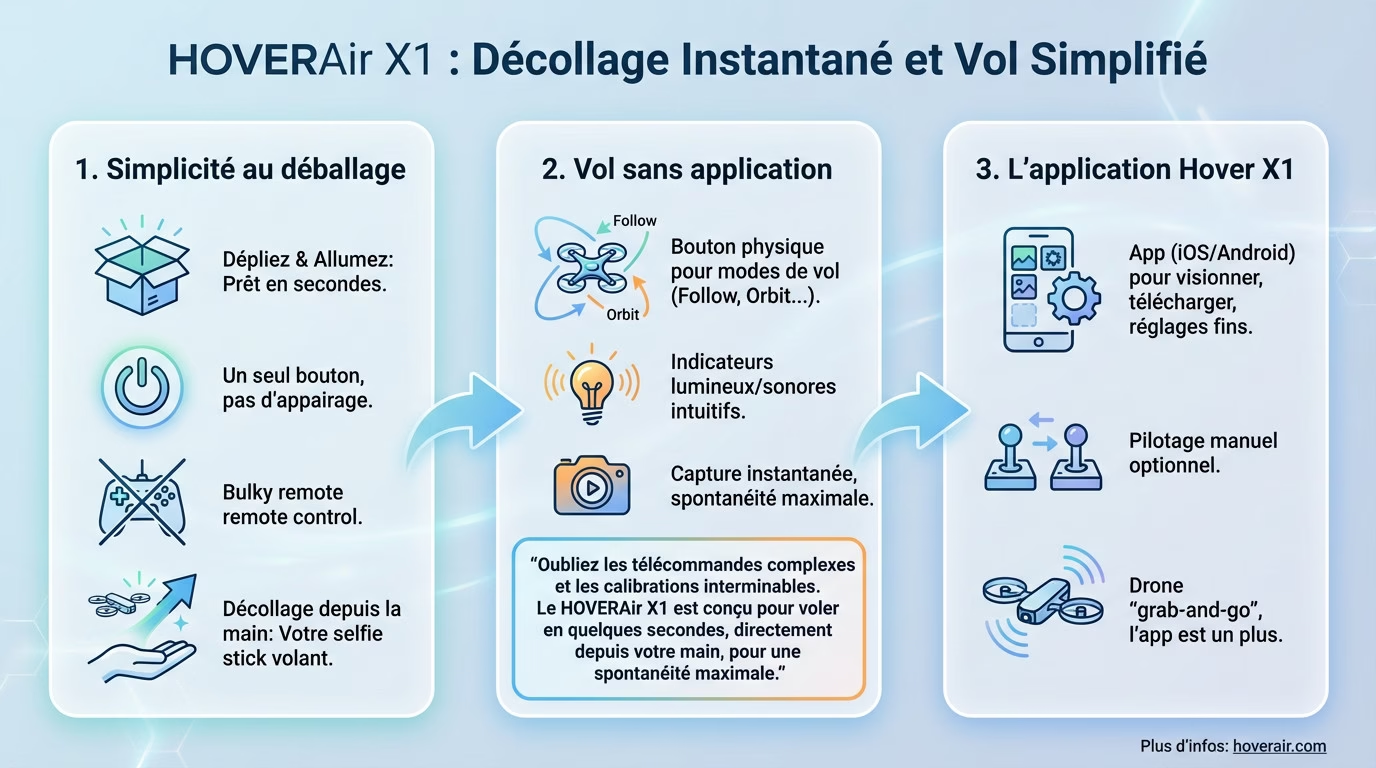
Upon taking the device out of the box, you’re immediately impressed. No propellers to screw on or tedious assembly required. This comprehensive review of the HOVERAir X1 autonomous selfie drone reveals a ready-to-use tool: simply unfold it, that’s all .
To turn it on? A two-second press of the single button is all it takes. The green light illuminates immediately. The best part: no remote control to pair , finally eliminating this often tedious setup step.
This is where the real magic happens. Simply place it flat on your open hand. A little pressure, and whoosh, it rises on its own and instantly stabilizes in mid-air . This is the ultimate “flying selfie stick” concept.
The first flight without an app: how does it work?
Look at the second physical button located on the drone’s chassis. This is your true command center. It allows you to change pre-programmed flight modes directly on the device, without ever needing to take your smartphone out of your pocket.
Want a fixed position? Tap to select “Hover” mode. Prefer a rotation around you? Switch to “Orbit.” The indicator lights confirm your choice instantly. It’s smooth, intuitive, and saves time .
This battery life is a game-changer for capturing spontaneous moments. No more wasting time launching an app, waiting for a connection, and missing the action. See a cool scene? Just pull out your camera, it’s flying, it’s filming. It’s pure instant capture .
Forget complex remote controls and endless calibrations. The HOVERAir X1 is designed to fly in seconds, directly from your hand, for maximum spontaneity.
The Hover X1 app: a complement, not a requirement
Of course, a dedicated app exists on iOS and Android for more advanced features. It’s mainly used to view your achievements, download images to your phone, or modify specific settings. Useful, but not essential for getting started.
You’ll also find a manual control option with virtual joysticks on the screen. It’s a nice feature for adjusting specific framing, but let’s be honest: this isn’t where the X1’s experience truly shines .
In fact, the app is there to manage your content and unlock its full creative potential. But the drone works perfectly well without it. It’s the very definition of “grab-and-go”: you grab it, launch it, and enjoy the moment .
The design: a pocket drone truly designed for safety
A featherweight that changes everything
We’re talking about a device that weighs only 125 grams, battery included. It’s ridiculously light , so much so that you can literally forget it’s in your jacket pocket without even realizing it.
This lightweight design is a regulatory boon: it classifies the drone in category C0 in Europe. In practical terms, this allows you to fly near people without worry , unlike heavier models which are often exempt from FAA registration in the US and very easy to operate here.
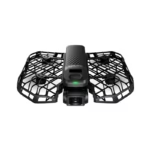
When folded, it measures 127 x 86 x 31 mm, exactly the size of your smartphone . It’s a true pocket-sized device that doesn’t require a dedicated bag.
Protected propellers: peace of mind
The stroke of genius in the design is the integrated propeller guards . The propellers are not exposed, but completely enclosed in robust plastic cages that are an integral part of the chassis.
It makes all the difference in use: you can launch it and land it directly in your palm without any fear . No more fear of accidentally cutting your fingers.
If you hit a wall or a branch, the drone simply bounces instead of crashing . For beginners, this is like insurance for your equipment and the safety of those around you.
Build quality and ergonomics
Even though it’s plastic, it’s far from a cheap toy: it seems sturdy and well-made . You can choose between classic black or white, depending on your preference.
The folding system is extremely convenient to use. The arms that house the propellers deploy in a synchronized manner, and once locked, the whole thing gives a real impression of being solid and ready to use.
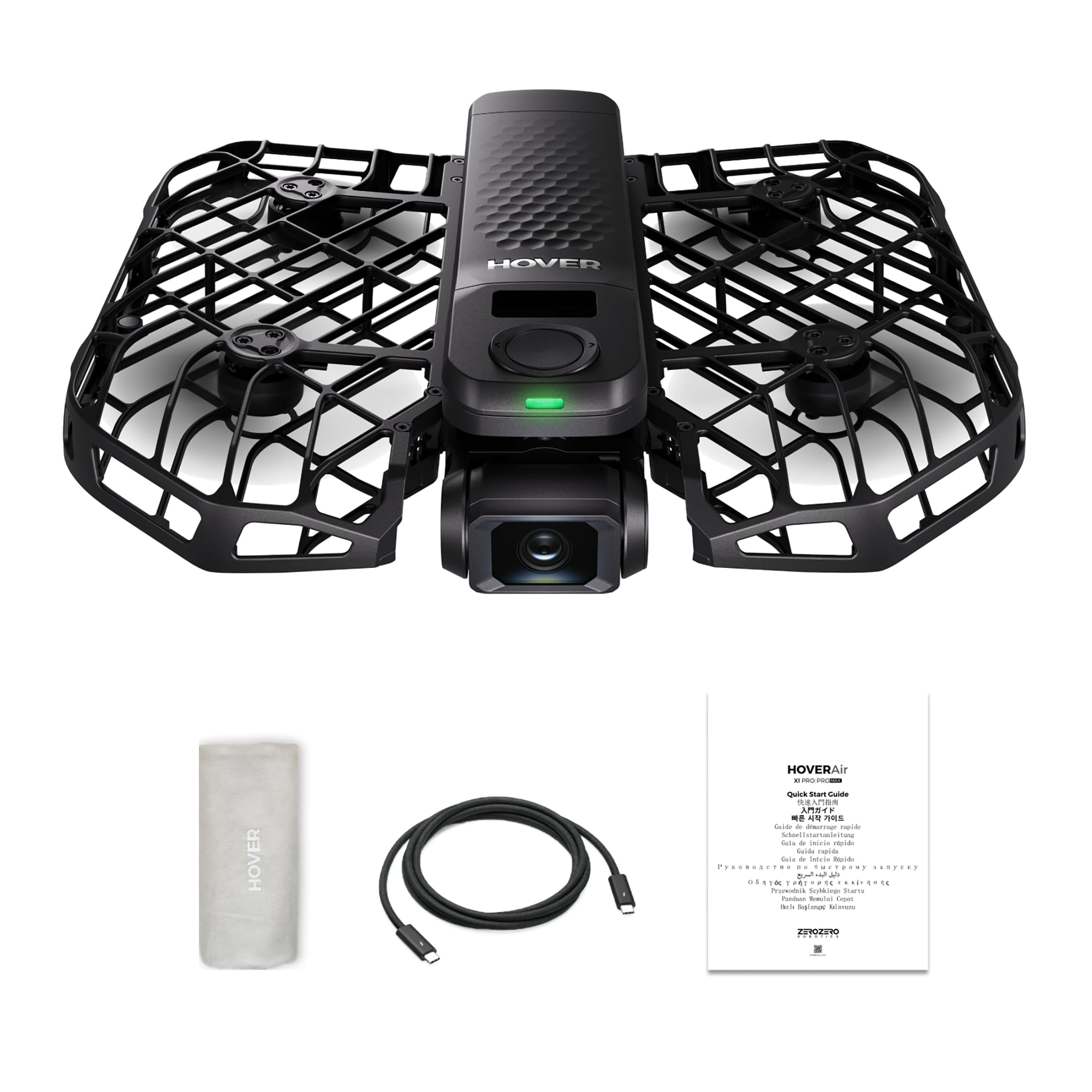
Here are the physical specifications recorded for this HOVERAir X1 full test of the autonomous selfie drone:
- Weight : 125 grams (battery included)
- Folded dimensions : 127 x 86 x 31 mm
- Dimensions when unfolded : 127 x 145 x 30 mm
- Materials: Plastic chassis with integrated protective cages


Autonomous flight modes: your personal director
You’re probably wondering how such a small device can film all by itself? That’s where the magic happens .
Basic modes for dynamic selfies
We start with Hover mode, which transforms the device into a veritable flying tripod. It lifts off from your hand and hovers in mid-air to perfectly frame you . It’s the ideal option for taking a group photo without leaving anyone behind the lens. You stay sharp, the drone takes care of the rest.
Want to add some dimension to your memories? Activate Zoom Out mode for an instant dramatic effect. The drone slowly pulls back while gaining altitude to reveal the breathtaking landscape . It’s the perfect shot to place the action within a setting.
To surprise your followers with a unique perspective, try Bird’s Eye mode. The camera tilts vertically and films straight down, offering a unique bird’s-eye view of your outfit or surroundings. The result is often stunning.
Subject tracking: the “Follow” mode put to the test in the field
Here’s the star feature of this HOVERAir X1 full review of the autonomous selfie drone: Follow mode . The device identifies you in seconds and follows you everywhere like a faithful shadow. It can film you from behind, from the front, or even from the side.
Imagine the possibilities during a jog or bike ride. It keeps pace up to 25 km/h without ever losing sight of you. The tracking reliability is impressive for such a small device. Your hands remain free to enjoy the action.
Be careful though, there’s a costly pitfall to absolutely avoid . This drone doesn’t have obstacle avoidance sensors. Only use it in wide-open areas to prevent crashing it.
Creative modes for videos that stand out
Want a cinematic look without a film crew? These automatic modes instantly add a cinematic touch to your clips.
- Orbit: The drone rotates 360 degrees around you, creating a perfect circular view . Ideal for highlighting a location.
- Dolly Track: The drone moves forward or backward while keeping you in the center of the frame, simulating a cinematic tracking shot .
- Snapshot: A simple mode where the drone just takes a quick photo before returning.
Press a simple button and let the technology do the work for you. You get a variety of sequences without any technical skills . To see examples of cinematic shots , check out their website. It’s accessible to everyone.
The technology behind autonomy: VIO vs. GPS, what you need to know
No GPS, but a VIO system: what difference does that make?
Unlike most DJI drones that search for satellites, the X1 works differently. It completely ignores GPS to orient itself in space. Instead, it relies on VIO (Visual Inertial Odometry) technology to determine its location.
How does it work? It’s quite simple. The drone uses its main camera and sensors located under its belly to “read” the ground. By analyzing the textures and movements of what it films, it calculates its exact position in real time .
The main advantage is its speed of operation. You turn it on, and it’s ready to take off instantly. There’s no need to wait for a GPS signal before starting to record. This is what guarantees its great spontaneity .
The lack of “Return to Home” (RTH): the main constraint
Be aware of the downside: without a GPS chip, there’s no “Return to Home” function . The drone doesn’t remember its starting point. If you’re hoping it will magically return on its own, you might be in for a nasty surprise.
Imagine the battery runs low or the signal is lost. The drone won’t return to you. It will immediately land vertically wherever it is. Whether it’s over grass or a roof, it will come down.
One piece of advice is essential: avoid flying it over water, precipices, or inaccessible areas. Keep it close to you. Losing your equipment unnecessarily would be a shame .
The absence of GPS is both its greatest strength for spontaneity and its main weakness in terms of safety, as there is no automatic return to the starting point.
Ideal flying conditions (and those to avoid)
Since the VIO system “looks” at the ground, it needs good lighting and visible textures. Grass, asphalt, or paving stones are perfect surfaces. The sensors lock onto these details to maintain impeccable stability .
Beware of traps where the VIO completely loses its bearings. At night, over water, fresh snow, or a flat surface (white tiles), it loses its bearings. Without texture to analyze, the drone becomes unstable and drifts dangerously .
Keep in mind the technical limitations: a manual range of 30 meters and a maximum altitude of 15 meters. This isn’t an exploration drone for seeing the horizon. It’s a close-range tool, designed to stay within your immediate surroundings .
Image and video quality: how good is the X1’s sensor really?
A selfie drone is great, but if the image quality is poor, it’s useless. So, does the HOVERAir X1’s camera live up to expectations? I critically analyzed the footage to see if the technical quality lives up to its promise of simplicity, and here’s my honest verdict on what you’ll actually get .
The camera’s technical specifications
For video, it has all the essentials. The drone films up to 2.7K at 30 frames per second , offering appreciable sharpness. I also note the presence of 1080p up to 60fps, which is perfect for obtaining smooth slow-motion footage in post-production.
The 1080p HDR mode is a useful option to enable. It allows for better handling of strong contrasts, typically for recovering detail in very bright skies or shadow areas .
On the photography front, it features a 12-megapixel sensor. It’s not professional-grade equipment, but it’s more than adequate for quick and clean sharing on your favorite social networks.
Real-world performance: strengths and weaknesses
Let’s be clear: the image quality is very good in daylight. The colors are vibrant and the sharpness is perfectly adequate for this size. The internal processing seems truly optimized for accurately exposing faces , which is the primary goal.
The problem lies in its low-light performance. Like any small sensor, the image quickly becomes noisy and blurry when light is severely lacking. It’s clearly not a drone designed for filming at dusk or on dark evenings.
However, the quality is still more than sufficient for Instagram stories, travel vlogs, or family memories. It’s comparable to what some entry-level action cameras offer .
Stabilization: a gimbal and electronics
How does it stay in the air? The drone combines a mechanical gimbal on one axis (the tilt, for up/down inclination). This is what keeps the horizon stable when it moves forward or backward.
This gimbal is complemented by effective electronic image stabilization (EIS), often called “Triple Stabilization” by the brand. It digitally crops the image to eliminate lateral shakes and vibrations .
Honestly, the result is impressively smooth . The videos are stable even when walking fast or when the drone moves to follow you. It’s amazing for its size.
Autonomy and practical aspects: the compromises to be accepted
Good image quality and cool flight modes are one thing. But can you really rely on the X1 for a full day? Let’s talk about the slightly disappointing aspects: the battery and storage .
A battery life of approximately 10 minutes: the need for multiple batteries
Let’s be frank. During our comprehensive HOVERAir X1 test of the autonomous selfie drone, the actual battery life we observed was capped at around 10 minutes per battery . That’s a short time, and this needs to be clearly stated to future users.
Fortunately, this flight time is sufficient to capture several short shots using the automatic modes. This is exactly the intended use for this type of flying camera : fast and efficient.
However, a single battery remains very limiting in the field. The “Combo” pack with an additional battery and dual charger becomes almost essential to avoid frustration.
32GB of internal storage, with no possibility of expansion.
Let’s talk about the second major compromise: memory management. The HOVERAir X1 has 32GB of internal storage to keep all your video footage.
The downside is simple: there’s no microSD card slot . You can’t expand the storage if you run out of space.
Rest assured, 32GB is enough to store quite a few short clips. But you’ll need to remember to regularly empty the drone’s storage to free up space.
File transfer and loading time
The transfer is done wirelessly via the Hover X1 app. It’s simple, but it can take a little while for 2.7K videos. You may need to be patient if you have a lot of footage to retrieve.
When it comes to charging time, organization is key. The multi-charger on the larger packs allows you to charge several batteries simultaneously. This is the ideal solution for maximizing efficiency in the field and ensuring you never run out of power.
Who is the HOVERAir X1 made for (and who is it not)?
After this overview, the verdict is clear . The HOVERAir X1 is not a drone for everyone, and that’s precisely what makes it so compelling.
The ideal companion for content creators and travelers
Throughout this comprehensive review of the HOVERAir X1 autonomous selfie drone, one thing becomes clear: it’s aimed at content creators for social media platforms like Instagram or TikTok. It’s also the perfect companion for solo travelers and families who want to capture lasting memories.
For what ? Because it allows you to easily film yourself from dynamic angles, without any outside help. You get shots that previously required an experienced pilot , all by pressing a simple button.
It’s primarily a tool for capturing the present moment . You take it out of your pocket, it takes off, and you enjoy the moment without worrying about technique or settings.
Why traditional drone pilots might be disappointed
Let’s be honest: this isn’t a device for hardcore pilots or classic aerial photographers. The limited range of a few dozen meters, the low altitude, and the lack of precise physical joysticks will be deal-breakers for you .
Similarly, demanding videographers seeking cinematic 4K quality or LOG color profiles will need to look at other, more advanced models. The quality is excellent for a smartphone screen, but it shows its limitations on a large screen .
It should be seen as a complement to a larger drone, but certainly not as a replacement . It simply doesn’t compete in the same league and doesn’t pretend to.
Facing the competition: where does the X1 stand?
The main competitor in this “remote-free drone” niche is now the DJI Neo. However, the X1 still stands out thanks to its reassuring full protective cage and its truly extreme ease of use .
To help you make an informed choice, our detailed comparison between the HOVERAir X1 and the DJI Neo analyzes their differences point by point. This will help you see which one best suits your needs.
It all depends on your priority: the safety and absolute simplicity of the X1, or the DJI ecosystem . In fact, reread our initial hands-on review of the HoverAir X1 to appreciate how far we’ve come.
Test verdict: my opinion on the HOVERAir X1
So, should you really go for this little flying device? After putting it through its paces in the field, here’s what I really think of this flying camera that promises to replace your selfie stick.
The strengths that make the difference
This gadget is a game-changer for solo content creators. It’s the ultimate tool for capturing aerial shots without any technical effort .
- Radical ease of use: You take it out and it flies in less than a minute , it’s amazing.
- Extreme portability : Weighing only 125 grams, it slips easily into a jacket pocket or small bag.
- Integrated safety: The protective cages are a real plus for peace of mind, you can grab it by hand.
- Effective tracking modes : The “Follow” mode and creative trajectories work surprisingly well for framing the subject.
Weaknesses to be aware of before making a decision
Let’s be honest, this model isn’t perfect. Battery life is the main drawback , barely offering 10 minutes of actual flight time. This is frustrating if you don’t have a spare battery. Extra batteries quickly become essential.
The other major limitation is the fixed 32GB storage, which requires regular file management to avoid filling up the memory. Furthermore, the lack of GPS necessitates a degree of caution during flights. The drone will not return on its own .
My final opinion: a successful gamble?
For me, Zero Zero Robotics’ gamble has paid off handsomely. They’ve succeeded in creating a new product category: the true consumer selfie drone . This comprehensive review of the HOVERAir X1 autonomous selfie drone confirms its unique positioning.
It’s not the highest-performing drone on the market, that’s for sure. Yet, it’s perhaps the most fun and accessible I’ve ever used. For anyone who wants original shots without becoming a pilot, it’s an excellent choice that delivers on its promise . You’ll love using it.
In short, the HOVERAir X1 is the ideal companion for capturing spontaneous memories . If you’re looking for absolute simplicity without worrying about piloting , go for it. Just accept its limitations in battery life and storage . It’s the perfect tool to boost your social media presence without any technical effort .
-1-150x150.avif)


Leave a Reply