
Are you unsure which camera to choose for your vlogs and worried you might regret your purchase? This DJI Osmo Pocket 3 vs. Sony ZV-1 comparison analyzes stabilization and image quality to clearly show you the best choice. Together, we’ll discover which camera is truly suited to your needs so you can create successful videos without any hassle.
- Stabilization and objective: the first round
- Ergonomics and image quality: two opposing philosophies
- The practical details that make all the difference
Stabilization and objective: the first round
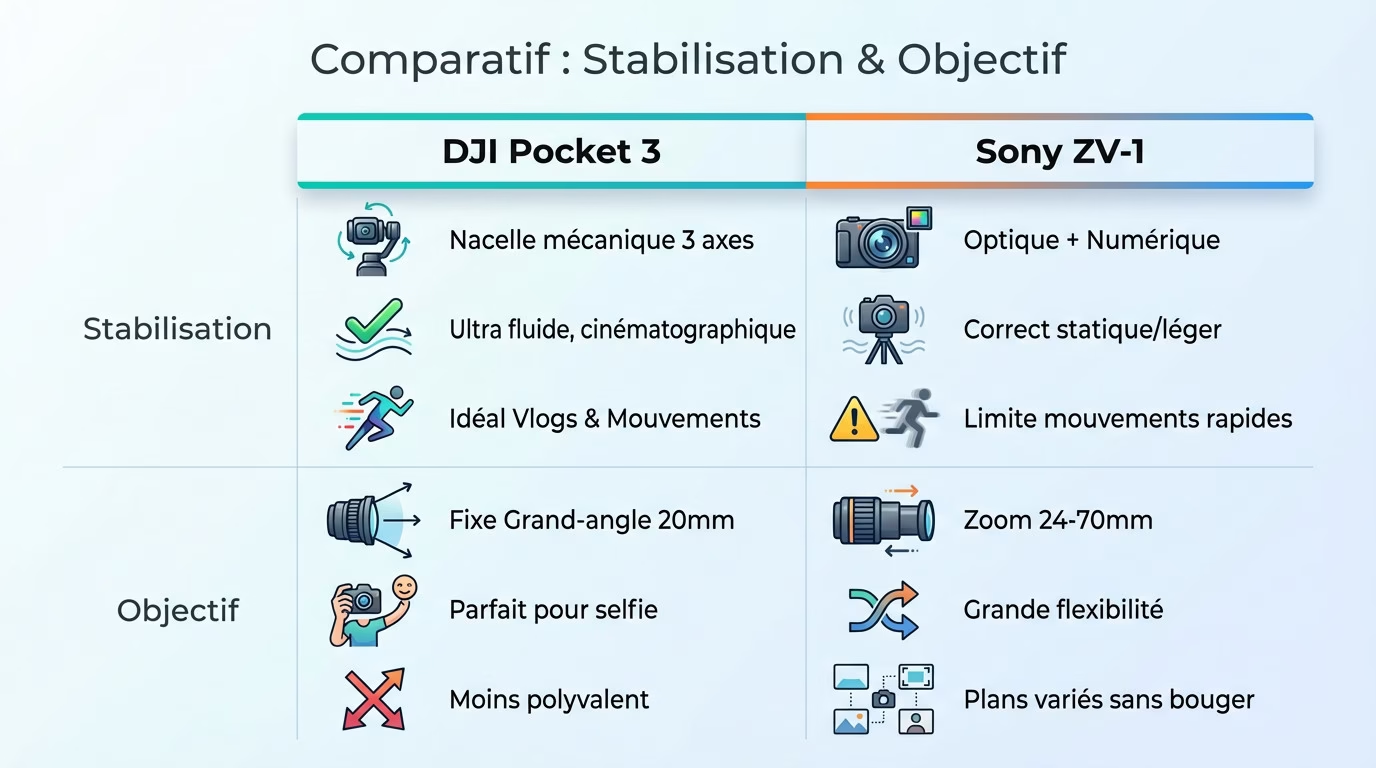
Stabilization: the Pocket 3 has the edge in action
The major difference between the DJI Osmo Pocket 3 and the Sony ZV-1 is the stabilization technology. The Pocket 3 uses a 3-axis mechanical gimbal, its key advantage. For vlogs while walking or moving, the result is ultra-smooth, almost cinematic.
In contrast, the ZV-1 only offers optical and digital stabilization. This is adequate for static shots or slight movements, but it quickly loses stability if you run or move around a lot.
The objective: the ZV-1 and the versatility of its zoom
Here, the Sony ZV-1 scores a decisive point. Its 24-70mm zoom lens offers great flexibility. You can switch from a wide shot to a close-up without moving.
The Pocket 3, on the other hand, is locked into a fixed 20mm wide-angle lens. It’s perfect for filming yourself at arm’s length, but it lacks the flexibility to vary the framing on a distant subject. It’s a trade-off you have to make.
Ergonomics and image quality: two opposing philosophies
Beyond stabilization, the use and image rendering differ radically between these two devices.
Instructions and format: the summary in table format
The Pocket 3 is an ultra-compact stick that fits in your pocket. Its rotating screen is ideal for shooting vertically in an instant.
The ZV-1 retains the form factor of a classic compact camera. It feels reassuring in the hand, but overall it’s bulkier.
Here’s a quick comparison of the DJI Osmo Pocket 3 vs. Sony ZV-1 match:
| Characteristic | DJI Osmo Pocket 3 | Sony ZV-1 |
|---|---|---|
| Sensor | 1 inch | 1 inch |
| Objective | 20mm (fixed) | 24-70mm (zoom) |
| Stabilization | 3-axis mechanics | Optical + Digital |
| Screen | 2-inch rotary | Adjustable 3 inches |
| ND filter | No (accessory) | Integrated |
| Weight | 179 g | 294 g |
Image rendering: 10-bit versus 8-bit
The Pocket 3 records in 10-bit. You capture more nuances, a major advantage for color grading and a professional look.
The ZV-1 is limited to 8-bit. The image is beautiful in its raw form, but less forgiving of advanced post-processing.
The practical details that make all the difference
Let’s talk about the practical aspects that can quickly become a headache on the ground.
Managing light and sound: the blind spots
In bright sunlight, the ZV-1 shines with its built-in ND filter: a single click is all it takes to maintain a professional background blur. With the Pocket 3, you have to buy and screw on magnetic filters.
In terms of sound, the ZV-1 delivers with a universal 3.5mm jack, while the Pocket 3 focuses on its ecosystem.
- Sony ZV-1: 3.5mm port for any external microphone.
- DJI Osmo Pocket 3 (only): Adapter required for a microphone.
- DJI Osmo Pocket 3 (Creator Combo): Includes the excellent DJI Mic 2 wireless microphone.
Budget and accessories: the final cost
Be careful about the actual price. For the Pocket 3, the “Creator Combo” is almost essential: it includes a microphone, tripod, and an extra battery.
A useful tip: a magnetic backpack clip is a game-changer. Also, keep an eye out for Black Friday deals to save money.
Ultimately, the choice is yours. If you’re constantly on the go, the Pocket 3 is unbeatable for its smooth performance and compact size. But if you’re looking for the versatility of a zoom lens and a classic format, the ZV-1 remains a solid choice. Define your vlogging style to find the perfect companion.



Leave a Reply