
Are you afraid of crashing your future drone on its first flight or regretting an unsuitable purchase? This DJI Mini 4 Pro vs. DJI Neo 2 comparison for beginners explains exactly which one to choose between absolute simplicity and technical performance. Discover immediately which model guarantees a stress-free experience, tailored to your creative aspirations.
- Two drones, two philosophies for getting started
- Ease of handling and piloting: which is the least stressful?
- Safety and obstacle detection: which will prevent the crash?
- Image quality: do you really need the best to start with?
- Budget and packages: the crux of the matter
- Regulations and sustainability: the details that matter
Two drones, two philosophies for getting started
The DJI Neo 2: the ultra-affordable “selfie” drone
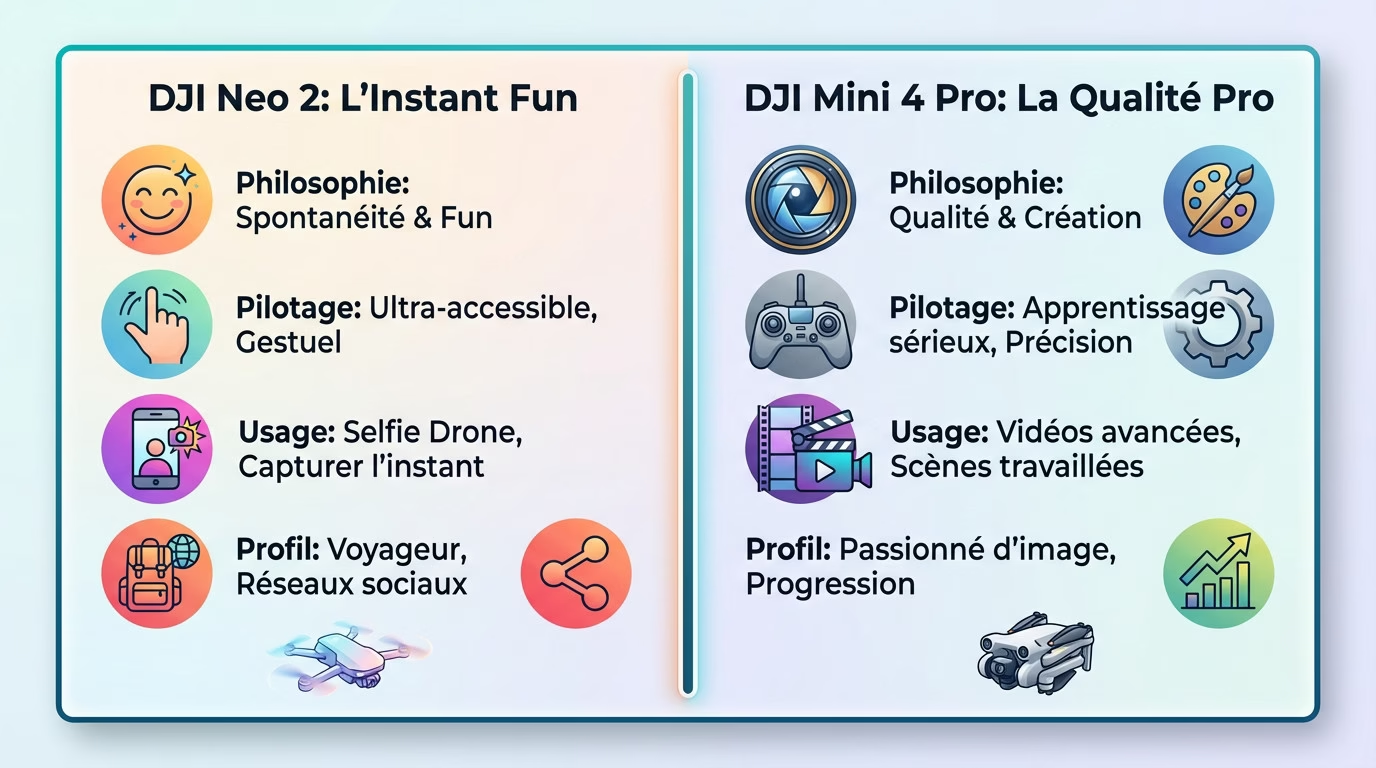
Want instant fun without the technical hassle? The Neo 2 is exactly what you need. It’s the ultimate fun drone for getting quick results.
Its controls are incredibly simple; you almost forget the complexity of a traditional remote control. Weighing only 160g, it’s the perfect “selfie drone” for your outings. Just launch it to capture spontaneous moments.
In short, it’s a choice based on spontaneity above all else. It’s made for those who just want to capture memories, not become pilots.
The DJI Mini 4 Pro: the gateway to professional quality
The Mini 4 Pro occupies a very different position in the market. It’s a “real” pilot drone, but cleverly miniaturized and simplified for beginners. This takes things to another level of technology.
The focus is on total flight safety thanks to obstacle detection and superior image quality (48 MP). It’s the ideal tool for beginners with real creative ambitions. You’ll learn the basics of piloting properly.
In fact, it’s a solid investment for the future. You’ll progress in the world of drones without ever being held back by your machine.
So, which profile suits which drone?
Let’s cut to the chase to help you decide. The Neo 2 is for the traveler or social media addict who wants cool plans effortlessly. It’s the easy tool.
Conversely, the DJI Mini 4 Pro vs. DJI Neo 2 beginner comparison wins with the Mini if you’re a budding video enthusiast. You want to create beautiful videos and you’re willing to learn a little.
So, are you more of a “capture the moment” or “create the scene” kind of person? The answer to this simple question determines your final choice.
Ease of handling and piloting: which is the least stressful?
Now that we’ve seen both approaches, let’s see what it’s like in practice with a controller in hand, or rather… without a controller.
The Neo 2 and its “hands-free” piloting
Forget the complicated remote control that scares beginners. With the DJI Neo 2, your hand is all you need. Place it in your palm, and it takes off on its own, looking right at you. It’s the perfect reflex to eliminate the stress of a crash.
Once airborne, the AI handles everything. The drone follows you or circles around you without manual intervention, thus eliminating 90% of the stress of flying.
With 22GB or 49GB of internal storage, forgetting your memory card is a thing of the past. Just take off and start filming immediately.
The Mini 4 Pro: Assisted Learning
Here, we fly with a real radio control. It’s a more traditional approach, but it’s also what truly trains you in precision flying.
Rest assured, there are plenty of assistance options. The drone is incredibly stable and hovers perfectly if you let go of all controls.
For professional images, built-in intelligence works wonders. Select your target and let the magic happen with these tools:
- QuickShots: automatic tricks (Dronie, Rocket) for stylish videos without being an expert.
- MasterShots: the drone performs several maneuvers and puts together a short video all by itself.
- ActiveTrack 360°: high-performance tracking to focus on the frame, not the riding.
Verdict on the stress of the first flight
For zero anxiety, the Neo 2 is unbeatable. It takes off in thirty seconds. It’s practically a smart toy. The DJI Mini 4 Pro vs. DJI Neo 2 comparison for beginners is quickly dismissed on this point.
The Mini 4 Pro is a little more nerve-wracking at first. But its assistance systems are so effective that the fear quickly disappears. Note that the Neo 2 follows the philosophy of its predecessor , focusing on absolute simplicity.
Safety and obstacle detection: which will prevent the crash?
An easy-to-fly drone is good. A drone that doesn’t end up in a tree on its first flight is better. Let’s talk safety.
Mini 4 Pro: 360-degree peace of mind
In this DJI Mini 4 Pro vs. DJI Neo 2 beginner comparison, the Mini 4 Pro brings out the big guns. Its safety system is top-of-the-line for a device of this size. It’s the clincher for getting started without stress.
The term “omnidirectional” may sound complex, but it’s very simple: the drone has eyes everywhere. It constantly monitors its environment and leaves no blind spots.
In practical terms, if you fly straight towards a tree or back towards a wall, the drone detects the danger and stops or goes around it automatically. It’s a true crash safety net that forgives the most common piloting errors.
- Forward-facing optical sensors
- Rear-facing sensors
- Sensors on the sides (laterals)
- Sensors facing downwards (with 3D infrared)
- Sensors facing upwards
Neo 2: a more basic but clever protection
Here, the philosophy changes radically. The Neo 2’s system is not omnidirectional. It relies primarily on downward-facing LiDAR and infrared sensors to ensure its stability.
The logic behind this choice is pragmatic: this drone is designed for simple flights, often in follow-me mode or facing you. It is not intended for high-speed slalom maneuvers between complex tree branches.
What it loses in electronic detection, it makes up for with its integrated protective frame. A physical barrier that provides immediate reassurance.
Physical resistance: what’s the verdict on the Neo 2?
Let’s address the issue of durability. The Neo 2 is presented as being much more resistant to minor everyday bumps and knocks thanks to its streamlined design. This is a very reassuring point during those first slightly clumsy handling attempts.
Conversely, the Mini 4 Pro remains a drone with a “classic” design. Its propellers and camera gimbal are exposed and vulnerable. A minor impact with an obstacle could necessitate costly repairs, whereas the Neo 2 would likely escape unscathed.
Image quality: do you really need the best to start with?
Mini 4 Pro: a camera that sees far
The Mini 4 Pro features a large 1/1.3-inch sensor. This size allows it to capture significantly more light for clearer images. It’s ideal when the light is a little low.
Its 3-axis stabilization makes all the difference for video. It delivers ultra-smooth, cinematic footage. The drone compensates for every bump, the image is never shaky. It’s clearly the professional standard today.
You also have the 10-bit D-Log M profile for professional-level color grading. Rest assured, the default quality is already stunning without any adjustments.
Neo 2: Efficiency above all
The Neo 2 has a smaller 1/2-inch sensor. However, it remains very capable and shoots 4K video without any issues. This is more than sufficient for everyday use.
Here, we’re switching to 2-axis stabilization, which is slightly less effective. Your videos will remain stable, but it might struggle with sharp turns. For simple, direct shots, the difference is minimal.
Its goal is simple: to produce beautiful images for your social media. It’s perfect for capturing vacation memories, without any fuss.
The real question is: do you need it?
Ask yourself honestly: where will your videos end up? If it’s for Instagram or watching on a smartphone, the DJI Mini 4 Pro vs. DJI Neo 2 comparison is quickly dismissed. The Neo 2’s quality is more than sufficient.
The Mini 4 Pro’s superiority is immediately apparent on a 4K TV or during editing. For a complete beginner, it might be an unnecessary luxury at first. Above all, remember to choose a high-performance memory card to handle this data flow.
Budget and packages: the crux of the matter
Technology is one thing, but the wallet often has the final say. Let’s see what these drones really cost.
The figures on the table: price comparison
No more unnecessary chatter, let’s look at the numbers. Here’s a direct comparison to help you see things clearly and make the right choice.
| Characteristic | DJI Neo 2 | DJI Mini 4 Pro |
|---|---|---|
| Ideal profile | Spontaneous / Selfie-addict | The creative / Apprentice pilot |
| Getting started | Ultra simple (gestures, auto) | Simple (advanced assistance) |
| Obstacle detection | Basic (Low/IR) | Complete (Omnidirectional) |
| Camera stabilization | 2 axes (mechanical) | 3 axes (mechanics) |
| Sensor quality | Good (1/2″) | Excellent (1/1.3″) |
| Approximate battery life | 18 min | 34 min |
| Starting price (indicative) | Less expensive (~$439) | More expensive (~$759) |
The Neo 2 is logically more affordable, positioning itself as an entry-level option. At around $439, it’s an unbeatable entry point for experiencing the joys of flying without breaking the bank.
The Mini 4 Pro represents a more significant investment, justified by its onboard technology. At $759, this price difference clearly reflects the gap between a purely recreational drone and a serious creative tool.
The “Fly More” pack: essential for a beginner?
You will often see the mention “Fly More Combo”. It’s a clever pack with accessories, often offered for both drones, which includes the essentials so you don’t get stuck on the ground after a flight.
For a beginner, I’m adamant: it’s almost always a good deal. The savings on individual accessories are real, and the comfort gained in the field is invaluable.
Imagine the frustration of a dead battery in the face of a perfect sunset. This pack eliminates that stress. Here’s why it’s a game-changer for your first outings:
- Extra batteries: The key to not being frustrated after 18 to 30 minutes of flight.
- Multi-charging station: Allows you to charge all batteries at the same time without juggling cables.
- Carrying bag: Protects the drone and keeps everything organized while you’re on the go.
- Spare propellers: Because an accident can happen quickly at the beginning and you need to be able to take off again.
Value for money for a novice
From a price perspective, the Neo 2 offers unbeatable fun-to-price ratio. For under $500, you get your money’s worth in terms of ease of use and immediate enjoyment, perfect for having fun without any pressure.
However, the Mini 4 Pro offers better long-term performance-to-price ratio. You pay more, but you get technology that will remain relevant for longer and opens up far more creative possibilities.
Regulations and sustainability: the details that matter
Regulations for Dummies: C0, A1, what difference does it make?
This is often the puzzle that scares beginners. Good news: here, everything is simple. The Mini 4 Pro and the Neo 2 both weigh less than 250 grams. This is the magic threshold that saves you from cumbersome administrative paperwork in Europe.
In practical terms, the Neo 2 is CO2 certified by EASA. The Mini 4 Pro also meets this requirement with its standard battery. Therefore, you can fly almost anywhere without having to pass a complex exam.
On this specific point, it’s a perfect tie. Both models offer exactly the same legal peace of mind.
Reliability and “obsolescence”: a good investment?
We’re talking about the world leader here, not some obscure toy. DJI provides serious software support for its devices, guaranteed until 2025 for the Mini. This is a reassuring sign of quality, especially for beginners.
Don’t worry about the Mini 4 Pro becoming obsolete. With its omnidirectional obstacle detection and high-performance sensor, it remains a top performer. It won’t be outclassed anytime soon by the current competition.
The Neo 2 may age more quickly technically. But its concept of simplicity and immediate fun remains timeless.
My final opinion: which one to choose so as not to regret it?
Here’s my verdict for this DJI Mini 4 Pro vs. DJI Neo 2 beginner comparison. If even the slightest technical complication puts you off and you just want to have fun, go for the Neo 2. You won’t be disappointed.
If you have a bit of a creative streak and the idea of learning to fly excites you, make the effort for the Mini 4 Pro. It’s a drone that will grow with you, and it positions itself as a more versatile drone that you’ll keep for longer.
The final choice depends mainly on your ambition. Are you looking for instant fun and zero stress for your memories? Go for the DJI Neo 2, it’s the king of easy selfies. Do you prefer to learn real piloting and aim for cinematic quality? The Mini 4 Pro is the ideal investment for lasting progress. The choice is yours.




Leave a Reply