
Are you torn between absolute portability and creative versatility in this DJI Mini 5 Pro vs. Air 3 comparison? This practical guide breaks down the key differences between these two models to help you identify the one that perfectly suits your filming needs. Discover right now which drone is truly worth your investment and avoid any regrets after your purchase.
- Portability and regulations: the all-purpose mini versus the robust one
- Image quality: a single sensor or the power of two?
- Safety and flight experience: which is more serene?
- The creative strengths that make a difference every day
- Verdict: So, which one do we choose for our backpack?
Portability and regulations: the all-purpose mini versus the robust one

The featherweight Mini 5 Pro: freedom under 250g
The real advantage of the DJI Mini 5 Pro is its weight of under 249 grams. This places it in class C0: no more complex paperwork or lengthy training. It slips into a pocket like a smartphone, becoming the ideal companion for travelers who want to choose the right DJI drone for traveling light. It’s the tool of spontaneity: you take it out and film instantly.
The Air 3: heavier, but why that’s also an advantage
In contrast, the DJI Air 3 weighs in at 720g, placing it in class C1 with a few additional regulations. But this weight is a real advantage. It offers exceptional stability in windy conditions: where a Mini drone wobbles, the Air 3 remains firmly planted for crisp images. Its robust design also allows for a larger battery, providing superior flight time and enhanced safety.
The key specifications at a glance
If you’re still hesitating between the DJI Mini 5 Pro and the Air 3, this table summarizes the comparison. No unnecessary jargon, just the key figures that influence your flying experience.
| Characteristic | DJI Mini 5 Pro | DJI Air 3 |
|---|---|---|
| Takeoff weight | Less than 249 g | 720 g |
| CE Class | C0 | C1 |
| Maximum flight time. | 34 minutes | 46 minutes |
| Wind resistance (max) | 10.7 m/s (Level 5) | 12 m/s (Level 6) |
| Internal storage | 2 GB | 8 GB |
| Dimensions (folded, L×W×H) | 148×94×64 mm | 207×100.5×92 mm |
This data confirms the dilemma: choose the extreme compactness of the Mini for traveling light, or the robustness and endurance of the Air 3 for more demanding conditions.
Image quality: a single sensor or the power of two?
Mini 5 Pro: the king of native vertical format
Want effortless viral content? The DJI Mini 5 Pro Air 3 stands out with its gimbal that physically rotates 90 degrees. Unlike digital cropping that degrades the image, here you film in true vertical 4K, utilizing the entire sensor area.
It’s the perfect tool for TikTok or Reels. No more complex editing to adapt the landscape format to a smartphone screen. You get a clean, ready-to-publish file that grabs your audience’s attention from the very first second.
Air 3: the added versatility of a telephoto lens
The Air 3 emphasizes versatility with its dual optical system. It combines a 24mm wide-angle lens and a 70mm telephoto lens on identical 1/1.3-inch sensors, guaranteeing perfect color consistency.
This second focal length boosts your creativity. The 70mm lens compresses perspective for cinematic shots and allows you to isolate the subject while maintaining a distance. This is a major narrative advantage for varying framing without dangerously close to the drone.
To delve deeper into its capabilities, take a look at our review of the DJI Air 3 .
D-Log M and 10-bit: a professional rendering for both, but…
Color grading enthusiasts will appreciate this: both drones offer 10-bit D-Log M and HLG recording. This is ideal for recovering maximum detail in shadows and highlights during post-production.
However, physics has its laws. While the Mini 5 Pro impresses with its 1-inch sensor, the Air 3’s larger chassis offers better heat dissipation. During long shoots, this often results in more stable noise management, especially in low light.
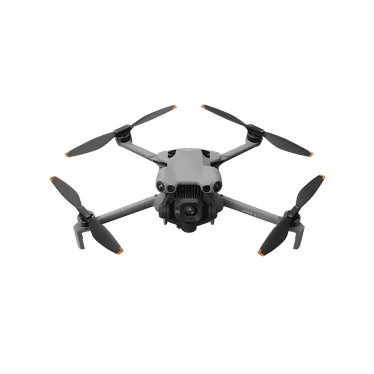
DJI Mini 5 Pro
The next generation ultra-compact drone from DJI. High-quality video, advanced stabilization, intelligent tracking and enhanced security — all in a lightweight and portable format.
Discover more on DJI →Safety and flight experience: which is more serene?
A beautiful image is great, but not crashing your drone while taking it is even better. Let’s see which of the two offers the most peace of mind in flight.
Obstacle detection: omnidirectional safety everywhere
Good news: the DJI Mini 5 Pro and the Air 3 both feature 360-degree omnidirectional obstacle detection. This is a giant leap forward, especially for the Mini series.
In practical terms, this changes everything for your sessions. Tracking modes like ActiveTrack become much more reliable and secure. You can finally let the drone follow you in the forest or in the city without any worries.
Frankly, it’s amazing. This technology was reserved for large, expensive models not long ago. Seeing the Mini 5 Pro incorporate it makes it incredibly capable for such a small size.
OcuSync 4 transmission: a foolproof connection?
In terms of transmission, both machines feature the O4 (OcuSync 4) system. The advertised theoretical range is simply enormous: up to 20 km in FCC and 10 km in CE.
But forget those figures for a moment. What matters is signal strength in challenging conditions. In congested urban areas or behind trees, the O4 provides a stability you won’t want to lose.
Some reviews suggest the Mini 5 Pro has a “plus” O4 processor. In practice, the difference remains minimal for everyday use. This mainly proves that DJI has focused heavily on the reliability of its latest model.
The creative strengths that make a difference every day
Beyond pure technology, it’s often a single feature that tips the scales. Let’s look at the “killer features” of each.
The Mini 5 Pro, the secret weapon of social media creators
If you live for TikTok, the DJI Mini 5 Pro Air 3 is a no-brainer. Native vertical video remains the killer feature. It’s a function designed for modern use.
Here’s why this gondola rotation is a real game changer:
- Maximum quality: Zero cropping, we utilize the entire 1-inch sensor.
- Precise framing: You compose your image directly vertically, without any unpleasant surprises.
- Time saving: The file comes out ready to be edited, no more conversion.
- More creativity: Dare to use vertical movements that are impossible to simulate properly in post-production.
This is an unfair advantage for anyone producing content for Instagram or Shorts. You gain an insane production speed.
The Air 3, the Swiss Army knife for varied shots
The Air 3’s strength lies in its versatility. The dual camera is clearly not a gimmick. It opens up a range of narrative possibilities that don’t exist on the Mini 5 Pro.
Imagine filming a wide shot of a magnificent landscape with the wide-angle lens. With a click, you switch to 70mm to isolate an architectural detail or an animal, without moving the drone.
In short, the Air 3 is aimed at a more “cinematic” videographer. It allows you to think in terms of sequences with different shot sizes. It’s the ideal tool for varying scales.
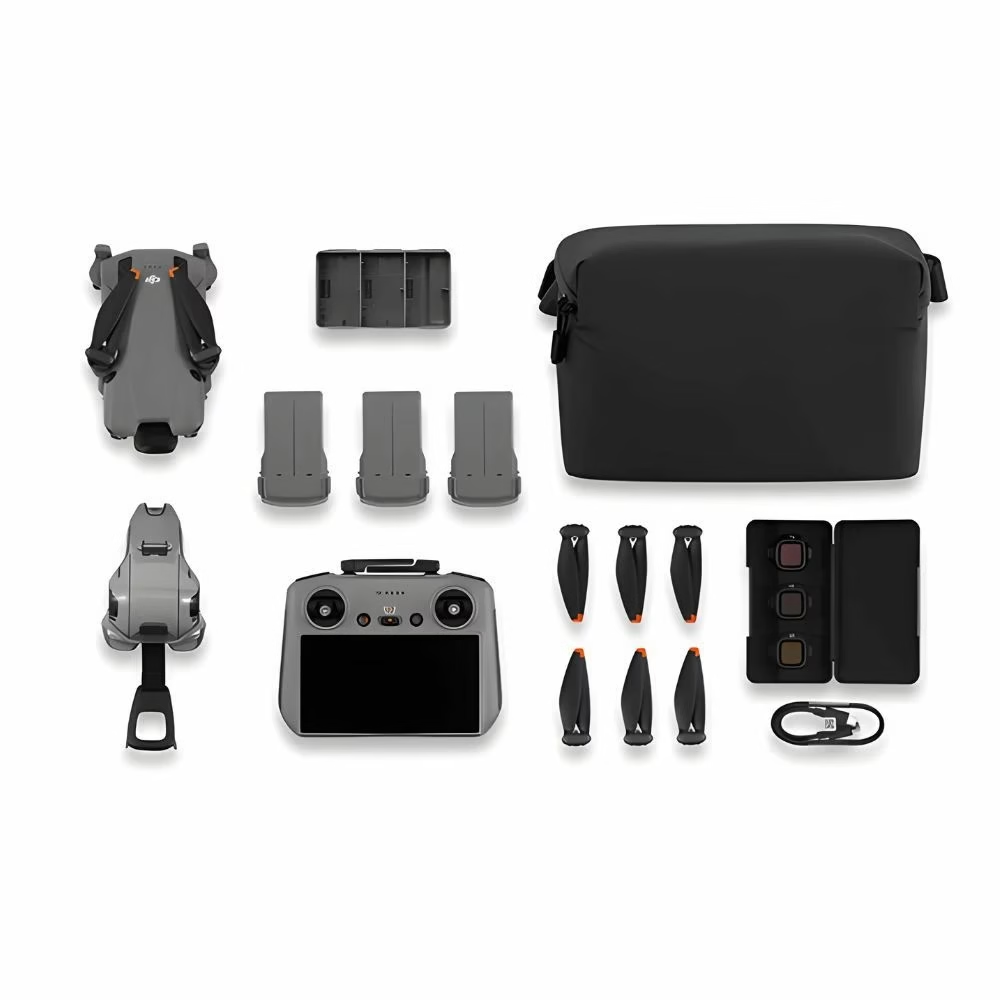
DJI Mini 5 Pro
DJI’s new high-end compact drone: exceptional video quality, 3-axis gimbal, intelligent tracking and latest generation sensors.
See the DJI Mini 5 ProVerdict: So, which one do we choose for our backpack?
The typical profile of a Mini 5 Pro driver
- You are a content creator for social media and vertical video is your priority.
- You travel light and every gram counts in your backpack.
- You want a “ready-to-fly” drone with minimal regulatory constraints.
- You favour spontaneity and discretion to capture moments in the moment.
This is the drone of efficiency and modernity, perfect for quick and social media-oriented use.
The typical profile of an Air 3 pilot
- You are looking for greater creative versatility with different focal lengths.
- You often fly in windy conditions and you need maximum stability.
- Flight autonomy is a major criterion for your projects (long timelapses, complex filming).
- You have a more “cinematic” approach to video and you like to construct your sequences.
The Air 3 is the sensible choice for the versatile videographer who wants a robust and flexible tool, a true Swiss Army knife of the skies.
The final choice and where to find them
There are no wrong choices, only decisions tailored to your actual needs. In the DJI Mini 5 Pro vs. Air 3 comparison, the Mini wins for simplicity and verticality, while the Air 3 triumphs in versatility and robustness.
For those who have made their choice and are leaning towards the ultra-compact format, don’t delay too long, as stock levels often fluctuate. Here are the best options for getting one:
Ultimately, the choice really depends on how you use it. If you prioritize absolute lightness and vertical video for your social media, the Mini 5 Pro is for you. On the other hand, if you’re looking for zoom versatility and rock-solid stability, the Air 3 remains the best. The decision is yours!



Leave a Reply