
Key takeaway: the HOVERAir X1’s actual battery life ranges from 9 to 10 minutes, while the PRO models offer up to 15 minutes . While this is sufficient for quick social media clips, purchasing additional batteries or the PowerCase quickly becomes essential for filming your sessions with peace of mind. See the Official Store
Are you worried about your drone making an emergency landing mid-flight and wondering about the actual battery life of the HOVERAir X1? It’s a legitimate concern, because between the theoretical figures on the box and reality in windy conditions or when using active follow mode, flight time can disappear very quickly. So we timed every second to reveal how long you can actually film before running out of power , and more importantly, which accessories are essential for extending your sessions without any frustration.
- The raw figures: the actual battery life of the HOVERAir X1 in the field
- Beyond the battery: factors that drain your drone faster
- PRO vs PROMAX: does the choice of version really impact battery life?
- Extend the fun: accessories that boost battery life
- Field testing in real-world conditions: our protocol and our results
- User experience: when battery life is no longer the only criterion
- The HOVERAir X1 versus the competition: where does its battery life stand?
- Final verdict: for whom is the battery life of the HOVERAir X1 sufficient?
The raw figures: the actual battery life of the HOVERAir X1 in the field
Standard model X1 range: promise vs. reality
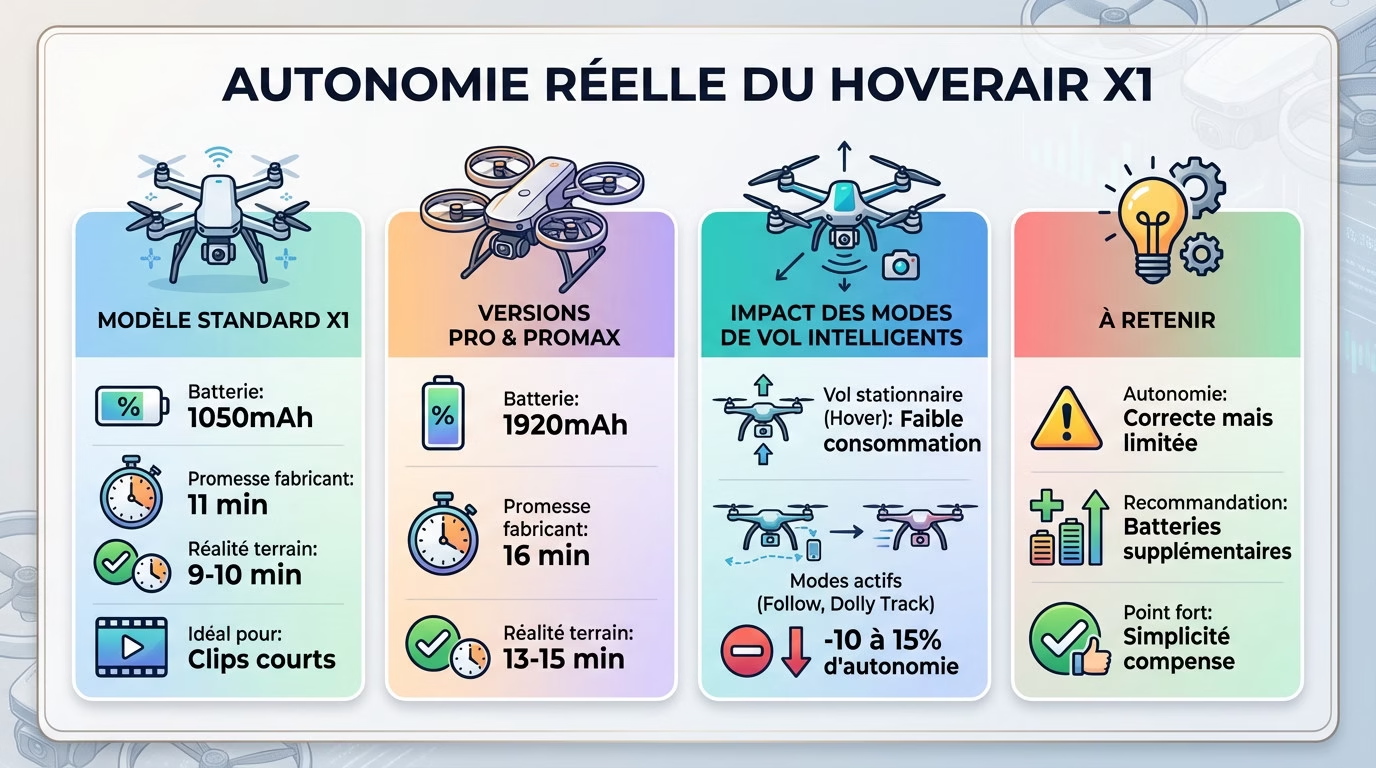
The manufacturer advertises an 11-minute flight time for the standard HOVERAir X1 with its 1050mAh battery. This is the theoretical figure printed on the box, which most buyers take at face value.
However, the reality on the ground is a little different. During our analysis of the HOVERAir X1’s real-world battery life, the timer often stopped between 9 and 10 minutes , especially if you switch between flight modes.
This is sufficient for short clips intended for social media, but you should be aware of this before buying to avoid any disappointment .
The PRO and PROMAX versions: a 5-minute saving that changes everything?
With the PRO and PROMAX models, the battery capacity increases to 1920mAh. The promised battery life immediately takes a step up .
The technical specifications boast a 16-minute flight time. That’s a significant improvement on paper. In our tests, we came much closer to that figure, with a consistent flight duration of between 13 and 15 minutes .
Here’s what it looks like in practice :
- Standard model X1 : 9-10 minutes in real-world conditions.
- X1 PRO & PROMAX models: 13-15 minutes in real-world conditions .
The impact of intelligent flight modes on the battery
Note that not all modes consume energy at the same rate . A simple hover is much less energy-intensive than a complex mode like “Dolly Track” or “Orbit”.
The manufacturer mentions “20 Intelligent Flight Paths” per battery. This is an interesting metric for creators, but it remains rather vague when discussing actual flight time.
In practice, an active tracking mode like “Follow” can reduce battery life by 10 to 15% compared to a calmer flight.
In short: what you need to know about flight duration
The battery life is decent for a drone of this size, but limited. Be prepared to buy extra batteries ; they’re almost essential for a smooth filming session without risking missing the best shot.
Battery life isn’t its strongest point, but its simplicity more than makes up for it . To see offers and battery packs: Visit the Official Store .


Beyond the battery: factors that drain your drone faster
Wind resistance: the number one enemy of autonomy
The actual battery life of the HOVERAir X1 field test is quickly impacted by its featherweight design of less than 250g. This is an undeniable legal advantage, but a serious handicap in windy conditions . It’s purely a matter of physics.
It boasts a wind resistance rating of 4 on the spec sheet. This is sufficient for a light breeze, but not much more. In gusts, the motors work constantly to compensate. The battery then drains rapidly .
On paper, the drone can handle a moderate breeze. In reality, every gust is a losing battle against the flight timer.
Is the “Follow” tracking mode energy-intensive?
The tracking mode is one of the key features of this small device. It instructs the drone to constantly calculate your position and adjust its trajectory. It’s a continuous calculation.
This constant maneuvering has an immediate energy cost on the battery. The faster the subject being tracked and the more it changes direction, the more resources the drone consumes . It’s a simple, undeniable logic.
For a mountain biking or running session, expect to easily lose one to two minutes of battery life compared to a more relaxed flight.
Outdoor temperature: why the cold is a problem
The X1’s lithium-ion batteries hate the cold, like all others on the market. Low temperatures slow down internal chemical reactions and They limit the available capacity. Your flight time then decreases drastically. .
Below 10°C, the performance loss becomes noticeable and rapid . The battery indicator can drop much faster than expected.
For winter flights, it’s a real technical challenge to manage. We’ll see later that a solution exists for this .
Weight and portability: an asset for endurance?
Paradoxically, its lightness also works in its favor when the weather is perfectly calm. Less weight to lift means the engines have to work much less hard. The effort required is then truly minimal .
This is what allows it to achieve 10-15 minutes of battery life with such a small battery. The foldable and ultra-portable design is central to its design, but this inevitably involves compromises in power and battery life .
PRO vs PROMAX: does the choice of version really impact battery life?
Battery comparison: 1050mAh vs 1920mAh
The fundamental difference in the actual battery life of the HOVERAir X1 field test lies here. The standard model makes do with a small 1050mAh battery. It’s quite small, but that clearly explains its limited endurance .
The PRO and PROMAX versions, on the other hand, feature a 1920mAh battery . That’s almost double the pure capacity to ensure durability.
- Standard battery : 1050mAh, approximately 40g, gives ~10 min of flight time.
- High capacity battery : 1920mAh, approximately 60g, gives ~14 min of flight time.
The image sensor: is the PROMAX more energy-intensive?
The X1 PROMAX is clearly distinguished by its larger sensor: 1/1.3 inch compared to 1/2 inch for the PRO. A larger sensor inevitably requires more processing power to handle the data.
However, in our tests, the real difference in battery life between the PRO and the PROMAX is truly negligible .
The software optimization seems perfectly well done so that this performance boost does not impact flight time .
Obstacle detection: additional sensors that consume
This is another major difference. The PROMAX adds vision sensors to its proximity sensors. They are more precise but also more active and therefore more energy-intensive .
Once again, the impact on overall battery life remains minimal . The drone only activates them at full power when an obstacle is nearby. Therefore, the impact on an entire flight is negligible.
Video quality: filming in 8K, what is the cost to the battery?
The PROMAX can film in 8K 30fps and even in 4K 120fps. These demanding modes require enormous computing and writing power .
This is where we see a slight difference. Enabling continuous 8K recording can reduce the footage by approximately 30 to 60 seconds on a full flight compared to standard 2.7K recording.
It’s not an absolute disaster, but it’s good to know if every second of flight counts for you.
Extend the fun: accessories that boost battery life
The HOVERAir X1’s real-world battery life quickly reveals its limitations if you’re shooting continuously without a break. Fortunately, there’s a whole ecosystem of clever solutions to ensure you never run out of power at the worst possible moment.
The PowerCase: a portable charging station
This is honestly the smartest accessory of the bunch. The PowerCase isn’t just a standard protective case. It hides a powerful internal battery capable of recharging your drone and spare batteries anywhere.
This device recharges a battery up to 2.5 times without a mains power outlet. This gives you approximately 40 extra minutes of flight time in the field.
This is the must-have for a worry-free day trip . No more stress about running out of fuel in the mountains.
The Duo Battery Pack: the simplest solution
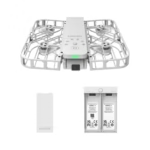
No magic here, just pure pragmatism for your filming sessions. The “Duo Battery Pack” simply provides you with two additional 1920mAh batteries , ready for immediate use.
Each unit gives you up to 16 minutes of additional recording time. Having two or three batteries in your bag is essential. This way, you can get the most out of your drone . Say goodbye to frustration.
The Thermo Smart Battery: the secret weapon for winter
Worried about voltage drops due to the cold? Hover has you covered with the Thermo Smart Battery. It’s an intelligent battery capable of self-heating .
It maintains an optimal internal temperature to prevent sudden power cuts. Your drone can then fly in extreme conditions , down to -20°C. That’s a real technical feat for a device of this size.
For ski fans, it’s not an option. It’s a vital investment to ensure you don’t miss out on anything.
The “Cycling” and “Ski” bundles: designed for endurance
Hover also offers well-designed themed packs. The “Cycling” and “Ski” bundles are particularly useful for managing battery life. They solve the problem right from the start .
Here’s exactly what they contain to help you choose the best option :
- Cycling Bundle : Usually includes the drone and 2 additional standard batteries.
- Ski Bundle : Includes the drone and 2 Thermo Smart Batteries, to face the cold without worry.
These complete packages are often much more financially advantageous than buying the items separately.
Field testing in real-world conditions: our protocol and our results
Our testing method: static flight, tracking, and wind gusts
To obtain reliable figures on the actual autonomy of the HOVERAir X1 field test, a strict protocol was applied. We simply timed the flight duration , from palm takeoff to forced landing, in three distinct situations.
Here are the scenarios : first, pure hovering for reference. Then, dynamic tracking of a walking person. Finally, an outdoor flight with moderate wind gusts, remaining below level 4 to avoid skewing the results.
Standard X1 result: how many “smart journeys” before failure?
On the standard X1, the stopwatch stopped at 9 minutes and 45 seconds while stationary . This is a respectable result that matches the initial estimates, without any unpleasant surprises.
Regarding the much-touted “Intelligent Courses,” forget the 20 promised on the box. In reality, you’ll generally complete 14 to 16 before the battery runs out, depending on the complexity of the required movements.
As soon as the wind gets involved, the battery life logically drops to just over 8 minutes .
X1 PROMAX result: Is it possible to track a cyclist for 15 minutes?
The PROMAX model performs better with a hover time of 14 minutes and 30 seconds . This comes close to the manufacturer’s promised 16 minutes, which is rare in this category.
In mode when tracking a cyclist at a moderate pace, the battery lasted for 12 minutes and 15 seconds . This is a solid performance, more than enough to capture a complete sequence without any issues.
Filming 15 minutes in one go? Impossible. But combining several clips to reach 12 minutes of usable footage , that’s a big yes.
PowerCase test: how long does it take for a full recharge in the field?
After draining a 1920mAh battery, we slipped it into the PowerCase. The result: it takes about 45 minutes to fully recharge and take off again.
It might seem like a long time, but this delay allows you to take a break, change spots, and come back refreshed. The PowerCase remains an essential companion to avoid getting frustrated.
User experience: when battery life is no longer the only criterion
Focusing solely on the actual autonomy of the HOVERAir X1 field test is to forget the essential: this is not a drone like the others .
Simplicity above all: take off without a remote control
This is the game-changer. No controller to pair, no complicated setup. You take it out of your pocket, turn it on, choose a mode, and It detaches from your hand. It’s immediate. .
This “no remote control” approach makes it incredibly spontaneous to use . You’ll never hesitate to pull it out again, even for a quick 30-second clip.
No setup, no controller, just take off and go. That’s exactly what makes this drone so different and practical for everyday use.
Filming solo: the real advantage of the HOVERAir X1
For solo content creators, athletes, or travelers, this is a major advantage. No more asking someone to film you or set up a tripod. You’re completely free .
The drone becomes your personal cameraman. That’s what user Darrell Hughes points out, finding that filming his bike rides has become much easier without a controller. It’s a real liberation.
The smartphone app: simple yet comprehensive control
Even though it’s a standalone device, there’s a smartphone app. It lets you view the video feed , download clips, and access more precise settings. This is useful for checking framing.
It can also be used as a virtual remote control for more precise manual control, or to increase the tracking range using the Beacon accessory. It’s very flexible .
Safety: protected propellers for worry-free flying
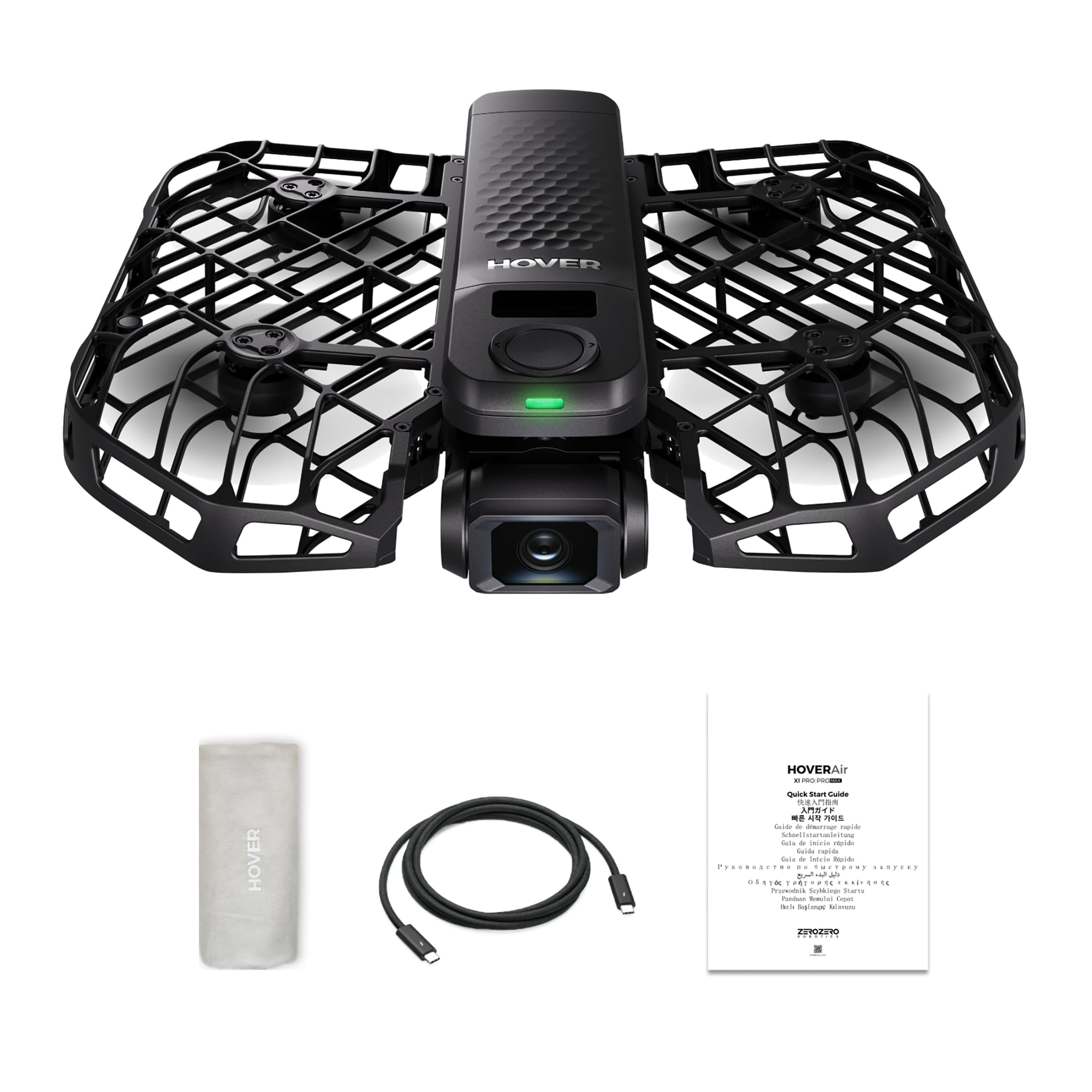
The HOVERAir X1’s design incorporates a full protective cage around the propellers. This is a huge safety advantage . Fingers are completely safe.
It can be launched by hand and caught in mid-air without any fear. This is also reassuring for flying near people or indoors, something unthinkable with a conventional drone .
The HOVERAir X1 versus the competition: where does its battery life stand?
Comparison with DJI pocket drones
Drones in the DJI Mini range, for example, boast significantly longer flight times, often exceeding 30 minutes . This is their main advantage when considering the actual flight time of the HOVERAir X1 in field tests. You can fly longer to explore; that’s undeniable.
But the comparison ends there. They require a remote control, aren’t designed to be handheld, and don’t offer the same ease of use. The comparison with competitors like the DJI Neo clearly illustrates these two different philosophies .
And what about action cameras? An alternative to consider.
For sheer battery life, an action camera is unbeatable , offering over an hour of continuous recording. But it doesn’t fly. It offers a subjective point of view, whereas a drone provides an external perspective to add dynamism to your videos.
The HOVERAir X1 doesn’t replace an action camera, it complements it . Choosing between certain action cameras like GoPro or Osmo Pocket and this drone really depends on the type of footage you want to capture.
The case of more traditional FPV drones
FPV (First Person View) drones are designed for immersive piloting and pure speed. Their battery life is often even shorter, rarely exceeding 5 to 7 minutes . This is very short and requires a lot of spare batteries.
The HOVERAir X1 is not an FPV drone. It’s designed for automated shooting and simplicity, not acrobatic piloting. They are two completely different worlds . You’re not looking for the same experience here.
Autonomy, one criterion among others
Ultimately, judging the HOVERAir X1 solely on its battery life would be a mistake . It’s a factor to consider, but not the most important one. We mustn’t overlook the essentials.
Its ease of use, portability, and safety are far stronger arguments that position it in a unique market segment: that of the intelligent “selfie drone.” You take it out, it films, and that’s it.
Final verdict: for whom is the battery life of the HOVERAir X1 sufficient?
So, after this comprehensive test, is this drone right for you despite its limited battery life?
The social media content creator
Yes, absolutely. To create Reels, TikToks, or Shorts, you need short, dynamic clips. The 11 to 16-minute flight time is perfect for that, allowing you to complete up to 20 smart routes without a break.
The ability to quickly switch between shots using automatic modes is a major advantage for maintaining a good pace. With two or three batteries in your pocket, you’ll have more than enough power to keep your social media feeds going all day.
The traveler and the vlogger
For travelers, its lightweight design and compact size are invaluable. It slips easily into a backpack without taking up much space, which makes all the difference when you’re walking all day.
The actual battery life of the HOVERAir X1 field test may seem just enough to capture grandiose landscapes, but combined with the PowerCase, it becomes sufficient to bring back unique memories without being burdened with heavy and complex equipment.
The athlete who wants to film himself
For mountain biking, skiing, skateboarding, or running, it’s an excellent tool . The tracking mode is effective and allows you to film yourself in action without any external assistance, simply by throwing it from your hand.
The 12-16 minute battery life in tracking mode is sufficient for a descent or a typical route. Having several batteries , especially Thermo models for cold weather, is, once again, key to avoiding frustration.
When to upgrade to a higher-end model?
If your primary need is for long cinematic tracking shots, long-distance exploration, or professional aerial photography, the HOVERAir X1 isn’t the right tool . You’ll likely find yourself quickly limited.
In this case, you need to look at more durable machines. A larger drone like the DJI Air 3 , with its 46 minutes of battery life, would be much more suitable, but it’s a different price range and a different way of flying.
The HOVERAir X1’s battery life remains limited , ranging from 10 to 15 minutes depending on the model. It’s short, but sufficient for dynamic social media clips . To get the most out of it, invest in extra batteries or the PowerCase . This drone prioritizes immediate ease of use over pure endurance: an ideal compromise for your daily vlogs .





Leave a Reply