Key takeaway: the HOVERAir X1’s lightweight design doesn’t exempt it from French law . Its camera classifies it as an Open A1 drone, making registration on AlphaTango mandatory for all pilots. This free administrative formality legalizes the use of automatic tracking modes, provided the operator’s registration number is affixed to the frame.
You probably think that weighing less than 250 grams is enough to ignore the laws, but drone regulations in France for flying a HOVERAir X1 impose strict rules as soon as a camera is present. We’ll break down the precise status of this C0 class drone and the concrete steps to register as an operator on AlphaTango without wasting any time. Master the authorized flight zones and formal prohibitions now to enjoy your intelligent modes with complete peace of mind, without risking a hefty fine.
- HOVERAir X1 and French law: the verdict
- Your obligations as a pilot: registration and training
- Basic flight rules to be followed everywhere in France
- The HOVERAir X1 pilot’s map of France: green zones, red zones
- The intelligent flight modes of the HOVERAir X1 and the law
- Preparing your HOVERAir X1 for an airplane trip
- Ignoring the law: the risks and the penalties
HOVERAir X1 and French law: the verdict
Its light weight: an advantage, but not a free pass.
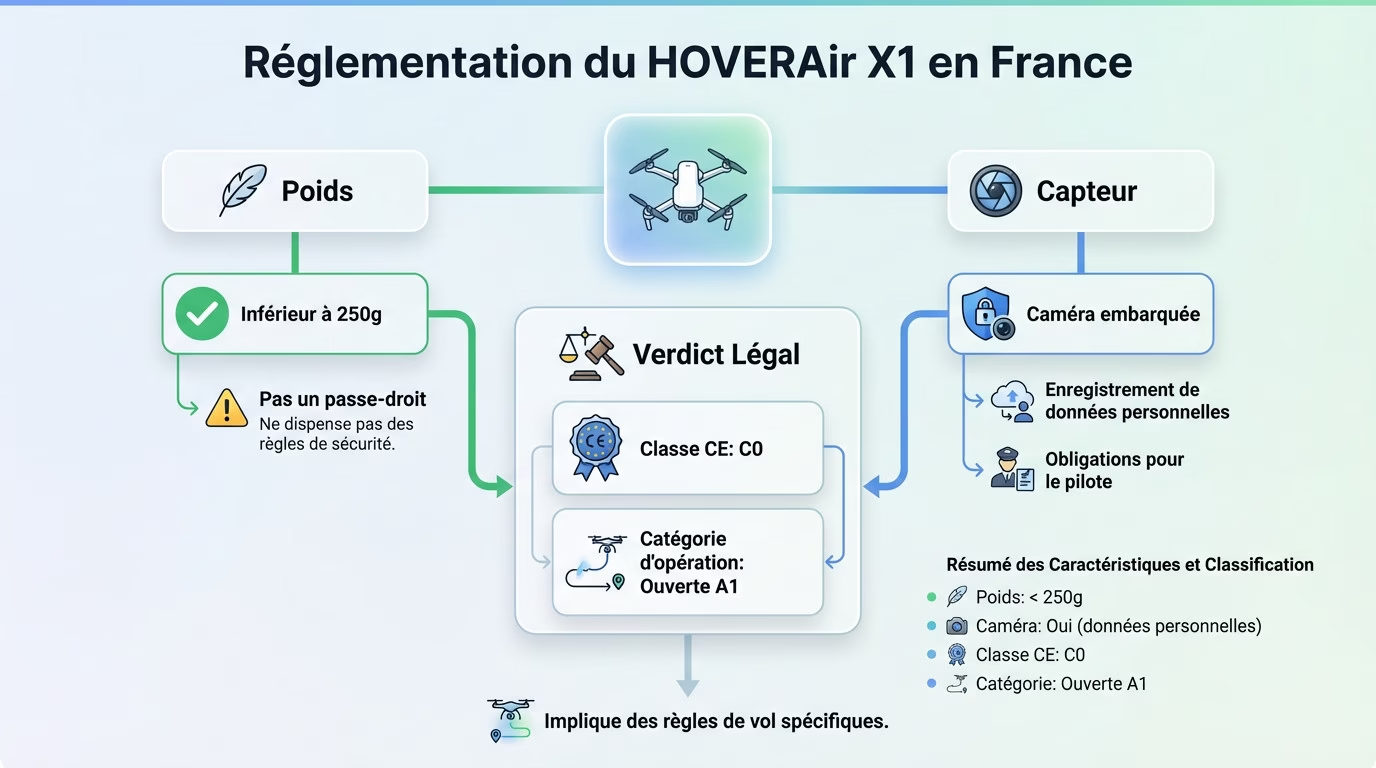
Weighing in at just 125 grams including the battery, the HOVERAir X1 is clearly a lightweight drone. It falls well below the critical 250-gram threshold, simplifying drone regulations in France for flying the HOVERAir X1.
But be careful not to declare victory too soon. Believing that “light” means “no rules” is a common mistake that can cost you dearly. French law doesn’t stop at simply weighing the goods, and ignoring this detail exposes you to avoidable penalties .
In reality, another technical element complicates the equation and imposes its own rules: the presence of a video sensor .
The dashcam: the detail that changes everything
European legislation is clear: a drone equipped with a sensor, even if it weighs less than 250g, cannot be considered a simple toy. In the eyes of the law, it is an aircraft capable of capturing data .
Why this strictness? Because the ability to film involves direct risks to the privacy of others. You can’t just fly over anyone or record images without adhering to a strict data protection framework .
It is precisely this camera that places the HOVERAir X1 under a specific regulatory regime. The immediate consequence: you are accountable and have a mandatory obligation to register as an operator on AlphaTango.
Verdict: what class and category does the HOVERAir X1 fall into?
The suspense is over. The HOVERAir X1 is officially recognized as a Class C0 drone . This is the regulatory label it bears to fly legally within European territory.
This means that it operates in the “Open” category, and more specifically under the A1 subcategory. This is the most flexible scenario , allowing flying near people (but never over crowds) without passing a complex exam.
Here is the regulatory information sheet to remember for your flight sessions:
- Weight : Less than 250g
- Camera: Yes, so it records personal data
- CE Class : Class C0
- Operation category : Open A1
Now that the framework is established, we can clearly see what this means in practical terms for the pilot . To compare with other models, take a look at the rules for drones under 250g .
Your obligations as a pilot: registration and training
Now that the status of the HOVERAir X1 is clear, we need to look at the administrative procedures. This section details the specific obligations that fall to the pilot even before the first takeoff.
Registration on AlphaTango: mandatory, period.
Let’s be clear: registration is mandatory. No, you don’t register the HOVERAir X1 itself, as it weighs less than 250g, but it is you, the pilot (the UAS operator), who must register because of the onboard camera.
Everything happens on AlphaTango, the official portal of the DGAC. It’s the one-stop shop for complying with drone regulations in France to fly a HOVERAir X1 and obtain your permit .
This administrative procedure is completely free and takes only a few minutes. Don’t skip it; it’s a non-negotiable legal requirement .
Online A1/A3 training: an essential (and free) step
To fly in the open A1 category, the law requires training , even for smaller aircraft. This is called A1/A3 training, essential for understanding where you place the propellers.
Good news, this module is accessible directly on AlphaTango. It’s free and ends with a quick quiz to check that you’ve grasped the basic security issues.
Even though the HOVERAir X1 is almost self-piloting, skipping this step would be a mistake. Knowing the rules of the airspace is not optional; it’s what separates a responsible pilot from a public danger.
Even with a 124-gram drone, the pilot remains solely responsible for flight safety. Technology cannot replace human judgment.
Your UAS operator number: where and how to display it
Once your registration on AlphaTango is complete, you will receive your unique identifier: a UAS operator number . Think of it as your personal drone pilot license plate, valid for all your devices.
The rule is strict: this code must be clearly displayed on the drone. On a small drone like the HOVERAir X1, a simple adhesive label under the battery or a marker marking is sufficient.
No need for remote electronic signaling for this C0 model, but the physical display is absolutely essential for safe flying.
Basic flight rules to be followed everywhere in France
Height, direct view and common sense: the basics
Drone regulations in France for flying the HOVERAir X1 are clear. Rule number one: the maximum flight altitude is 120 meters above the ground or the nearest obstacle. This is a strict limit, not a suggestion. Do not exceed this legal limit.
Rule number two: the drone must always remain within the pilot’s direct line of sight (DLOS). This means being able to see it with the naked eye without any aids such as binoculars. You must control its trajectory every second.
In short, common sense is a pilot’s best ally in avoiding dangerous situations. Simply fly with caution.
The golden rules of the open category A1
The HOVERAir X1 benefits from the A1 category, which is very permissive for C0 class drones. This is a boon for nomadic creators . But this freedom comes with specific responsibilities.
The main rule is simple: flying over isolated people is tolerated if it is unintentional. However, it should be avoided as much as possible. Never hover over a passerby .
Note this formal prohibition: flying over gatherings of people is strictly forbidden . Whether it’s a concert or a crowded beach, it’s a no-go. This is a fundamental distinction to understand in order to stay within the rules.
Night flights and respect for privacy
Be warned: in France, night flying is prohibited for recreational operations in the Open category. Aeronautical night begins 30 minutes after sunset. Don’t push your luck after dusk.
Let’s address the issue of privacy, a sensitive topic. Remember that it is illegal to film people in a private place without their consent . If they are recognizable, do not share anything without explicit written permission.
The HOVERAir X1 camera imposes a great responsibility in this regard. Respect the privacy of others as you would like to have yours respected.
The HOVERAir X1 pilot’s map of France: green zones, red zones
Forget about dubious apps. The only reliable resource to avoid fines is the Géoportail map “UAS restrictions, Open category and model aircraft” . It’s the official, free, and essential tool for understanding drone regulations in France and flying a HOVERAir X1 stress-free.
It’s incredibly simple. The map displays colored zones : red for strict prohibition, orange or yellow for height restrictions. No color? That’s often a good sign.
Make it a habit from now on: always consult this map before even taking your flying camera out of your pocket.
Permanent restricted areas: know them by heart
Some areas are self-evident; you don’t play around with national security or air transport. Yet, many beginners are caught out by ignorance and risk serious consequences .
Here are the places where your drone must absolutely remain on the ground, under penalty of serious legal trouble :
- Airports, airfields and their immediate surroundings.
- military zones and sensitive sites .
- Nuclear power plants (overflight strictly prohibited).
- Prisons and penitentiary establishments .
- National parks, often highly regulated for the sake of tranquility .
- specific wildlife protection zones .
Géoportail does show all of that, it’s true. But frankly, common sense must prevail . You don’t take off next to an Airbus or an Air Force base, map or no map. That’s basic safety.
Be aware of potential surprises throughout the day. Temporary restricted zones (TRZs) appear during air shows or official visits. Stay alert, things are constantly changing.
Flying in urban areas: the big “no” by default
This is a classic, costly mistake. For recreational purposes, flying over public spaces in urban areas is simply prohibited . Yes, that includes the street in front of your house, municipal parks, and village squares.
There is one notable exception: flying over private property, such as your garden. You must have the owner’s permission, never fly over the street, and above all, strictly respect privacy .
The intelligent flight modes of the HOVERAir X1 and the law
The HOVERAir X1 isn’t your typical drone; its autonomous flight modes are its main selling point for content creators. But how does French drone regulation address these “hands-free” features when flying a HOVERAir X1 ? It’s often unclear for beginners, so let’s take a closer look.
Automatic tracking (“Follow me”): who is in control?
We love using tracking modes to film ourselves walking or running without touching anything. It’s technically amazing, but a major legal question arises . When AI manages the trajectory and framing on its own, who is considered the pilot in command by the authorities?
The answer is clear: the pilot remains the person who activated the mode . You cannot blame the algorithm if a problem arises. You absolutely must be able to regain manual control instantly if the situation goes wrong.
Furthermore, the visual line-of-sight (VLOS) flight rule still applies, without exception. The pilot must keep a close eye on the physical drone , not just on their smartphone.
Flying without a radio control: what it legally implies
The HOVERAir X1 is often piloted via a smartphone or simple gestures, which is very intuitive. Legally, this changes absolutely nothing regarding air regulations. The pilot must remain focused and always be able to interrupt the mission at any time to ensure safety .
Beware of the false sense of security brought on by autonomy. Just because there are no physical controllers doesn’t mean your responsibility diminishes. On the contrary, you must be even more vigilant to react quickly, because you don’t have the joysticks at your fingertips.
The case of first-person view (FPV) flight: a regulated activity
The HOVERAir X1 isn’t a pure FPV drone, but the video feed on your smartphone can come dangerously close . Let’s clarify the strict rules of first-person view (FPV) flight right away to avoid any unpleasant surprises.
In France, FPV flight is permitted under one condition: that a second observer is positioned next to the pilot . Their role is crucial: they must maintain the drone in direct line of sight and be able to guide the pilot verbally to avoid any immediate danger.
This is an often overlooked point that can be costly. Take a look at what the legislation says about FPV flight for those who want to delve deeper into the subject.
Preparing your HOVERAir X1 for an airplane trip
Batteries in the cabin: the only possible option
The rule is strict: lithium (LiPo) batteries are prohibited in checked baggage. While the drone itself can travel in checked baggage, all your batteries must be carried in the cabin . This is the only way to get through security without confiscation.
Why this requirement? The risk of fire. In the cabin, a fire can be quickly brought under control, whereas in the cargo hold, the situation can rapidly become uncontrollable . It’s a non-negotiable international aviation safety rule for everyone’s safety.
Power and protection: the two points to check
Rest assured, the HOVERAir X1’s battery boasts a capacity of 8,085 Wh. This is far exceeding the 100 Wh limit imposed by most airlines. You’ll therefore be well within the limits for worry-free travel .
Don’t stress about the quantity either. As long as it’s for personal use, you can carry enough spare batteries .
However, one crucial point remains: your batteries must be protected against short circuits . The metal contacts must never touch to avoid any dangerous sparks.
The right things to do before boarding
To avoid problems during boarding, insulate your batteries using these simple methods:
- Keep the batteries in their original packaging or a rigid box.
- Secure the connectors with electrical tape.
- Place them in individual LiPo protective bags .
Practical tip: leave one battery in the drone when it’s switched off and transport the others separately. This optimizes storage and prevents unnecessary bumps during travel.
Finally, always check your airline’s rules. Even though the drone regulations in France for flying a HOVERAir X1 are clear, each carrier has its own nuances .
Ignoring the law: the risks and the penalties
Finally, we need to be clear about the consequences. Flying your HOVERAir X1 without respecting the rules is not harmless and can be very costly .
Fines: enough to deter even the most reckless.
Think a slight altitude gain or a momentary loss of sight is harmless? Think again. Failure to comply with French drone regulations when flying a HOVERAir X1 can result in fines of several hundred euros .
The same applies if you neglect the administrative aspects. Failure to register as an operator or the absence of training, if applicable, are also offenses punishable during a police check .
In short, keep in mind that “ignorance of the law is no excuse.” Especially when the safety of others is at stake, there is no room for tolerance .
Flying over restricted areas: the crime not to be committed
Here, we’re moving into a different category. If you fly over a sensitive area or a prohibited urban area, it’s no longer just a simple fine that’s hanging over your head, but a real crime in the eyes of the law .
The penalties are considerably more severe : the texts provide for fines of up to thousands of euros and prison sentences, not to mention the permanent confiscation of your flying equipment.
Flying over a nuclear power plant or an airport is not a game. It is a dangerous act that is dealt with very severely by the law.
Civil liability insurance: essential protection
Officially, insurance isn’t a strict legal requirement for recreational drones weighing less than 250g. However, flying without liability insurance is a beginner’s mistake that I strongly advise against.
Accidents can happen quickly, like an unexpected fall onto a car or a person. Without insurance, compensation costs can be astronomical . A quick way to avoid financial ruin: check now if your home insurance already covers this type of use.
And tomorrow? What awaits us after 2025?
The legal framework continues to evolve. European regulatory changes are to be expected, including the gradual shift from national scenarios to Standard Flight Scenarios (STS) to govern the most complex flights.
Rest assured, however: for a drone like the HOVERAir X1 classified C0, the rules of the Open A1 category should remain stable and not be impacted.
You now have all the information you need . Even though the HOVERAir X1 is tiny, don’t break the rules . Remember to register on AlphaTango and always check Géoportail before taking off . Fly responsibly and make the most of your footage.