
We’ve all wondered, while publishing a video, whether the vidIQ reliability score is truly a guarantee of immediate success or just smoke and mirrors. 🧐 We put the tool through its paces to determine if it acts as an essential compass or simply a vanity indicator for stressed-out creators. Expect to see some myths debunked, because we’re going to reveal how to transform this simple score into a concrete lever to launch your channel. 🚀
- Deciphering the vidIQ score: what exactly does this number mean?
- The two pillars of the score: what you control and what escapes you
- Interpret your score and take action (no pressure).
- The reliability of the vidIQ score: put to the test in real-world conditions
- Going beyond the score: the indicators that really matter
Deciphering the vidIQ score: what exactly does this number mean?
The vidIQ score, your first indicator (but not the only one)
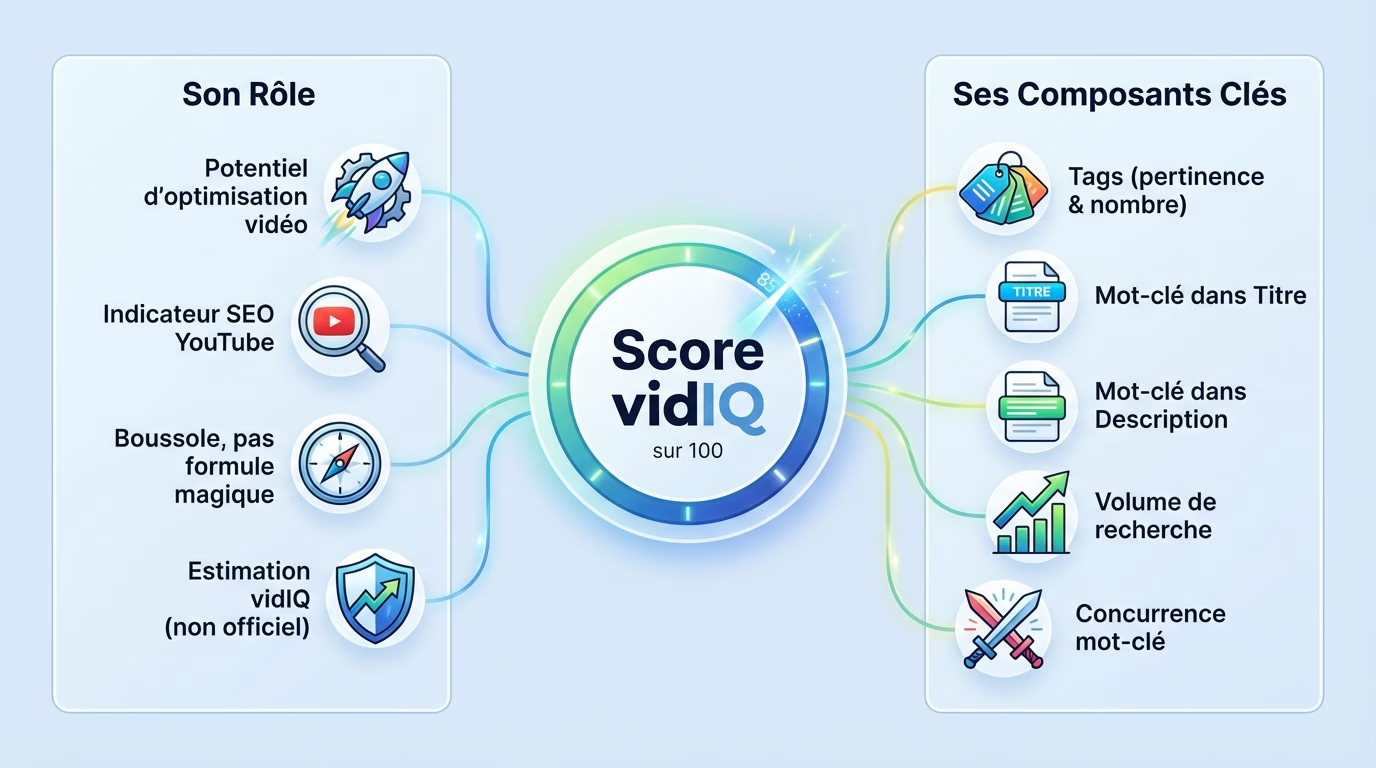
This score out of 100 assesses a video’s optimization potential. It’s not a score for artistic “quality,” but rather a score for technical “preparedness” to feed the YouTube algorithm.
Its purpose is to give you a quick idea of your video SEO performance . It’s a tool to guide you, a kind of compass, not a magic formula for going viral.
It’s important to emphasize that this is a proprietary estimate from vidIQ . It’s not an official figure from YouTube.
The ingredients that make up the score
We’re going to break down what’s “under the hood” to clarify the vidIQ score, its reliability, and its interpretation . The score isn’t a number pulled out of thin air; it’s calculated based on several concrete criteria.
VidIQ thoroughly analyzes your video by looking at very specific points that you can, for the most part, improve yourself, thus avoiding wasting traffic unnecessarily:
- The relevance and number of tags (keywords).
- The presence of the main keyword in the title.
- The presence of the main keyword in the description.
- The search volume of the target keyword.
- Competition for the same keyword .
The two pillars of the score: what you control and what escapes you
The optimization score: your personal checklist
We begin with the “Actionable” score, rated out of 50. To fully understand the vidIQ reliability interpretation score, this is the foundation: it encompasses everything we control before publication. We didn’t regret spending time on it, as it’s the only area where we have 100% control .
This is the to-do list of a top SEO student, a bit like planning your route. If you check off the technical boxes, the score automatically increases . It seemed like a reassuring way to start off on the right foot.
In short, this is your exclusive playground. Take advantage of it and lock everything down ! 🛠️
The performance score: the audience’s reaction
The other half, also out of 50, is based on actual performance once the video is online : views, engagement, and velocity. This is often where things get complicated.
This part is less predictable, like unpredictable weather. It depends mainly on the audience’s reaction. The magic happens… or not , sometimes not without difficulty.
We do not control this score directly, but the quality of the content remains decisive in influencing it.
Dashboard: Optimization vs. Performance
To help you see things more clearly, we’ve put together a summary table . It allows you to distinguish between these two aspects and know what to focus on.
This comparison highlights the difference between preparation beforehand and the reality on the ground . 👇
| Criteria | Optimization Score (Actionable) | Performance Score (Actual) |
|---|---|---|
| Creator control | Total. You can edit each item. | Indirect. Influenced by the quality of the content. |
| Nature | Technical (SEO Checklist). | Organic (Public reaction). |
| Examples | Title, tags, description, maps, end screen. | Views per hour (VPH), engagement, retention. |
| Goal for you | Get the best possible score before publication. | Analyze to understand what appeals to your audience. |
Interpret your score and take action (no pressure).
Okay, we’ve got the theory down. But what about the vidIQ score, its reliability, and how to interpret it? Now’s the time to translate that score into concrete actions for your channel.
A low score (below 40/100): the basics need to be reviewed
A low score isn’t a disaster. It’s just a sign that the fundamentals of YouTube SEO have been forgotten. It seemed obvious to us: the title, tags, or description aren’t aligned .
Our advice: don’t panic. Focus on the optimization score (the checklist) . That’s where points are easiest to gain to get back on track quickly.
An average score (between 40 and 70/100): time to fine-tune.
An average score is the most common result. This means the basics are there, but there’s room for improvement . Keyword research is often the key here.
The goal is to transform this “not bad” into “very good” . Here are the points to check to gain more visibility:
- Check if your tags are numerous enough and relevant .
- Analyze the search volume versus the keyword competition . Is it realistic?
- Ensure that the title is both catchy for humans and clear for the algorithm .
A high score (above 70/100): what now?
Congratulations, your SEO is solid! But be careful, a high score doesn’t guarantee success. It’s a necessary condition, but not sufficient .
Now, the focus needs to shift. Look at the “performance” section of the score and, most importantly, the YouTube Studio statistics (CTR, retention). That’s where the truth lies.
The reliability of the vidIQ score: put to the test in real-world conditions
Why the score is an excellent starting guide
We tested the tool, and for SEO, it’s a solid ally . The score acts like a coach, forcing us to work on keywords and descriptions, perfect for structuring a coherent vidIQ reliability interpretation strategy from the start.
It’s a kind of essential safeguard when you’re focused on the task at hand. It saved us from a lot of mistakes by making sure YouTube understood the video’s topic even before publication.
Limits that should never be forgotten
Let’s not kid ourselves, vidIQ isn’t YouTube’s algorithm. This score remains an estimate based on public statistics, and sometimes the AI can even make mistakes or give contradictory advice, as some users have reported.
The major problem is that it doesn’t judge the intrinsic quality of your work. We’ve already seen technically perfect videos (score 100/100) completely flop because the content was just incredibly boring.
By trying too hard to please the robot, we risk over-optimization which makes the title unreadable for real humans .
High scores don’t always equate to views and revenue.
This is where the problem often lies. A 90/100 score will never guarantee virality or a good CPM. We’ve learned the hard way that financial success depends on much more complex factors .
View this score as a tool to improve your chances, not as a guarantee of winning. Ultimately, if the audience doesn’t click or stay, no tool will be able to save the day .
Going beyond the score: the indicators that really matter
The real arbiter: your YouTube Studio
Once the video was published, we quickly switched from the tool to YouTube Studio. That’s where the raw truth lay, the truth we were looking for. YouTube’s data is direct and unfiltered. It’s the real performance of your content , measured by the platform itself.
Metrics to watch like a hawk
The vidIQ score is useful, but the success of our video hinged on metrics that YouTube loves. We focused our attention on three key areas to validate our thumbnails and content :
- Click-through rate (CTR): How many clicks are there when YouTube suggests the video? This is the immediate test of your thumbnail .
- Watch time : How long do people stay? The ultimate test of content quality.
- Audience retention : At what point do people lose interest? A goldmine for improving future videos.
In short: the vidIQ score, friend or foe?
Ultimately, regarding the vidIQ reliability score, it’s a great friend, but a poor master . We use it to structure SEO, but never let it dictate our creativity.
It is a tool, and its effectiveness depends mainly on how it is used on a daily basis.
If you want to test it yourself and form your own opinion, you can learn more about VidIQ or directly view VidIQ prices .
In summary, we see the vidIQ score as a super compass To avoid getting lost in the YouTube SEO jungle. It’s a great tool for optimizing our videos, but let’s not forget that the real magic happens when the content resonates with the audience . So, it’s our turn ! 🎬✨





Leave a Reply