

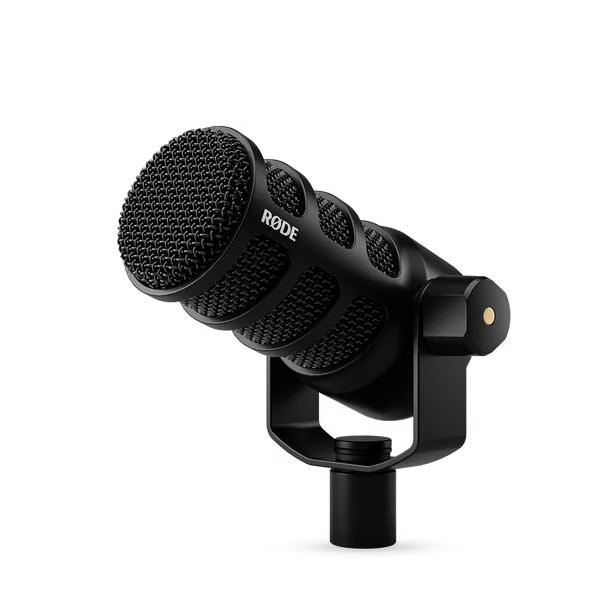
We all know that choosing the perfect microphone for your podcast or stream is a real headache: sound quality, connectivity, budget… And here, the Rode White PodMic USB (€229.99) appears to be an attractive solution. In this detailed review, I analyze its audio performance, its dual XLR/USB connectivity, and its sleek design to help you decide without regret .
Summary
- Rode PodMic USB Overview: Key Features
- Rode PodMic USB Sound Quality and Performance
- Comparison with other microphones and market positioning
- Rode PodMic USB User Experience and Installation
Rode PodMic USB Overview: Key Features
Rode Microphone Design and Construction
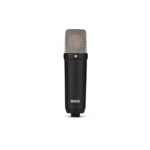
The white Rode PodMic USB sports a classic studio microphone look , with its matte finish and all-metal chassis. Its sleek design fits into any environment.
Built from sturdy steel, this dynamic microphone is shock and vibration resistant thanks to its internal shock-absorbing system. The integrated pop filter limits “p” and “b” sounds. Its 5-year warranty reinforces its reliability. Its weight (862 g) is impressive, but its uncompromising strength justifies it.
Technical specifications and connectivity
A dynamic cardioid microphone, the PodMic USB offers dual XLR and USB-C output . Its Revolution Preamp™ and APHEX® DSP via USB ensure professional sound. Compatible with Windows, macOS, iOS, and Android.
| Characteristic | Specification | Detail |
|---|---|---|
| Acoustic principle | Dynamic microphone | Resistant to ambient noise |
| Directivity | Tight cardioid | Rejects side and rear sounds |
| Frequency response | 20 Hz – 20 kHz | Covers the entire human audible spectrum |
| Output impedance (XLR) | 460 Ω | Optimal compatibility with audio interfaces |
| Maximum sound pressure level | 148 dB SPL | Records even very loud sounds without saturation |
| Equivalent noise | 26 dBA (XLR) / 19 dBA (USB) | Better performance in digital mode |
| Sensitivity | -57 dB re 1 Volt/Pascal (±3dB) | Low sensitivity, ideal for controlled studios |
| Output connectors | 3-pin XLR + USB-C + 3.5mm headphone jack | Dual connectivity + integrated direct monitoring |
| Bit Depth (USB) | 24 bits | High resolution audio |
| Food | Bus (via USB) | No external USB power supply required |
| Size | 10.9 cm (Ø) x 17.2 cm (L) | Compact format suitable for the studio |
| Weight | 862 g | Sturdy metal construction |
| Integrated DSP processing | APHEX® | High-pass filter, noise gate, compressor, Aural Exciter™, Big Bottom™ |
| Preamplifier | Revolution Preamp™ | High gain and low noise |
| System compatibility | Windows, macOS, iOS, Android | Versatile: computer or mobile |
| Included Accessories | SC29 USB-C cable (3m) + WS14 pop filter | Ready to use |
| Guarantee | 5 years | Industry-leading extended warranty |
Dual XLR/USB-C connectivity offers great flexibility. In USB mode, it’s plug-and-play on a computer or smartphone. In XLR mode, it integrates into professional setups. The headphone output allows for latency-free monitoring. In short, a microphone suitable for all needs , from home studio to live performance.
Rode PodMic USB Sound Quality and Performance
Audio rendering and voice capture
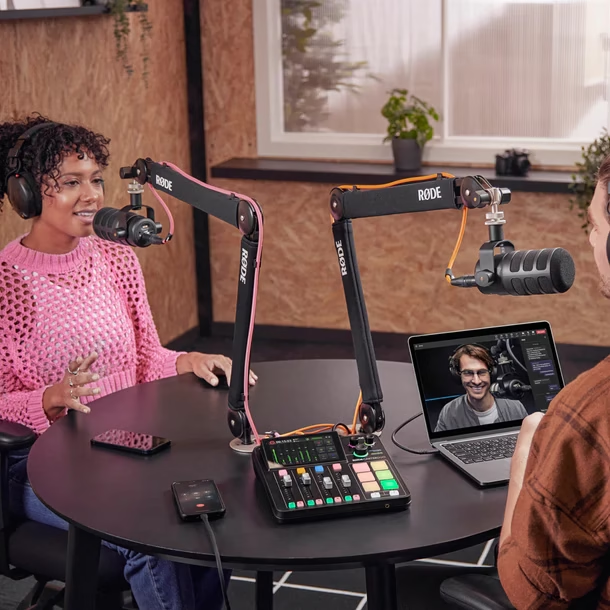
The PodMic USB delivers clear, warm, and professional sound . Its frequency response (20 Hz-20 kHz) accurately captures vocal nuances. The Revolution™ preamp and APHEX® DSP enhance the quality, ideal for voiceovers or podcasts.
- Broadcast sound quality optimized for speech with clear and detailed rendering
- Extended frequency response from 20 Hz to 20 kHz to capture all vocal nuances
- APHEX® DSP integration with Aural Exciter™ (brightness) and Big Bottom™ (depth) for customizable sound
- Effective plosive reduction thanks to the included internal and external WS14 pop filter
- High-resolution 24-bit/48 kHz recording and limited mechanical shock management
Ideal for podcasting, streaming or voice-over, this dynamic microphone adapts to low or high voices . In USB mode, the sound is clearer (19 dBA equivalent noise). For music, it is better to use DSP presets.
Filters and noise reduction
The built-in pop filter attenuates “p” and “b”, but an external WS14 model is included for greater precision. The APHEX® DSP includes a noise gate to reduce ambient noise (fans, servers).
Position the microphone 5-10 cm from your mouth, at an angle to avoid popping sounds. Activate the noise gate and high-pass filter via RØDE Central. A microphone boom (type PSA1+) stabilizes the assembly and limits vibrations.
Recommendations for optimal microphone use
Comparison with other microphones and market positioning
Direct comparison and value for money
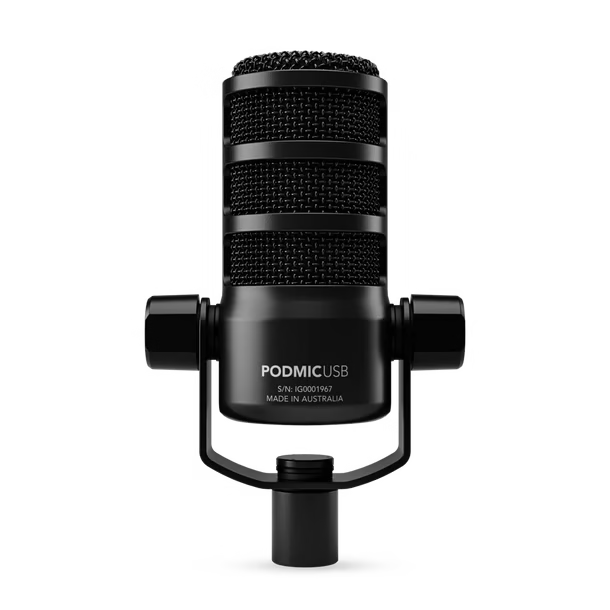
The Rode PodMic USB competes with models like the Shure MV7. Both offer dual XLR/USB connectivity, but the PodMic USB stands out with its built-in APHEX® DSP and all-metal construction . The MV7 favors a warmer sound, while the PodMic USB shines with vocal clarity. At €229.99, it’s in the same price range as its direct competitors.
| Model | Connectivity | Audio processing | Indicative price | Main force |
|---|---|---|---|---|
| Rode PodMic USB | XLR + USB-C | APHEX® (Aural Exciter, Big Bottom), DSP | ~€229.99 | Vocal clarity, latency-free monitoring, versatility |
| Shure MV7 | XLR + USB-C | Built-in equalizer, control app | ~239 € | Warm sound, adaptability to deep voices |
| Rode PodMic XLR | XLR only | None (requires audio interface) | ~149 € | Robustness, ease of use |
👉 To sum up:
- The PodMic USB is the most flexible (USB + XLR, built-in DSP).
- The Shure MV7 focuses on a warmer sound with more control.
- The PodMic XLR remains the economical and robust solution if you already have an interface.
At €229.99, the PodMic USB justifies its price with its XLR/USB versatility and APHEX® DSP. The XLR-only version is less expensive (€149), but requires an additional investment for an audio interface. For content creators, the USB model represents a time saver and immediate studio quality , without complex setup. Don’t wait any longer to buy a Rode Microphone on Amazon at the best price and start your audio projects!
Rode PodMic USB User Experience and Installation
Installation and compatibility
Connecting the Rode PodMic USB is a breeze: simply connect it via the included USB-C cable for immediate use on Windows, macOS, iOS, or Android. No drivers are required, but to unlock advanced settings (gain, DSP), you’ll need to download the RØDE Central app. Some users have reported detection issues on Windows, which were resolved by selecting “Microphone Array” in the audio settings.
Compatible with smartphones and tablets, the PodMic USB works perfectly on iOS and Android via a USB-C/Lightning or OTG adapter. Be careful, however: defective USB cables can cause connection issues. The solution? Replace the cable or update the firmware via RØDE Connect. In the studio, the XLR output integrates seamlessly with a mixing console, provided you disable phantom power.
Daily use and practicality
In everyday use, this microphone impresses with its robustness (862 g) and its swivel stand that allows you to adjust the angle in the blink of an eye. Latency-free monitoring via the 3.5 mm headphone output is a real plus for checking your sound in real time. On the other hand, its imposing weight (almost 1 kg) requires a robust microphone arm , like the PSA1+, to avoid tipping.
The controls are minimalist but effective: a volume knob that turns monitoring on/off and a LED indicating the microphone status (green/red). To adjust the gain or audio processing, you have to go through RØDE Central . The included WS14 pop filter reduces “p” and “b,” but an external model can refine the result in noisy environments.
Rode Central Software and Customization
The free and intuitive RØDE Central software transforms this microphone into a mobile studio . It lets you configure the noise gate, compressor, and APHEX® effects (Aural Exciter, Big Bottom) to sculpt your sound. VoxLab™ presets (Depth, Sparkle, Punch) simplify quick adjustments, ideal for beginners. Settings saved in the microphone persist even after reboot.
For professionals, RØDE Connect supports up to four microphones simultaneously, perfect for podcasts or live broadcasts with multiple guests. Virtual channels integrate remote guests via Skype or Zoom, while sound pads add real-time effects. In short, this software is worth a try to fully exploit the PodMic USB’s capabilities .
Compatible accessories and extensions
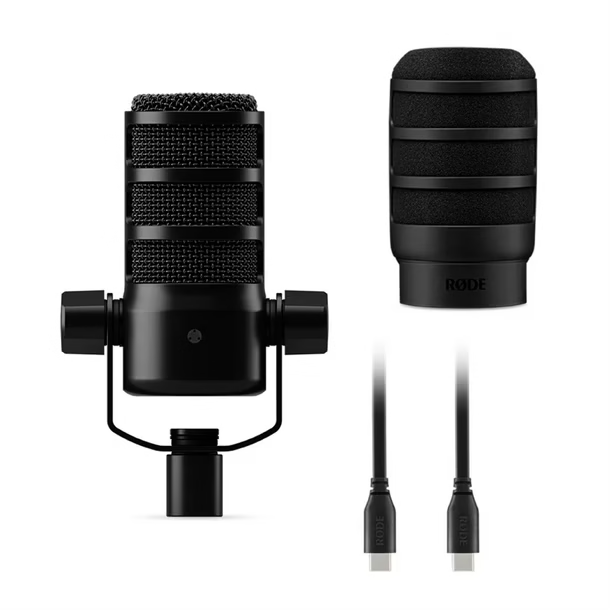
The PodMic USB already includes a 3-meter USB-C cable and a WS14 pop filter, but to optimize the experience, a few additional accessories are recommended . A microphone arm like the PSA1+ (€149) offers stable and flexible positioning. To reduce vibrations, an anti-vibration mount like the SM6 (€99) is useful, especially in untreated environments.
Mobile content creators will appreciate the USB-C to Lightning adapter (for iOS) or OTG adapter (for Android) for recording directly to a smartphone. RØDE’s 5-year warranty provides reassurance regarding durability, but for travel, a protective case (around €30) protects the microphone from bumps and dust. In short, a long-term investment with well-thought-out expansion options .
The Rode PodMic USB White impresses with its XLR/USB connectivity, professional sound quality, and robust construction. For demanding podcasters or streamers, it’s a reliable ally. At €229.99, the investment pays off for uncompromising recordings . Imagine your ideas resonating clearly, everywhere, with this microphone.



Leave a Reply