
Key takeaways: The HOVERAir X1 easily wins this comparison thanks to its 2.7K video and flawless sports tracking, ideal for active creators. The DJI Neo, however, stands out as the best budget-friendly option for getting started with autonomous flight without breaking the bank. With a top speed of 42 km/h, the X1 remains the undisputed king of action . See the Official Store
Looking for the perfect companion to film yourself, but this HOVERAir X1 vs DJI Neo comparison of drones without a remote control leaves you undecided between two very different philosophies? We analyze every technical detail, from portability to video quality, to determine which of these two flying cameramen truly deserves to follow you everywhere . Discover right now whether you should prioritize the intelligent tracking of the foldable model or the unbeatable value of the giant DJI for your memories.
- Design, portability and robustness: the physical match
- Flight modes and control: autonomy tested on the terrain
- Flight performance: speed and tracking for active creators
- Image quality: the battle between camera and stabilization
- The ecosystem and regulations: more than just a drone
- Verdict and comparison chart: which drone is right for you?
Design, portability and robustness: the physical match
Lightweight versus foldable format
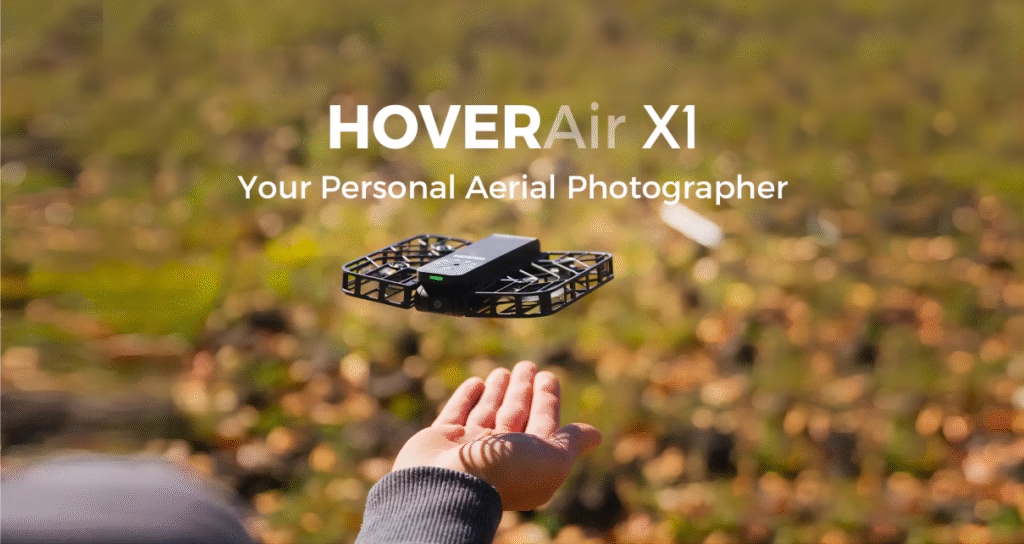
To begin this HOVERAir X1 vs DJI Neo comparison of drones without remote control, let’s look at the balance: The DJI Neo weighs 135 grams. The HOVERAir X1 is heavier at 192.5 grams. .
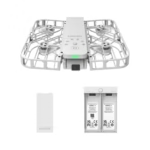
However, make no mistake, the X1 has the edge in portability . Its ingenious folding design allows it to slip effortlessly into a jeans pocket, a luxury impossible with the Neo’s rigid frame. This is a real plus for travelers who want to pack light.
To learn more about this pocket drone concept, take a look at our full review of the pocket-sized selfie drone .
Everyday durability and wind resistance
Rest assured, both machines exhibit good impact resistance , even against obstacles like trees. They are clearly designed to withstand minor piloting errors without ending up in pieces.
The real challenge lies in its performance against the elements: the HOVERAir X1 excels with a Level 5 wind resistance rating . The DJI Neo, on the other hand, only reaches Level 4, which can be quite insufficient in windy conditions and risk loss of control.
If you plan to film by the sea or in the mountains, believe me, you will really feel the difference .
Autonomy and storage capacity
Regarding battery life, be wary of official figures: while the Neo advertises 18 minutes compared to 16 for the X1, the reality is different . In real-world conditions, both offer around 14-15 minutes of actual flight time before landing.
Storage is the real sticking point . The HOVERAir X1 delivers with 64GB of internal storage and expansion via microSD card. The DJI Neo limits you with only 22GB of internal storage, with no possibility of expansion, which fills up very quickly.
For long journeys or intensive filming, the X1 is therefore much more flexible and will prevent you from having to empty the memory in an emergency .
Flight modes and control: autonomy tested on the terrain
Autonomous flight modes: similar brains?
In this HOVERAir X1 vs DJI Neo comparison of drones without a remote control, battery life is key . Both drones are designed to be used without a remote control thanks to intelligent modes.
They share a set of very practical automatic modes for easy self-filming. You simply select the desired option, and the drone handles the framing automatically .
- Selfie mode : the drone moves backwards in a straight line.
- Follow Mode : the drone follows you as you move around.
- Stationary Mode (Orbit/Hover) : the drone rotates around you or remains fixed, keeping you in the frame.
However, the HOVERAir X1 ProMax stands out with more specific modes like Ski, Cycling, and Sidetrack , designed for action sports. This is a major advantage if you move quickly.
Controlling without a remote control: buttons or smartphone?
For both, there are three ways to control them : the buttons on the drone, the mobile app, and an optional controller. So you have plenty of choice depending on the situation.
The X1 has the advantage here . Its small screen allows you to adjust the height and distance directly on the drone. With the Neo, you have to use the app for these settings, which wastes time.
For quick use in the field, the X1 is more direct and efficient . It avoids having to take the phone out unnecessarily.
User experience: which application is the most intuitive?
In manual mode via smartphone, the HOVERAir X1 app is considered more responsive . Control is more direct, and you feel less latency between the touch command and the action.
Here, the DJI Fly app for the Neo is better . It allows you to view videos in full quality directly. The X1 app only shows previews and requires a download for full viewing.
Despite its limitations, the DJI Neo is surprisingly capable for its price. It offers fun autonomous modes and great durability, making it perfect for occasional use.
Flight performance: speed and tracking for active creators
Beyond trends, what matters in action is raw performance . Let’s see which of the X1 or the Neo performs best when things get really moving.
Sprinting: who is the fastest?
In this HOVERAir X1 vs DJI Neo comparison of drones without remote controls, the HOVERAir X1 ProMax is significantly faster . This is a crucial point for sports tracking.
The X1 achieves an impressive top speed of 41.8 km/h (26 mph). In comparison, the Neo tops out at 32 km/h (20 mph), and that’s only after a recent update.
When it comes to keeping up with a runner, both perform respectably. But as soon as you switch to cycling, the difference becomes obvious .
Monitoring a subject in action: the bicycle test
The HOVERAir X1 excels in cycling mode thanks to its technology. Its obstacle avoidance system (front and rear sensors) allows it to navigate between branches without any problem , even in the forest.
The DJI Neo struggles more in these demanding conditions. It tends to collide with obstacles or simply lose track of the subject if it’s going too fast .
These observations are confirmed by extensive field tests . The reliability is not the same .
Palm landing and gesture control
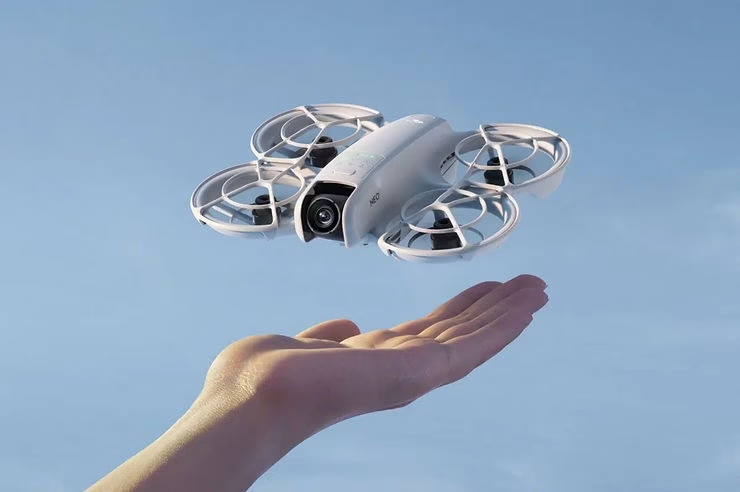
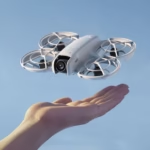
Both drones support this practical everyday function. Simply hold your palm flat and they will gently land on it .
The HOVERAir X1 goes further with end-of-flight gesture control. Making an “X” with the arms stops tracking and initiates landing .
Be aware, however, that hand recognition to initiate the return is sometimes temperamental on both models.
Image quality: the battle between camera and stabilization
Good tracking is great, but with a beautiful image, it’s even better. In this HOVERAir X1 vs DJI Neo comparison of drones without remote controls , let’s see what these cameras are really capable of.
Video resolution and stabilization: the clash of technologies
The HOVERAir X1 ProMax outperforms the Neo with recording up to 2.7K 30p, even though it’s often used in 4K 60p. The Neo is limited to 4K quality, which is sufficient for social media. It’s acceptable, but its limitations quickly become apparent on a large screen. For true high definition, the X1 wins hands down .
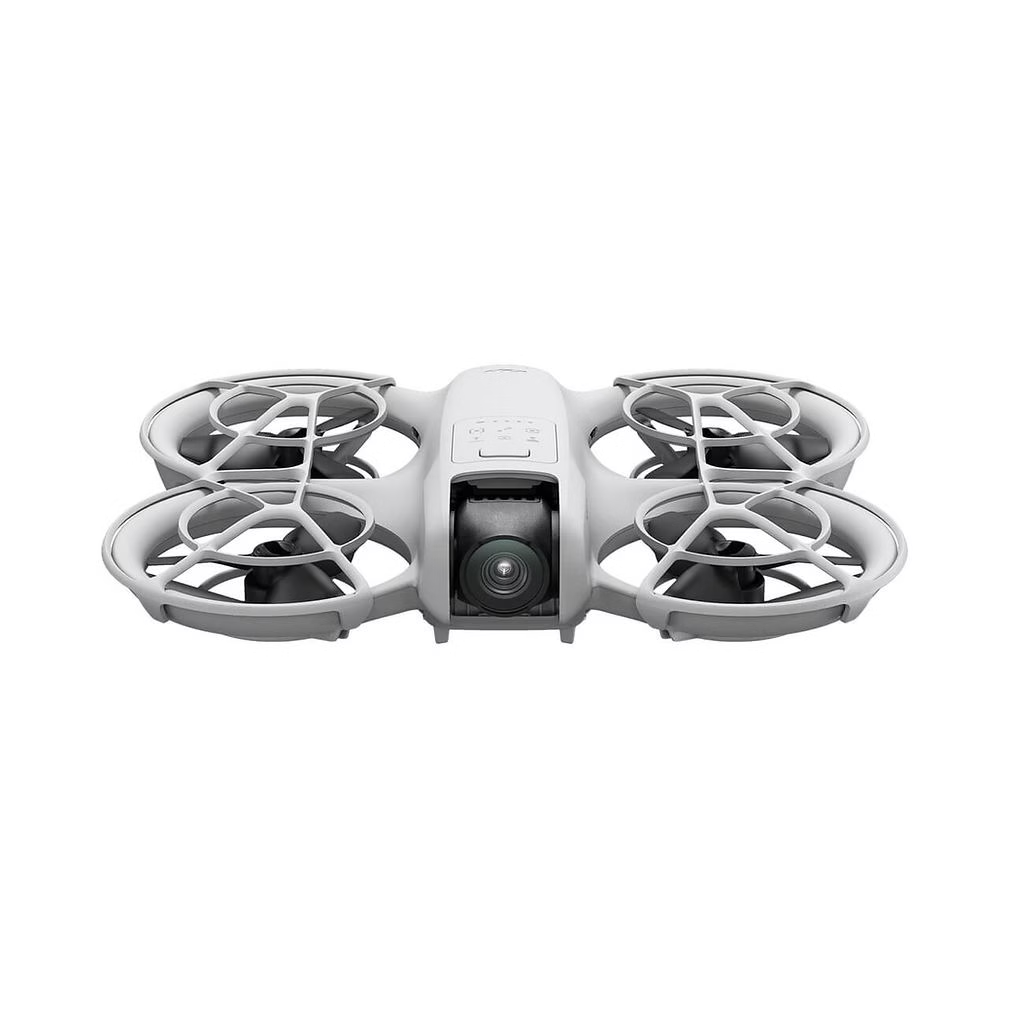
The X1 features a two-axis mechanical gimbal to absorb vibrations. The Neo uses a simpler single-axis system, supplemented by electronic stabilization. The technical difference is striking .
The difference is noticeable ; the X1’s image is more stable and professional. The Neo’s image is a bit shaky.
Photo quality: sensor and megapixels
The HOVERAir X1 has better equipment: a larger sensor and a 16mm wide-angle lens. It captures 12MP and 48MP photos . The details are there, even when you zoom in on the image.
The DJI Neo is limited to 12 MP photos. Its sensor is smaller. You get nice shots for the web, but they lack sharpness for printing .
In good lighting conditions, the Neo still produces decent photos for its price . It does the job well.
The color rendering and the verdict for demanding creators
The HOVERAir X1 captures more faithful and natural colors . The hues of the environment stand out more accurately.
The HoverAir X1 ProMax is the best drone for action sports, thanks to its speed, superior obstacle avoidance and video quality that clearly surpasses the competition.
For a content creator seeking professional-grade image quality, there’s no debate. The X1 is in a different league. The Neo is a good companion for leisure. In short, if image quality matters, the choice is easy .
The ecosystem and regulations: more than just a drone
Buying a drone isn’t just about its specs. You also need to consider its integration into an ecosystem and the rules governing its use.
The advantage of the DJI ecosystem: remote controls and FPV
In this HOVERAir X1 vs DJI Neo comparison of drones without remote controls, the Neo’s versatility is striking . This is DJI’s major strength. The Neo isn’t just an autonomous drone; it’s also compatible with classic DJI remote controllers (RC-N3, RC2).
Even better, it can be piloted in first-person view (FPV) with a headset and motion controller. It’s a gateway to a whole new, much more dynamic world of piloting .
Conversely, the HOVERAir X1 remains limited to its smartphone use or its Beacon module . It offers fewer development prospects.
Regulations for Class C0 drones
From a legal standpoint, it’s simple: both drones weigh less than 250 grams. They therefore fall into category C0, the most flexible category in Europe for flying without the hassle of paperwork.
You don’t need to undergo extensive training. However, operator registration remains mandatory because the drone carries a camera. It’s a quick but essential process to be compliant with regulations.
This is good news for beginners. These two very affordable models are extremely easy to use.
Driving with a smartphone: what are the constraints?
Warning: piloting solely with your phone carries technical risks. The range is limited by the strength of the Wi-Fi signal , often to just a few dozen meters. Beyond this distance, the video feed becomes choppy.
Safety takes a hit. The law requires that the drone always be kept within direct line of sight . This is all the more important with a touchscreen connection that is less stable and precise than a real physical remote control.
The Neo’s radio control option eliminates these limitations . You immediately gain in safety and flight distance.
Verdict and comparison chart: which drone is right for you?
So, which one do we choose? Let’s take stock to decide according to your budget and needs .
Value for money: a huge gap
In this HOVERAir X1 vs DJI Neo comparison of drones without remote controls, the price difference is enormous . It’s the deciding factor.
The DJI Neo is a very affordable option , around $200. The more powerful HOVERAir X1 ProMax is priced at around $300.
Summary table of features
To get a clearer picture, here’s the essential information at a glance .
| Characteristic | HOVERAir X1 ProMax | DJI Neo |
|---|---|---|
| Weight | 192.5g | 135g |
| Dimensions | Foldable | Rigid |
| Wind resistance | Level 5 | Level 4 |
| Maximum speed | 41.8 km/h | 32 km/h |
| Actual autonomy | ~15 min | ~15 min |
| Storage | 64GB + microSD | 22GB |
| Maximum video resolution | 2.7K30p | 4K |
| Stabilization | 2 axes | 1 axis |
| Approximate price | ~$300 | ~$200 |
For whom and for what purpose?
The choice will really depend on your budget and your requirements .
- Choose the HOVERAir X1 if… you are an active creator, you film sports and aim for the best image quality with maximum portability .
- Choose the DJI Neo if… your budget is tight, you want a fun drone for the holidays and to learn FPV piloting .
Still hesitating? Our comparison tool is here to help you decide.
Ready to get started? Find these drones at the official stores via the links below. View the Official Store and Buy the drone here .
The final choice depends on your budget and needs. Opt for the HOVERAir X1 if you’re looking for sporty performance and image quality . Choose the DJI Neo for a fun and affordable drone. Still undecided? Check out our comparison tool . If you’re ready, you can visit the Official Store or buy the drone here .



Leave a Reply