
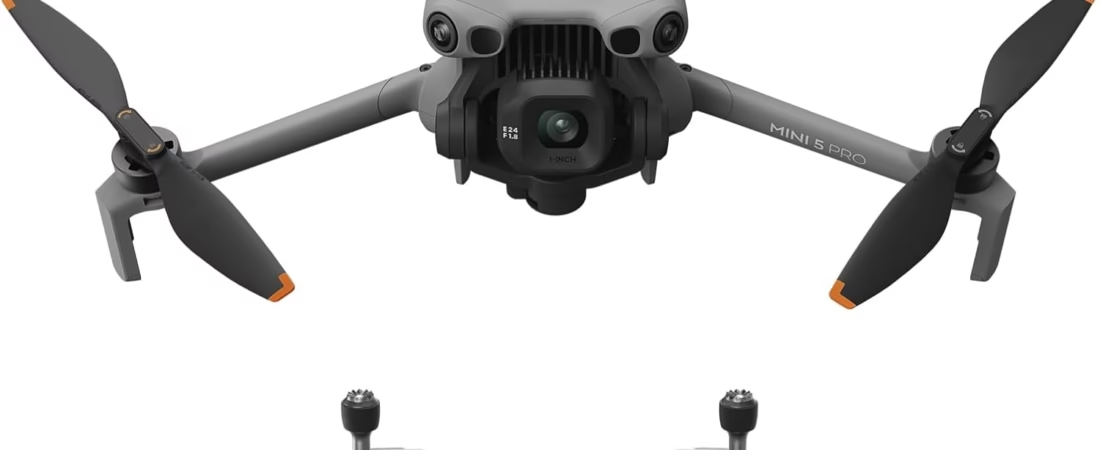
To get to the heart of the matter: this duel pits specialization against versatility . The HOVERAir is the ultimate tool for filming yourself in action thanks to its autonomous tracking , while DJI remains the benchmark for exploring and composing precise cinematic footage. It all comes down to the HOVERAir’s 42 km/h tracking speed and DJI’s comfortable 34 minutes of flight time.
Still unsure whether to prioritize the freedom of an AI cameraman or the precision of manual piloting for your next videos? This detailed comparison of the HOVERAir X1 vs. the DJI Mini 5 Pro autonomous drone versus the classic drone finally answers that question by contrasting the simplicity of hands-free flight with technical versatility. We explain exactly which device to choose based on your needs so you won’t regret your investment and can get great shots from your very first takeoff.
- Two philosophies, one goal: aerial video
- Ease of handling and portability: simplicity versus versatility
- Piloting and flight modes: hands-free or total control?
- Image quality and cameras: does the race for pixels make sense?
- Flight performance: range and speed, the numbers showdown
- Flight safety: radically different approaches
- The ecosystem and long-term cost: beyond the purchase price
- Concrete use cases: who is each drone made for?
- The verdict: HOVERAir X1 or DJI, how to make the right choice in 2025
Two philosophies, one goal: aerial video
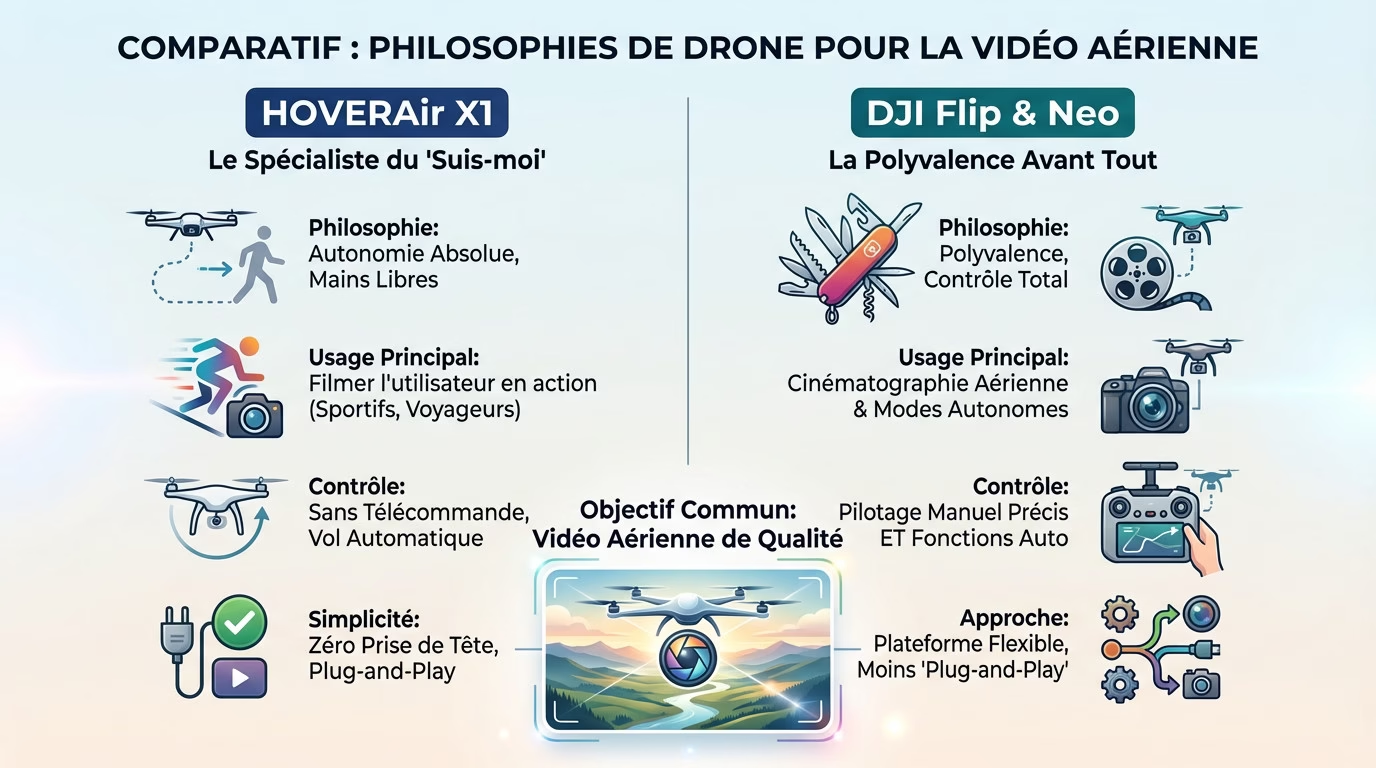
Autonomous drone versus conventional drone: the real debate
Looking for information on the DJI Mini 5 Pro? Stop right there, because you might miss out on the real innovation of 2025. The real competition is elsewhere: between the HOVERAir X1 and DJI’s new solutions like the DJI Neo.
An autonomous drone is simple: no controller, no stress. It takes off from your hand, follows you thanks to AI and manages the framing all by itself in total hands-free mode .
Conversely, the “classic” or hybrid drone from DJI remains a piloted aircraft. Even though it has automatic modes, it excels in precise manual piloting and its ability to capture cinematic shots from long distances.
HOVERAir X1: the “follow me” specialist
The HOVERAir X1 isn’t looking to explore the world; it’s there to film you. It’s a purist of autonomy that rejects the complexity of a remote control to focus on immediate action.
Think of it as a personal flying camera rather than a traditional drone. Whether you’re running or vlogging, it stays focused on you, framing the shot perfectly without you having to lift a finger.
Its mission is unique: to offer radical simplicity and absolute autonomy for those who want to create without piloting.
DJI Flip and Neo: versatility above all
DJI drones, on the other hand, play the Swiss Army knife card to never limit you. Certainly, they can track a subject, but their strength lies in superior technical versatility .
These are true hybrids. You benefit from automation for quick shots, but you retain the ability to take back control to perform complex movements of traditional aerial cinematography.
This freedom comes at a price: it’s less instantaneous than the HOVERAir. To better understand the nuances of this duel between the HOVERAir X1 and the DJI Neo , you have to accept a slightly steeper learning curve .
The choice of philosophy: what kind of creator are you?
Forget the technical specifications for a second: what is your actual content creation need ? That’s the only question that matters to avoid regretting your purchase.
Are you looking for a “zero hassle” tool to film yourself, or a flexible aerial platform to compose your images?
The rest of this article will break down each technical aspect to help you make a final decision .
Ease of handling and portability: simplicity versus versatility
Design and weight: the pocket-sized HOVERAir
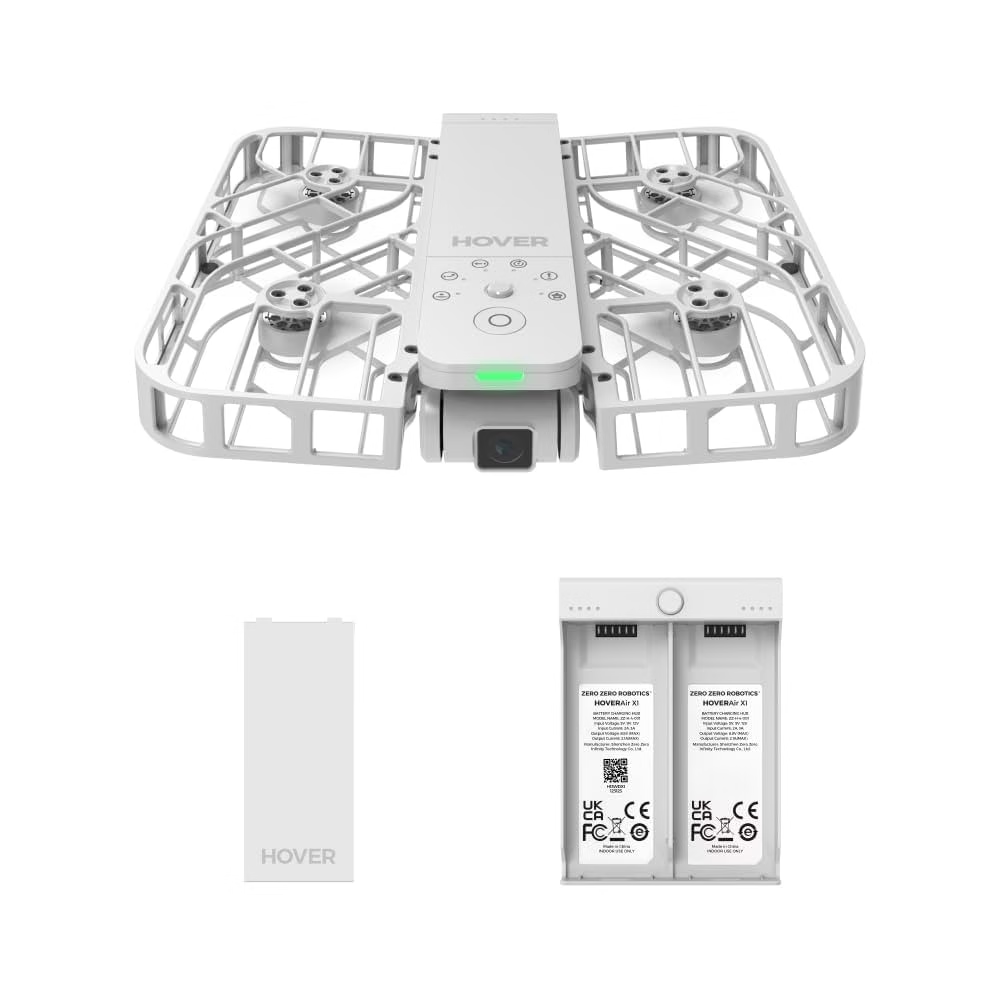
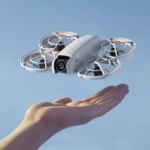
The HOVERAir X1’s design is surprisingly bold. In this comparison between the HOVERAir X1 and the DJI Mini 5 Pro (autonomous drone versus traditional drone), it boasts a foldable, pocket-sized form factor . Weighing in at 185g, it remains well under 250g.
Its key advantage lies in its fully enclosed propellers. This is a major safety feature: you can grab it in mid-flight without any fear . No more worrying about hurting your fingers during handling.
This entire design was conceived to be drawn and used anywhere, anytime. You always have it with you, ready to serve the action .
DJI’s classic design: foldable but larger
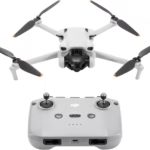
The DJI Mini 4 Pro retains the aesthetics of a traditional quadcopter. Although foldable, its articulated arms remain fragile and require care. You’ll need a small carrying case to transport it safely without risk of breakage.
Its weight is a plus, hovering around 249g. But be aware that even though it’s light, it ‘s still bulkier than the HOVERAir when folded . Furthermore, its exposed propellers require much more care during everyday handling.
This is the compromise DJI found to integrate more technology. A little compactness is sacrificed for pure performance .
Takeoff and start-up: instantaneous or deliberate?
Forget complicated procedures with the HOVERAir. A simple press of a button, and takeoff from the palm of your hand is accomplished in three seconds flat . It’s the ultimate argument for spontaneity: you’re ready to film instantly.
In contrast, the DJI process requires a methodical approach. You have to unfold it, turn on the drone and the remote controller, and then wait for the GPS to acquire a fix. It’s quick, but it’s clearly not instantaneous when the action unfolds.
This is the perfect contrast between capturing the moment with the HOVERAir and the technical preparation of a shot with the DJI.
The “cycling bundle” and accessories: designed for action
Bundles like the HOVERAir “Cycling Bundle” are no illusion. They target athletes and creators on the go with dedicated accessories. Everything is designed to film the action hands-free , right in the heart of the action.
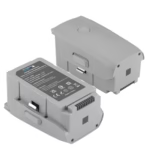
DJI’s “Fly More” package takes a different approach. It focuses on extended flight time with extra batteries and a carrying case. This offering reflects its versatile nature, ideal for travelers who want to fly for long periods .
Even the packages sold tell the story of the intended use for each drone : one for exertion, the other for travel.
Piloting and flight modes: hands-free or total control?
The hands-free control of the HOVERAir X1
The concept is simple and stands out in the HOVERAir X1 vs DJI Mini 5 Pro autonomous drone vs classic drone duel: everything happens via the smartphone application or directly on the device to launch predefined modes.
For added freedom, voice control and the “Beacon” (a simplified remote control) prove very practical. These options enhance the feeling of completely hands-free flight .
Note that the range is limited to the signal from your smartphone or the Beacon. The idea is not to explore, but to remain the main subject of the frame. It’s a perfect solution for filming yourself alone .
Intelligent and automated flight modes
The HOVERAir shines with its pre-programmed flight modes that mimic professional camera movements. This is the core of its offering for effortlessly creating dynamic content .
- Follow : A classic tracking system where the drone stays right behind you.
- Orbit : The device rotates around the subject for a cinematic effect.
- Bird’s Eye : A very stylish, high-angle vertical shot.
- Camera Dolly : An automatic forward or backward panning effect.
These modes are designed to be launched with a single click, requiring no piloting skills. It’s pure and simple creative automation , as can be seen on the official HOVERAir website .
DJI: the power of the remote control and the long range
Here, we enter a different world with the DJI RC 2 remote controller and its integrated screen. It offers stable video feedback and complete manual control, essential for precisely framing your landscapes over long distances.
With a range of over 10 km (and even up to 20 km), the drone becomes a tool for exploration and aerial photography , far beyond simple close-range monitoring.
It is this ability to fly remotely that defines the DJI as a “true” classic drone. It offers a freedom that autonomy alone cannot provide .
Subject tracking (ActiveTrack): Can DJI compete?
DJI’s ActiveTrack system is very effective for general tracking. It locks onto the target well, but quickly shows its limitations when there is too much movement .
According to feedback, DJI’s tracking is less adept at handling fast-paced action sports and sudden changes of direction. The HOVERAir excels precisely where the DJI falters .
The HOVERAir specializes in close tracking, while DJI is a generalist that also performs tracking well. That’s the key difference .
Image quality and cameras: does the race for pixels make sense?
Video resolution: 8K for the HOVERAir versus 4K HDR for DJI
In the HOVERAir X1 vs DJI Mini 5 Pro autonomous drone vs classic drone debate, the HOVERAir Pro Max draws first: 8K recording at 30 fps . This is a major marketing point that promises stunning detail.
In contrast, the DJI Mini 4 Pro emphasizes fluidity with 4K HDR at 60 fps. Let’s be honest: 8K is mainly used for cropping. The richness of HDR and the smoothness of 60 fps often win out visually.
Ask yourself: who actually watches 8K videos on a smartphone? For Instagram or TikTok, is this abundance of pixels really necessary ?
Stabilization: 2-axis gimbal + EIS versus 3-axis mechanical gimbal
The HOVERAir uses an interesting hybrid approach . It combines a 2-axis mechanical gimbal with electronic image stabilization (EIS) to handle the third axis. It’s a clever technical compromise to keep the drone compact and lightweight, but is it enough for purists?
DJI remains committed to a sure thing: the 3-axis mechanical gimbal. It’s the absolute benchmark for perfectly smooth videos , eliminating shakes even in tight turns or light breezes.
The obsession with 8K shouldn’t make us forget the essential point: a stable image is a usable image . The mechanical gimbal remains the king of smooth footage.
Check out our comparison of HOVERAir X1 vs stabilizer – Is it really useful? to understand the difference between hybrid stabilization and a purely mechanical solution.
Sensor and color options: the devil is in the details
Although the sizes are similar, the DJI sensor often handles digital noise better. A larger sensor ensures better low-light performance , saving your dusk-time shots. It’s a detail that makes all the difference.
For creators who love to edit their images, DJI has a head start. DJI’s D-Log M profiles offer incredible dynamic range in post-production . It’s a powerful tool for recovering detail in shadows and highlights.
In short, the HOVERAir aims for immediacy […] DJI […] offers this flexibility essential to image experts.
Native vertical format: an advantage for social networks?
One feature changes everything: the ability to film in native vertical format. Both the DJI Mini 4 Pro and the HOVERAir allow direct capture for mobile devices without any loss of definition . This has become an essential standard.
Why is this vital in 2025? No more post-production workarounds. You get a full-quality 9:16 image that’s immediately usable for TikTok or Shorts. It’s a huge time saver and a guarantee of sharpness for your audience.
This feature proves that these brands have grasped current needs. We no longer film just for TV, but for the palm of our hand .
Flight performance: range and speed, the numbers showdown
A beautiful image is great, but if you only have 5 minutes to capture it, it limits the possibilities. In this comparison of the HOVERAir X1 vs. the DJI Mini 5 Pro autonomous drone versus the classic drone, the analysis of raw performance reveals two radically opposed philosophies .
Battery life: the HOVERAir’s weak point
16 minutes. That’s the maximum flight time displayed by the HOVERAir Pro Max. This figure leaves no room for doubt: it’s short, very short for a complete filming session.
This limited battery life is a direct consequence of its ultra-portable design and featherweight 185g. A small battery in a compact chassis inevitably means a compromise in portability that must be accepted. Do you see the problem if you’re not prepared?
To avoid getting frustrated in the middle of an action, you will absolutely need to plan your plans and, above all, invest in several spare batteries .
DJI’s comfortable flight time
In contrast, the DJI platform sets its standard with a much more reassuring battery life: 34 minutes for the Mini 4 Pro model. That’s more than double what its direct competitor offers .
In practical terms, it completely changes the dynamics of your session. You have time to explore the area, wait for the perfect light, or reshoot a failed take without worrying about battery level. It’s a valuable luxury that unleashes creativity .
This ability to stay airborne for a long time remains one of the most compelling arguments for choosing a classic drone architecture.
Tracking speed: the HOVERAir’s advantage for action
However, the HOVERAir regains the advantage in a very specific area. It is capable of reaching a tracking speed of 42 km/h , which is impressive for its size.
Why is this crucial? Because it’s this speed that allows it to stay right behind a mountain biker or a fast skier without ever losing contact. Where other drones would lose their target, this one stays locked on . That’s its raison d’être: to capture pure action without complex human intervention.
Its speed in manual control matters little here; what counts is its ability to keep up when it really accelerates.
Wind resistance: a factor not to be overlooked
Finally, we must address an invisible but very real enemy: the wind. It is often the Achilles’ heel of ultralight aircraft, which struggle to stabilize.
Thanks to their more traditional design and greater weight (249g), DJI drones generally offer better wind resistance . The HOVERAir, being lighter and with a different wind resistance, will struggle more quickly if the wind picks up. It will have a harder time maintaining its position.
This is a vital criterion to check depending on your region: by the sea or in the mountains, this additional stability can save your images .
Flight safety: radically different approaches
Flying fast and for a long time is great. But flying without crashing is even better . Let’s see how each brand approaches safety.
DJI’s Omnidirectional Obstacle Detection
The DJI Mini 4 Pro leaves nothing to chance with its 360-degree optical sensors . It scans the front, back, sides, as well as the top and bottom for complete coverage. This is a key point in the comparison between the HOVERAir X1 and the DJI Mini 5 Pro autonomous drone versus the traditional drone, and it’s a game-changer.
This system creates a true safety net around the device. If an obstacle appears, the drone calculates a trajectory to avoid it automatically , even if you are in active follow mode.
For a novice pilot or in a dense forest, it’s a guarantee of absolute peace of mind . You avoid silly accidents.
The minimalist approach of the HOVERAir
The philosophy here is quite different; the HOVERAir relies primarily on a ToF (Time-of-Flight) sensor . This is positioned downwards and, on advanced models, towards the rear.
The goal isn’t to see everything, but to ensure safe tracking at high speeds , especially when the drone is moving backward. However, be aware that it remains blind to the sides and front, which requires some adjustment.
The user must therefore remain vigilant . It shouldn’t be expected that they will magically dodge a side branch.
Confidence in flight: a feeling, not a technical specification
Beyond the raw specs, what matters is how you feel with the controller in your hands. Confidence allows you to capture images you would never have dared to attempt otherwise.
DJI regulars will tell you: the omnidirectional sensors offer unparalleled peace of mind . You can focus on framing and lighting, without the constant fear of an imminent crash with every movement.
Flying with omnidirectional sensors is like having an invisible co-pilot. It doesn’t replace vigilance, but it completely changes your peace of mind.
Passive safety: the advantage of protected propellers
The HOVERAir scores a decisive point with its design incorporating fully enclosed propellers. This is what we call passive safety , and it’s fantastic for everyday use.
You can literally catch it in mid-air without risking your fingers. It’s much safer for people nearby and, in the event of a minor impact, the cage protects the mechanism .
This is an undeniable advantage if you plan to film indoors or very close to your subjects.
The ecosystem and long-term cost: beyond the purchase price
Buying a drone isn’t just a one-time expense. You have to think about batteries, repairs, and accessories. It’s an often overlooked point, but one that weighs heavily in the balance .
Purchase price: basic packs and bundles
The entry price varies considerably in the HOVERAir X1 vs. DJI Mini 5 Pro comparison between autonomous and traditional drones. The HOVERAir X1 can be found for around $349, making it much more affordable than the DJI models. This immediate price difference is striking .
But beware of appearances with bundles. At DJI, the “Fly More” is the standard, just like the “Cycling” pack at HOVERAir. The advertised price often hides the need to budget for additional batteries. Don’t be fooled.
In reality, the initial cost is just a facade. Without the essential accessories, your flying experience will remain very limited .
The DJI ecosystem: a well-established giant
The DJI ecosystem literally dominates the current market. You can find parts everywhere, which makes life much easier. It’s the quiet strength of the undisputed leader .
Let’s look at what this means in concrete terms :
- DJI advantages : A huge selection of official and third-party accessories, readily available spare parts, and worldwide after-sales service.
- DJI disadvantages: The bill quickly adds up because the cost of official accessories often remains quite high.
Choosing this brand means betting on security. You’re investing in a mature and reliable ecosystem , which provides significant reassurance for years of use.
The HOVERAir ecosystem: the challenger under construction
HOVERAir is playing in a different league. It’s a young, dynamic brand, but with a more limited ecosystem . You can tell that everything is still under development.
Here, you’ll be mostly reliant on brand-name accessories. Finding third-party repairers or generic parts proves more complicated. It’s clearly a gamble you’re taking with the new .
This can influence the total cost of ownership. The durability of your investment will depend on direct support from the manufacturer .
Total Cost of Ownership (TCO): an estimate to be made
Let’s talk about the real cost: the TCO (Total Cost of Ownership). It’s not just the check you write at the store. To understand it, you need to calculate the cost of batteries, insurance, repairs, and accessories over two or three years.
With the HOVERAir, the reduced battery life is a game-changer . Your budget will need to include the purchase of numerous batteries to last a full filming session.
For DJI, the cost increases differently. The TCO rises quickly if you add ND filters or a more advanced remote control.
Concrete use cases: who is each drone made for?
You’re tearing down a ski slope, pulling off tricks on your mountain bike or skateboard, and you’re filming yourself all alone? The HOVERAir is clearly your personal cameraman . It’s the perfect tool for pure, immediate action.
For what ? It takes off from your hand in a second. Its fast and reliable tracking up to 42 km/h is amazing: it keeps you on track without you touching a controller . You focus on your performance, not on piloting.
Admittedly, 16 minutes of battery life is short. But let’s be honest: an intense descent rarely lasts more than five minutes. To capture the moment, that’s enough .
The versatile content creator and the traveler: DJI’s strength
Do you run a YouTube channel or vlog your travels to the other side of the world? Are you a YouTube content creator who needs variety? The DJI Mini is the Swiss Army knife you need .
Imagine: he follows you down an alley, then suddenly, you send him 500 meters away for an epic aerial shot of the landscape. This ability to do everything, from close-ups to wide panoramas , is his real strength compared to the competition.
With 34 minutes of flight time, you have plenty of time to compose your shots. It’s the perfect complement to a better action camera for your editing needs.
Aerial photographer and videographer: DJI, without hesitation
Are you looking for the “beautiful image” above all else? Is landscape photography or carefully crafted cinematic shots your absolute priority? Forget automation, you want to maintain control over the final result .
Here, the choice is clear. Precise manual control, long transmission range, a 3-axis mechanical gimbal, and color profiles (Log) are essential for professional results . You’re truly in control, framing with millimeter precision.
The HOVERAir is simply not designed for that purpose. It’s aimed at raw action, not artistic contemplation .
So, which one should you choose? A quick guide
Still hesitating? Here’s a direct summary to help you decide based on your profile and avoid wasting your money on the wrong equipment.
- For solo action plans and maximum simplicity: Choose the HOVERAir X1. You accept compromises on battery life and safety for unparalleled capture of the moment .
- For versatility, travel, and creating diverse content: Get a DJI drone (Flip/Neo/Mini 4 Pro) . You’ll have a tool capable of doing everything, from tracking to wide-angle aerial shots.
- For serious aerial photography and videography: The choice is DJI, without any possible discussion .
The verdict: HOVERAir X1 or DJI, how to make the right choice in 2025
The undeniable strengths of the HOVERAir X1
Forget complex settings and tedious preparations. This drone reigns supreme in terms of spontaneity and simplicity . You take it out, launch it, and it captures the moment instantly, without requiring a pilot’s license.
Its main advantage? It’s ultra-portable and takes off in 3 seconds directly from the palm of your hand. With its high-performance action tracking and enclosed propellers that guarantee total safety, it’s literally a flying action camera that never leaves your side .
Its audience is very specific, that’s true. But for vloggers and solo athletes who want to film themselves without a cameraman, it is now almost without competition .
The decisive advantages of the DJI ecosystem
Here, we move into a different category, focusing on practicality, performance, and versatility. DJI is in a different league: this is a machine designed for those who want total control over the image .
Look at the numbers: a massive battery life of up to 34 minutes, precise manual control, and perfect 3-axis mechanical stabilization. Add to that omnidirectional active safety and an enormous transmission range, and you get a reliability monster .
It’s undeniably a much more comprehensive creative tool. However, it requires a bit more involvement and learning to be truly mastered.
The compromises to be accepted by each side
Be warned, there’s a price to pay for this ease of use. By choosing the HOVERAir, you sacrifice battery life, range, and long-distance active safety . With approximately 16 minutes of flight time and limited sensors, you’re technically limited to close-up shots of yourself.
Conversely, by choosing DJI, you sacrifice ultimate portability and spontaneity . There’s always that little “barrier to entry”: taking out the controller, connecting everything, and checking the flight zones before filming.
Don’t look for the perfect drone; it doesn’t exist. There’s just a drone suited to your actual use and constraints.
My personal opinion as a content creator
To be frank, as a creator who needs flexibility, my choice is the DJI ecosystem . The ability to switch between a cinematic wide shot and precise manual tracking is too valuable a resource to do without.
But I have to admit that for a mountain bike ride or a ski session, the idea of slipping the HOVERAir into my pocket is extremely appealing . The freedom of not having to manage anything while still getting 8K images is addictive.
Ideally, you’d have both. But when it comes to the HOVERAir X1 vs DJI Mini 5 Pro autonomous drone vs classic drone, it all depends on your absolute priority .
The verdict is simple . Looking for a personal cameraman for your sports vlogs ? Get the HOVERAir X1; it’s the king of hands-free action . Prefer exploring the skies and composing stunning images with long battery life? The DJI ecosystem remains the master of versatility . Choose the tool that best serves your creativity.


Leave a Reply