

Drone legislation in Spain: The complete guide
Spain, like all European Union member states, has adopted the European drone regulations established by EASA (European Union Aviation Safety Agency). This harmonization aims to create a clear and safe framework for the use of unmanned aerial vehicles (UAS). If you plan to fly a drone in Spain, whether for leisure or professional purposes, it is crucial to be aware of the applicable rules. The competent national authority in Spain is EASA (Agencia Estatal de Seguridad Aérea) .
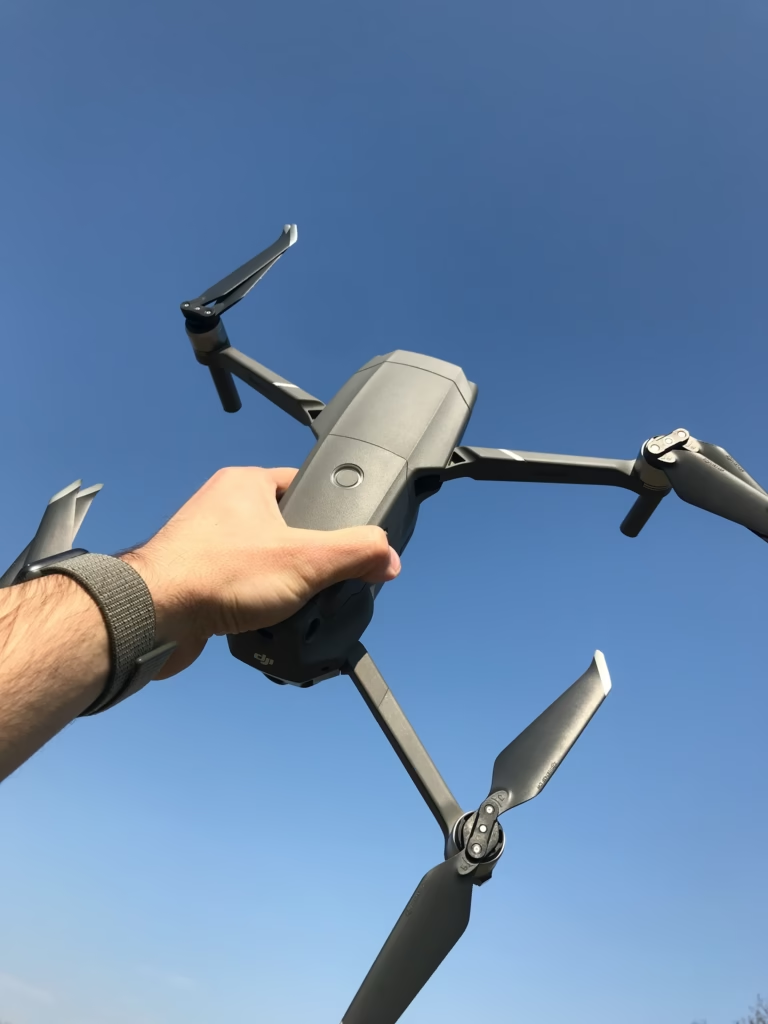
Categories of drone operations
European regulations are based on the level of risk of the operation. They define three main categories:
- Open Category: This category applies to the majority of recreational pilots and many professionals. It covers low-risk operations. It is further subdivided into subcategories (A1, A2, A3) based on the drone’s weight and proximity to people.
- Specific Category: For moderate-risk operations that do not fall under the Open category. For example, beyond visual line of sight (BVLOS) flights or flights over gatherings of people. These flights require EASA authorization following a risk assessment.
- Certified Category: This category covers high-risk operations, such as the transport of passengers or dangerous goods by drone. It is subject to requirements similar to those of traditional aviation.
The essential obligations for every drone pilot
To be able to fly a drone in Spain under the Open category, you must comply with several fundamental obligations.
- Registering as an operator: If your drone weighs more than 250 grams or is equipped with a camera (even if it weighs less than 250g), you must register as a drone operator with EASA. You will receive a unique operator number.
- Training and exam required: Online training is mandatory. For subcategories A1 and A3, a 40-question multiple-choice online exam is required. To operate in subcategory A2 (closer to clients), additional training and a theoretical exam are required.
- Taking out insurance: In Spain, liability insurance is mandatory for all drones, regardless of their weight or use (recreational or professional). It must cover potential damage caused to third parties.
- Identifying your drone: The operator number you obtained must be clearly displayed on the drone. Additionally, some newer drones are required to have a remote identification system (Remote ID).
Flight rules that must be strictly followed
Once you are in compliance, you must follow strict flight rules to ensure everyone’s safety.
- Flight altitude: Do not exceed 120 meters above the ground or the nearest obstacle.
- Visual line-of-sight (VLOS) flight: The pilot must always keep his drone in direct line of sight, without the aid of binoculars or screens.
- Flight Zones: It is prohibited to fly near airports, military zones, critical infrastructure (power plants, etc.), and certain protected areas (national parks). It is essential to consult the official flight zone map before each takeoff. In Spain, the reference tool is ENAIRE Drones , which provides an interactive map of airspace restrictions.
- Privacy and data protection: Respect people’s privacy. Do not film or photograph people without their explicit consent, especially in private places.
- Flying over people: Flying over gatherings of people (crowds) is prohibited in the Open category. Flying over uninvolved people is highly regulated and depends on the subcategory and weight of the drone.
Conclusion: Fly safely and legally
Flying a drone in Spain offers incredible opportunities to capture stunning landscapes, but it also comes with responsibilities. The key is to be well-prepared: register, get trained, insure your drone, and, above all, always check the ENAIRE Drones map before each flight. By following these rules, you will not only ensure your safety and the safety of others, but you will also contribute to a positive and lasting image of the drone community.




Leave a Reply