
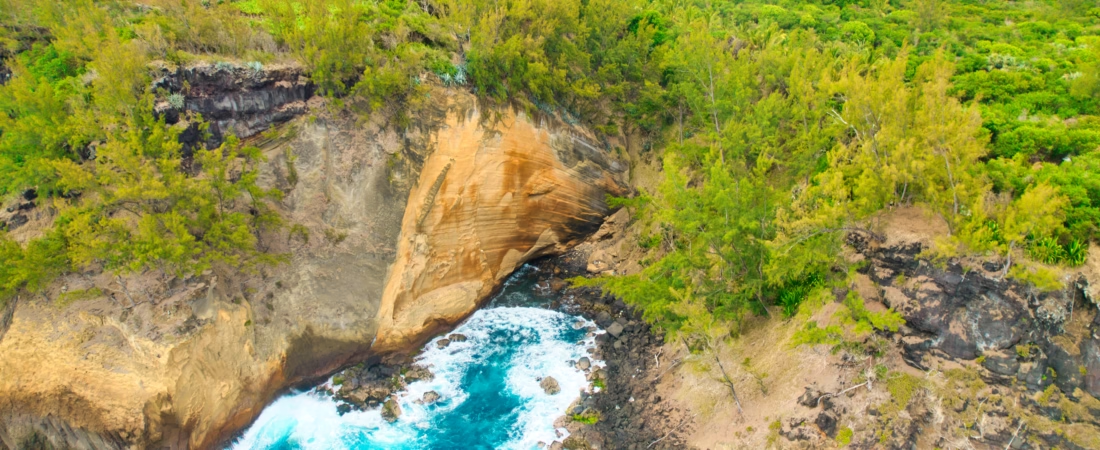
Drone operation in Réunion is governed by strict legislation designed to guarantee both air safety and environmental protection . This regulation combines national directives from the DGAC (French Civil Aviation Authority) with specific local rules, particularly within the Réunion National Park .
Failure to comply with these rules may result in significant financial penalties, or even confiscation of equipment.

General Regulations (DGAC)
The general rules for flying a drone in Réunion follow French national regulations:
- Mandatory registration : All drones over 800g must be registered on AlphaTango .
- Training : The pilot must complete online training (open category) to be able to fly legally.
- Insurance : Civil liability insurance is strongly advised (and mandatory for professional use).
- Maximum altitude : Flights are generally limited to 120 m (and no longer 150 m, following European updates).
- Visual line-of-sight flights : The drone must always remain within the pilot’s field of vision.
- Respect for distances : Prohibition of flying over people, dwellings, roads and sensitive infrastructure.

Prohibited and Restricted Zones in Reunion Island
In addition to national rules, local restrictions exist .
1. Restricted areas in the Reunion National Park
Overflights are prohibited in certain sensitive areas to protect endemic species such as Barau’s Petrel , the Mascarene Petrel or the Tuit-tuit :
- The Roche Écrite massif (from Dos d’Ane to Plaine des Chicots)
- The Piton des Neiges massif
- The summit and ramparts of Great Benares
- The ramparts around Grand Bassin
- The ramparts of the River of the Ramparts
These areas are strictly prohibited because the noise from drones disrupts nesting and can lead to the abandonment of chicks.
2. Restricted areas within a 200m radius of iconic viewpoints
To preserve the peace and quiet of visitors, overflights are prohibited within a 200m radius of the following sites:
- Summit of the Written Rock
- View from Maïdo
- Belvedere Window of Les Makes
- Col des Bœufs
- Three Salazes
- Beef Nose
- Viewpoint from Pas des Sables
- Bellecombe Pass viewpoint
- Commerson Crater
- Summit of Piton de la Fournaise
- Takamaka’s point of view
- Piton de Bert
(full list available on the National Park website)
👉 This means you can fly, but only if you stay at least 200m away from these places.
3. Areas with additional restrictions
- Airports and airfields : no-fly zones (Roland Garros, Pierrefonds, Gillot).
- Military and sensitive areas : strictly prohibited.
- Urban areas and populated zones : regulated, require specific authorization.
Possible exceptions
The National Park can issue a special permit for specific uses:
- Public service missions
- Scientific or conservation activities
- Production of television, film, or photographic images
- Public demonstrations
- Forestry or technical work
📩 To submit an application, the file must be sent at least 15 days before the flight date:
- By email: autorisations@reunion-parcnational.fr
- By mail:
Reunion National Park – Planning and Sustainable Development Support Service – 258 rue de la République – 97431 La Plaine-des-Palmistes
Practical tips for flying to Reunion Island
- Consult the dynamic map of permitted and prohibited areas before each flight.
- Respect the wildlife and flora : avoid nesting areas.
- Opt for flights in open natural areas and far from dwellings.
- Always check the weather : the wind is strong and changeable in the highlands of the island.
- Remember that a drone weighing less than 250g is still subject to the same rules regarding environmental protection and privacy.
In summary
Flying a drone in Reunion Island is possible, but under certain conditions.
- ✅ Respect the general rules of the DGAC
- ✅ Check the restricted areas in the National Park
- ✅ Submit a request for an exemption if necessary
- ✅ Adopt responsible behavior to protect nature and ensure the tranquility of visitors
👉 By respecting drone legislation in Reunion Island , you will fully enjoy the spectacular landscapes of the island while contributing to the preservation of this unique natural heritage.
Drone Legislation in Reunion Island: A Complete Guide
Drone operation in Réunion is governed by strict legislation designed to guarantee air safety and environmental protection. This regulation, based on national directives and adapted locally, defines the conditions for drone use, administrative procedures, and areas where flights are authorized or prohibited. Failure to comply with these rules can result in significant penalties.
General Regulations
Drone legislation in Réunion is based on the regulations of the French Civil Aviation Authority (DGAC) . These regulations apply to all drone users, whether professional or recreational. Here are some key points:
- Mandatory registration: All drones weighing more than 800 grams must be registered with the DGAC.
- Training: Online or in-person training is mandatory to pilot a drone.
- Insurance: Civil liability insurance is mandatory to cover damage caused by the drone.
- Compliance with flight altitudes: Flights are generally limited to an altitude of 150 meters above the ground (unless otherwise specified).
- Safety distance: It is imperative to respect safety distances in relation to people, buildings and infrastructure.
Prohibited and Restricted Zones
Flying over certain areas is strictly prohibited or subject to restrictions. These zones are designed to protect the safety of people, property, and the environment. It is therefore essential to check the specific flight zones in Réunion before each flight.
- Airport and heliport zones: Flights are prohibited within a radius of several kilometers around airports and heliports.
- Military and sensitive areas: Flying over military areas, nuclear power plants and other sensitive sites is strictly prohibited.
- National parks and nature reserves: Flying over national parks and nature reserves is often regulated, or even prohibited, in order to preserve the fauna and flora.
- Populated areas and built-up areas: Flights over populated areas and built-up areas are subject to specific rules and may be prohibited.
Administrative Procedures and Authorizations
For certain activities, particularly flights in specific scenarios or professional flights, additional administrative procedures are required. It is essential to contact the Prefecture of Réunion or the DGAC (French Civil Aviation Authority) to find out the procedures to follow. This may include:
- Application for declaration of activity: for professional flights.
- Flight authorization request: for flights in prohibited areas (after justification and risk assessment).
Practical Advice and Additional Information
To fly safely and legally, here are some additional tips:
- Consult the map of geographical restrictions: Use applications like Geoportail or AlphaTango to identify prohibited or regulated areas.
- Check with local authorities: Contact the prefecture or the DGAC for information specific to Reunion Island.
- Follow common sense rules: Never fly over people, gatherings, or in adverse weather conditions (strong wind, rain).
- Keeping informed about changes in legislation: Regulations can change, so it is important to stay informed.
By complying with current drone legislation, you will contribute to air safety and environmental protection, while fully enjoying the flying experience.


Leave a Reply