
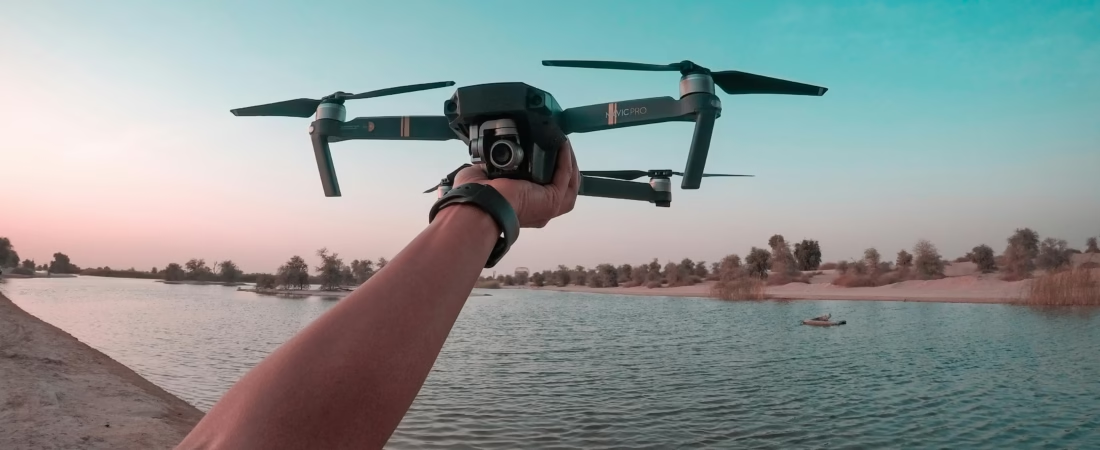
Flying a drone in Germany, whether for leisure or professional purposes, is governed by specific regulations. Like all European Union member states, Germany applies the regulatory framework defined by the European Union Aviation Safety Agency (EASA). However, national specificities are added to this common basis. Here’s everything you need to know to fly legally.
The European Framework: The Basis of Regulation
Since December 31, 2020, harmonized European regulations have governed the use of drones. They classify flight operations into three categories based on the level of risk:
- Open Category: For low-risk flights. This category applies to the vast majority of recreational pilots and many professionals. It does not require prior authorization, but does require compliance with strict rules.
- Specific Category: For moderate-risk flights that exceed the limits of the Open category. Authorization from the national authority is required after a risk assessment.
- Certified Category: For high-risk flights, such as the transport of passengers or dangerous goods. Requirements are similar to those for manned aviation.
This article will focus mainly on the Open category , the most common.
Operator Registration: A Mandatory Step
In Germany, you must register as a drone operator if your device meets one of these conditions:
- It weighs more than 250 grams .
- It is equipped with a sensor (camera, microphone) capable of recording personal data, regardless of its weight.
Registration is not for the drone itself, but for its owner/operator. It must be completed online with the German aviation authority, the Luftfahrt-Bundesamt (LBA) . Once registered, you will receive an operator number (e-ID) that you must visibly affix to all the drones you use.
Certificates of Competence: Proving Your Knowledge
To fly most drones, you need to have proof of proficiency. There are two main levels for the Open category:
- The A1/A3 certificate of competence: Often called the “small drone certificate,” it is obtained after completing an online training course and passing a theoretical exam (also online) with the LBA. It is mandatory for piloting drones weighing more than 250g.
- The A2 Certificate of Competence: Known as the “great drone certificate,” it allows you to fly class C2 drones closer to people. It requires holding the A1/A3 certificate, completing practical self-training, and passing an additional theoretical exam at an approved center.
General Flight Rules in Germany
Whether you are an amateur or professional pilot, you must follow fundamental flight rules to ensure everyone’s safety and privacy.
- Maximum height: Flight is limited to a height of 120 meters above the ground.
- Line of Sight Flight (VLOS): You must always keep your drone in direct visual contact, without using binoculars or video transmission as your primary means.
- Mandatory liability insurance: This is a very important German specificity. Every drone, regardless of its weight, must be covered by liability insurance that covers potential damage caused to third parties.
- Respect for privacy: It is prohibited to fly over private property without the express permission of the owner. Filming or photographing people without their consent is also prohibited.
- Minimum Age: The minimum age to fly a drone autonomously is 16 years old. A younger pilot may fly under the direct supervision of an eligible individual.
Geographic Zones (Geo-Zones): Where not to fly?
Germany, like all countries, has defined areas where drone flights are restricted or prohibited. It is imperative to consult a map of the geo-zones before each flight. Apps like DFS-DrohnenApp or the DIPUL portal are official tools for this. The main prohibited zones include:
- Airports and airfields (safety distances apply).
- Industrial sites, power plants and military installations.
- Nature reserves and national parks.
- Emergency service intervention locations (police, fire brigade).
- Gatherings of people.
- Federal highways, railways and waterways.
In conclusion, flying in Germany requires careful preparation. The key steps are: registering with the LBA, obtaining the appropriate certificate of competence, taking out liability insurance , and checking the authorized flight zones before each takeoff. By following these rules, you can enjoy your drone safely and legally.



Leave a Reply