

Wondering which drone to choose in this Djineo Hoverair X1 selfie drone showdown to film your adventures with complete freedom? We tested these two flying cameras to help you identify the one that truly meets your needs without breaking the bank. Take a close look at our comparison results, as the performance differences in tracking and image quality will quickly influence your final decision.
- Specs matchup: comparison chart
- Design and handling: the drone that follows you everywhere
- Flight performance: who can go the distance (and withstand the wind)?
- Image and video quality: the key to success for your content
- Management and budget: two philosophies, one choice to be made
Specs matchup: comparison chart
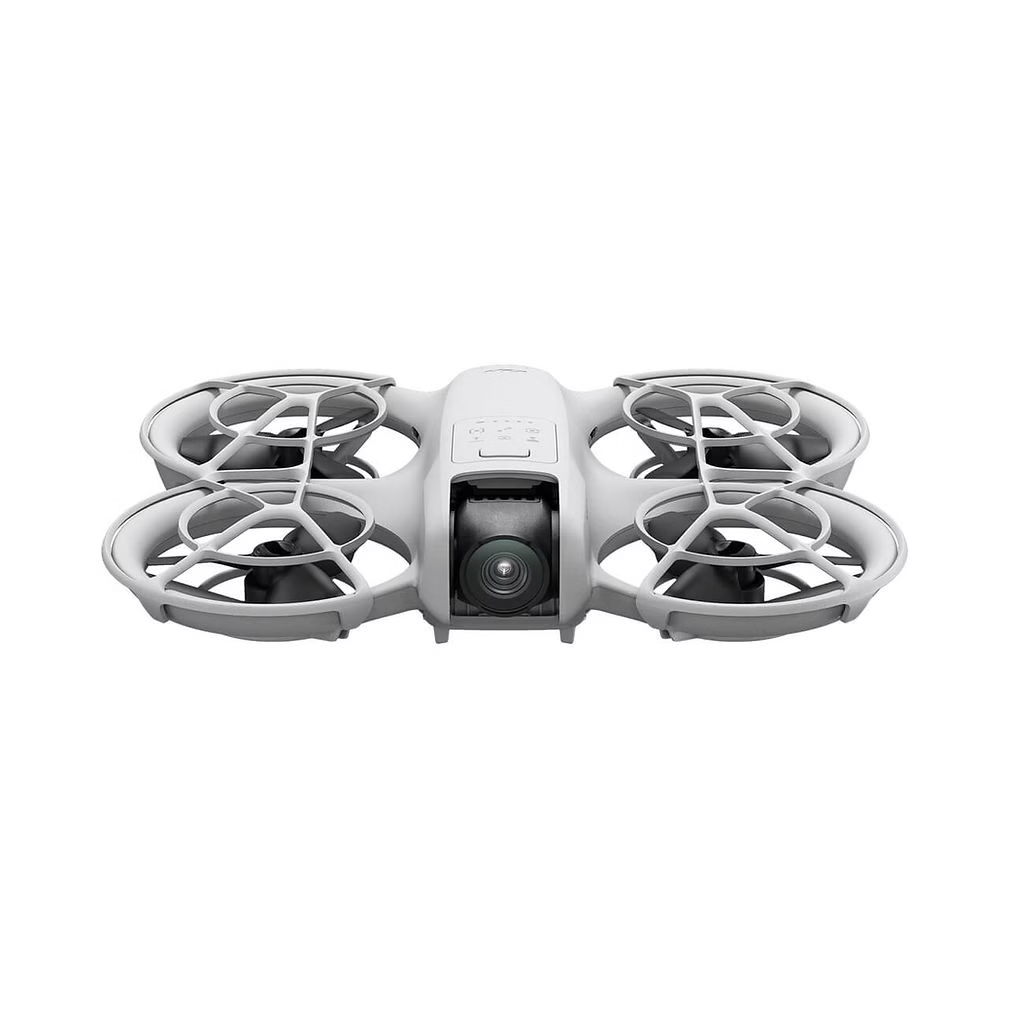
Before we begin: who is this DJI Neo?
The DJI Neo reinvents the DJI Hoverair X1 selfie drone. It’s not a stripped-down “Mini” version, but an ultra-affordable option designed for instant gratification. It targets those who want to capture quick memories without breaking the bank or becoming certified pilots.
The HoverAir X1 Pro, on the other hand, targets the high-end market. Already well-established, it’s aimed at demanding creators. Its main advantage? Remarkable autonomous tracking designed for much more intense action.
Key figures head-to-head
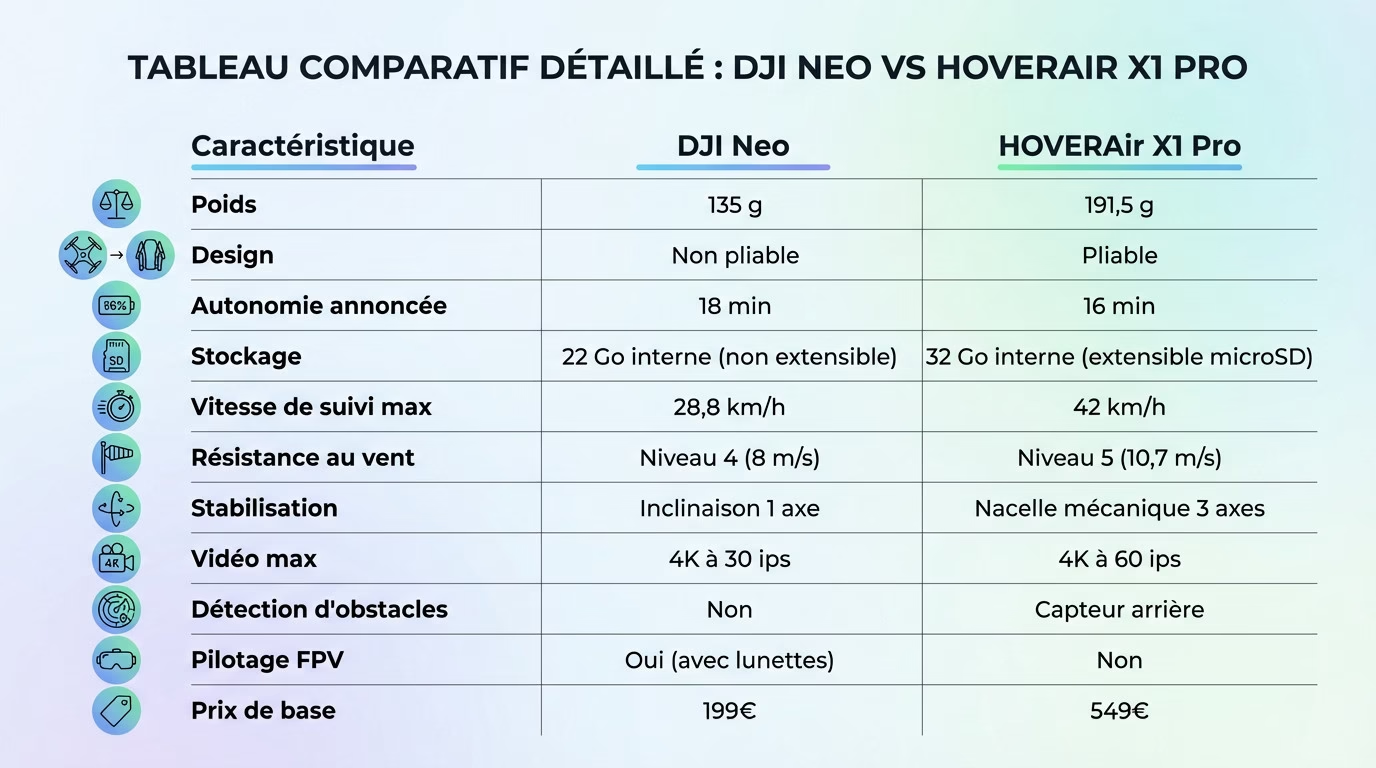
To make your choice, forget the marketing and look at the facts. This table compares the actual technical specifications to highlight the striking differences between these two devices.
| Characteristic | DJI Neo | HOVERAir X1 Pro |
|---|---|---|
| Weight | 135 g | 191.5 g |
| Design | Non-folding | Foldable |
| Advertised range | 18 min | 16 min |
| Storage | 22 GB (fixed) | 32 GB (+ microSD) |
| Maximum tracking speed | 28.8 km/h | 42 km/h |
| Wind resistance | Level 4 (8 m/s) | Level 5 (10.7 m/s) |
| Stabilization | 1 axis | 3-axis platform |
| Max Video | 4K at 30 fps | 4K at 60 fps |
| Obstacles | No | Rear sensor |
| FPV | Yes (glasses) | No |
| Starting price | €199 | €549 |
The conclusion is undeniable. On one hand, the versatile accessibility of DJI, on the other, the raw and specialized performance of the HoverAir.
Design and handling: the drone that follows you everywhere
Enough with the technical details, let’s get down to brass tacks. Let’s see which of these devices fits best in your pocket and hands on a daily basis.
Foldable or ultra-lightweight, the transport dilemma
The HoverAir X1 Pro scores a decisive point with its foldable design. Even at 191.5g, it disappears into a pocket, perfect for taking your Djineo HoverAir X1 selfie drone out on the spur of the moment.
The DJI Neo boasts a lightweight design at just 135g. However, its rigid structure makes it bulkier. So you have to choose between the compactness of the X1 Pro and the lightness of the Neo.
Storage, a detail that changes everything
For storage, the X1 Pro offers 32GB of internal memory. Most importantly, its microSD card slot allows you to expand the memory up to 1TB. This is a huge safety net for large-scale shoots.
The DJI Neo, however, remains limited to 22GB without any expansion. You’ll have to clear the memory very often, which quickly becomes a major inconvenience when you’re on the go.
Actual battery life: how long does it take to take selfies?
On paper, the Neo leads with 18 minutes against 16. The reality is more nuanced: expect 13 to 14 real minutes for the DJI, compared to 11 to 13 for the X1 Pro.
The difference is minimal. Moreover, the X1 Pro stands out with its optional “Thermo Smart” battery, an essential feature for filming in extreme cold down to -20°C.
Flight performance: who can go the distance (and withstand the wind)?
A selfie drone is great when it’s portable, but it’s even better when it stays stable and can follow you.
Tracking speed: the HoverAir X1 Pro’s key advantage
In this djineo hoverairx1 selfie drone duel, the X1 Pro takes the lead with a top speed of 42 km/h.
It’s perfect for cycling or sprinting: it doesn’t let you down. In contrast, the DJI Neo tops out at 28.8 km/h. It’s suitable for a leisurely walk, but loses tracking if you accelerate too much.
Wind resistance and safety
Facing the elements, the X1 Pro withstands level 5 gusts (10.7 m/s) without flinching, compared to level 4 (8 m/s) for the Neo. At the seaside, this robustness is immediately reassuring.
In terms of safety, the X1 Pro scores even more points thanks to its rear obstacle sensor, which is absent on the Neo. You can let it reverse in follow mode without fear of hitting a tree.
Intelligent flight modes
While both devices excel in their autonomous modes, the management of these functions reveals two very distinct philosophies.
- Settings on the HoverAir X1 Pro: You manage the height and distance directly on the device.
- Settings on the DJI Neo: Using the smartphone app is mandatory here.
- User experience: It’s faster on the X1 Pro, whereas the Neo requires more clicks.
The X1 Pro’s approach is therefore more direct, ideal for “on-the-fly” use.
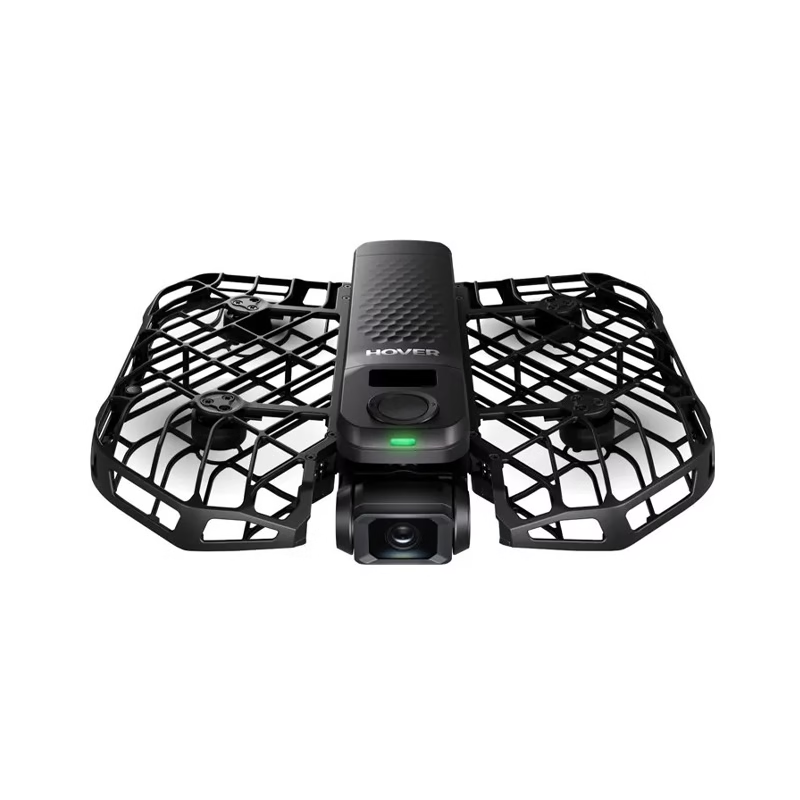
Image and video quality: the key to success for your content
But good tracking isn’t everything. The quality of the image you bring back is what really matters in the end.
Image stabilization: the secret to a smooth image
Here, the difference is striking. The HoverAir X1 Pro features a true 3-axis mechanical gimbal. This guarantees perfectly stable images, even in windy conditions or with sudden movements.
In contrast, the DJI Neo uses only a single mechanical axis for tilt. The rest is handled electronically (EIS). The result is acceptable, but noticeably less refined than on the X1 Pro.
Resolution and format: the X1 Pro takes the lead
In terms of raw video quality, the X1 Pro widens the gap even further in this djineo hoverairx1 selfie drone duel.
- HoverAir X1 Pro: 4K up to 60 frames per second, vertical format in 2.7K at 60 fps, throughput of 100 Mbps.
- DJI Neo: 4K limited to 30 frames per second, vertical format in 1080p, bitrate of 75 Mbps.
This results in smoother slow motion, better quality vertical videos for social media, and an overall image richer in detail.
The FPV experience, exclusive to the DJI Neo
The DJI Neo has a unique feature: its compatibility with DJI’s FPV goggles. This transforms this small selfie drone into a machine for learning immersive flight.
It’s a versatile asset that takes it out of the simple “selfie drone” category. It’s a gateway to other types of piloting, much like the comparison between the Antigravity A1 and the DJI Avata 2 .
Management and budget: two philosophies, one choice to be made
We’ve seen the design and the image. Two crucial points remain before we pull out our credit cards: the verification and the bill.
Control: classic radio control or modular remote control?
The DJI Neo caters to the traditional pilot. Compatible with standard remote controllers, it offers an impressive range of 10 km (FCC). It’s ideal for experiencing true manual piloting and complete freedom.
Opposite it, the HoverAir X1 Pro unveils its “Beacon.” This modular remote control, usable alone or with joysticks, is designed for discretion. Its range is limited to 1 km, but the idea is clear: to prioritize close and immediate control.
The price: a wide gap between affordable and premium
This is often where the game turns. Budget remains the decisive factor, depending on your financial situation.
- DJI Neo: Standard pack at €199, Fly More pack at €349, Motion Fly More (FPV) pack at €529.
- HoverAir X1 Pro: Standard pack at €549, and specialized packs (bike, ski…) which can exceed €1200.
The conclusion is undeniable: the DJI Neo is far more affordable. Its most expensive package costs less than the entry-level price of the X1 Pro.
So, who is each drone designed for?
The DJI Neo is a smart option for a first selfie drone. On a tight budget or looking for FPV? It’s a great all-around choice without breaking the bank.
The HoverAir X1 Pro is aimed at those who refuse to compromise on video. It’s a tool for demanding creators, as seen in Drone & Cam’s reviews and guides . Pure performance comes at a price.
The final choice depends mainly on your budget and intended use. If you’re looking for an affordable drone to get started with FPV, the DJI Neo is unbeatable. However, if image quality and sports tracking are your priorities, consider the HoverAir X1 Pro. It’s an investment, but the results are superior.


Leave a Reply