
Are you still hesitating between the DJI Mini 5 Pro and the Autel Nano+ and worried about making the wrong choice for your next drone weighing less than 250 grams? We’ve compared the real-world capabilities of these two devices to see if the new model’s 1-inch sensor truly blows the competition away. See what really sets them apart to determine which one is worth your investment before you take off.
- The sensor war: Does the Mini 5 Pro knock out the Autel Nano+?
- In flight: agility and safety, who dominates the sky?
- Head-to-head technical specifications: a summary for those in a hurry
- The context that changes everything: legislation and geopolitical risks
- Verdict: Which sub-250g drone is right for you in 2025?
The sensor war: Does the Mini 5 Pro knock out the Autel Nano+?
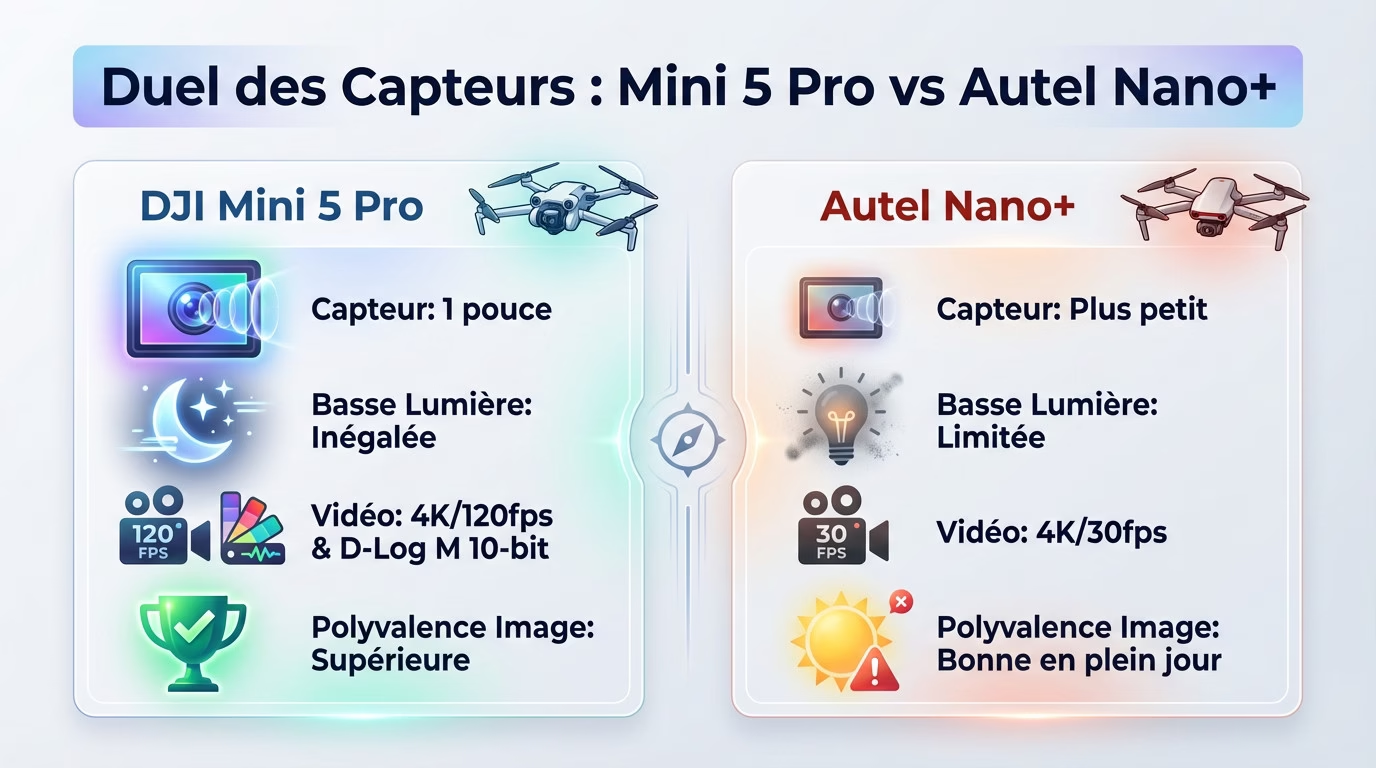
The DJI’s 1-inch sensor: the difference between seeing and guessing
The DJI Mini 5 Pro features a massive 1-inch sensor. This isn’t just a technical detail, but a major advancement in its weight class. It’s what sets it apart from the current competition.
In practical terms, it makes all the difference for the user when the light fades. You get much cleaner images, with significantly less digital noise once the sun has set. This is a huge advantage for your filming.
For anyone who takes image quality seriously, the debate is practically over here. We find a technical feature inherited from much larger and more expensive drones. It’s the standard you’ve been waiting for.
Autel Nano+: a beautiful image, but only in the right light
The Autel Nano+ remains a capable machine with its dedicated sensor. It produces very beautiful images in good conditions, with flattering colors and good sharpness. Its performance in bright daylight shouldn’t be underestimated.
However, as soon as the light dims, it can’t compete. The smaller sensor quickly reveals its physical limitations. Noise appears more rapidly, and details in the shadows are irretrievably lost.
It’s a good drone, but it plays in a lower category in terms of image versatility.
Video and photo: when the numbers really speak for themselves
The Mini 5 Pro allows you to film in 4K at up to 120 frames per second. This finally opens the door to smooth, professional slow motion, an option completely absent on the Nano+.
In contrast, the Autel Nano+ is limited to 4K/30fps. This is perfectly fine for standard shots, but limiting for creative possibilities. Furthermore, only the DJI offers 10-bit color depth.
- 1-inch low-light sensor
- 4K up to 120 frames per second
- D-Log M 10-bit color profile
- High-resolution photos with more detail
In flight: agility and safety, who dominates the sky?
Okay, in terms of image quality, the Mini 5 Pro has taken the lead. But a drone can fly. Let’s see who performs best once airborne.
The LiDAR of the Mini 5 Pro: a virtually infallible safety bubble
In this DJI Mini 5 Pro vs. Autel Nano+ comparison, the DJI comes out on top with its omnidirectional avoidance system and LiDAR. Unlike conventional cameras, this technology works day and night, providing 24/7 active protection.
The Autel Nano+, on the other hand, only has three-way sensors: front, rear, and bottom. It’s a good basic system, but be aware that it leaves blind spots to the sides and top.
For automatic tracking or complex flights in the forest, the DJI system is much more reassuring.
O4 transmission versus SkyLink: who’s keeping the connection?
The OcuSync 4 (O4) system of the DJI Mini 5 Pro is incredibly stable. Its theoretical range is superior and it almost completely ignores interference, which is fantastic in urban environments.
Autel’s SkyLink remains very efficient with excellent video quality. For most everyday uses, it’s more than adequate and won’t let you down.
However, the O4 offers an extra margin of safety for those who like to push the limits of range.
Autonomy: the marathon runner versus the sprinter
The theoretical figures are striking: up to 45 minutes for the DJI Mini 5 Pro with its “Plus” battery, compared to 28 minutes for the Autel Nano+. That’s a considerable difference on paper.
But be warned, these figures are optimistic. In practice, you can expect around 35 minutes for the DJI and 22-24 minutes for the Autel. The difference remains significant and is noticeable in real-world use.
Head-to-head technical specifications: a summary for those in a hurry
Feelings are all well and good, but raw numbers help to see things clearly. Let’s put it all in black and white.
The large comparative table
Here is a technical summary to visualize the forces at play. This table summarizes the essentials.
| Characteristic | DJI Mini 5 Pro | Autel Nano+ |
|---|---|---|
| Weight | <249 g | <249 g |
| Sensor size | 1 inch | 1/1.28 inch |
| Maximum video resolution | 4K/120fps | 4K/30fps |
| Photo resolution | 50 MP | 50 MP |
| Maximum autonomy | 45 min | 28 min |
| Detection system | Omnidirectional LiDAR | Three-way visual |
| Transmission range | 20 km (O4) | 10 km (SkyLink) |
| vertical gondola rotation | Yes | No |
| Price (approx.) | ~€740 | ~€680 |
On paper, the DJI Mini 5 Pro vs. Autel Nano+ comparison is a short-lived affair. DJI dominates with battery life and LiDAR. The Autel salvages some ground thanks to its price, but its technology is outdated.
This technical specification marks a break from the previous Mini 4 Pro , placing the Mini 5 Pro in a different category than the Nano+.
DJI is clearly pushing its ‘mini’ models towards professional standards, as confirmed by our other comparisons of the DJI range .
The context that changes everything: legislation and geopolitical risks
On paper, the match seems over. But a drone doesn’t fly in a vacuum. The legal and political context could completely change the game.
The “DJI case” in the USA: why the Autel is becoming a strategic option
In the United States, the NDAA law is shaking up the current market. DJI finds itself in the crosshairs of federal authorities for national security reasons. While this mainly affects government agencies for now, uncertainty also hangs over the general public. The level of uncertainty is rising.
This is where the Autel Nano+ scores decisive points. It currently avoids the harshest sanctions and appeals to those who fear future blocking. Furthermore, the brand doesn’t impose strict geofencing to restrict your access.
Here’s why some pilots are switching to Autel across the Atlantic:
- Not affected by the NDAA’s immediate restrictions.
- Absence of restrictive geofencing (No-Fly Zones).
- Brand perceived as more “open”.
And in Europe? The C0/C1 class shuffle
For us, the issue is different and revolves around CE certification. Everything hinges on the aircraft’s lightweight takeoff weight. This is the key criterion for flying freely without undergoing complex training.
The DJI Mini 5 Pro vs. Autel Nano+ duel is a battle of grams. Both are aiming for CO2 emissions, the holy grail for flying almost anywhere, even over people. It’s the ultimate freedom for nomadic creators.
But be careful with accessories or a “Plus” battery on the DJI. If you exceed 250g, you’ll fall into category C1 with stricter regulations. Double-check your setup before taking off to ensure you remain legal.
Accessibility and sustainability: is your money safe?
Investing today requires looking a little further ahead. Will political tensions block software updates or spare parts? It’s a legitimate question to ask before reaching for your credit card.
Let’s be realistic, the risk remains low in Europe for the time being. DJI has a massive distribution network and technical support across the continent. Conversely, Autel has a smaller presence, which could complicate after-sales service in case of a problem.
For a European pilot, DJI’s dominance is reassuring today. Paradoxically, it’s also a guarantee of safety for the product’s lifespan.
Verdict: Which sub-250g drone is right for you in 2025?
Now that we have all the cards in hand — the technology, the performance and the context — it is time to answer the only question that matters: which one to buy?
For the discerning content creator: the choice is easy.
The verdict is clear for this profile. The DJI Mini 5 Pro is the only logical choice. Image quality is the absolute priority.
Its 1-inch sensor is a game-changer with incredible dynamic range. You get 4K/120fps and 10-bit color depth, essential tools for professionals. The Autel Nano+ simply can’t compete in this area.
For this type of user, the complete DJI drone ecosystem is also an advantage.
For the enthusiast who wants peace (and simplicity)
Here, the DJI Mini 5 Pro vs. Autel Nano+ comparison is much closer. The Autel Nano+ has some real advantages. Its ease of use is a major plus.
What’s particularly appreciated is the absence of restrictive geofencing, which is often frustrating elsewhere. For someone who just wants to fly without the hassle of pre-registered permissions, it’s a real convenience.
However, the Mini 5 Pro’s omnidirectional safety is a compelling argument for beginners. Less stress, less risk of crashing. The choice depends on your priority: freedom or maximum safety.
The choice of budget: prices and available packages
Let’s address the crux of the matter: the price. The DJI Mini 5 Pro, with its superior technology, is logically positioned at a higher price.
The Autel Nano+ is often more aggressively priced. It represents a more accessible entry point into the world of quality drones. It offers excellent value for money given its performance.
- The DJI Mini 5 Pro: for those who have the budget and want the best.
- The Autel Nano+: the smart choice for a tighter budget without sacrificing the essentials.
- The “Fly More” pack: always recommended for having several batteries, regardless of the brand.
In short, the DJI Mini 5 Pro reigns supreme in its category if you’re looking for pure performance and safety. It’s the choice of professionals. But don’t overlook the Autel Nano+: it remains an excellent alternative, more affordable and without flight restrictions. The choice is yours, depending on your budget and priorities.





Leave a Reply