

The mid-range drone market is booming. Brands are competing with each other to offer high-performance devices at still-affordable prices. Are you hesitating between the DJI Air 3 and the Autel EVO Lite+ ? Good news: we’re going to analyze their strengths and limitations, step by step, to help you choose the drone that best suits your needs.

DJI Air 3 vs Autel EVO Lite+: Design and Construction
Need a drone that’s easy to carry? The DJI Air 3 was designed for just that: compact and foldable, it fits easily into a backpack. It’s the perfect companion for travel and impromptu outings.
The Autel EVO Lite+ , for its part, also adopts a foldable design. It seems a little more robust and slightly more imposing than the DJI, which can inspire confidence in the field. In terms of build quality, both models are top-notch: solid materials, careful finishing… In short, nothing to complain about.

DJI Air 3 vs Autel EVO Lite+: Video and Photo Quality
This is often the number one criterion when buying a drone. So, which one really stands out?
The DJI Air 3 features a dual-camera system, with two identical 1/1.3-inch CMOS sensors (48 MP each): one wide-angle and one medium telephoto. This setup offers excellent detail, strong dynamic range, and consistent image quality across focal lengths. Video recording goes up to 4K/60fps, with accurate color reproduction and reliable autofocus. The dual-camera design adds real creative flexibility, especially for video creators.
The Autel EVO Lite+ is equipped with a single 1-inch sensor, which is larger than the Air 3’s sensors and traditionally advantageous for image quality. It produces very clean images, sharp photos, and smooth video, particularly in low-light conditions, where the larger sensor and variable aperture can be beneficial.
In practice, the difference is more nuanced than sensor size alone. While the EVO Lite+ can have an edge in pure low-light scenarios, the DJI Air 3 compensates with modern sensor processing, excellent stabilization, strong HDR performance, and the versatility of its dual-camera system.
Bottom line:
If you prioritize creative flexibility, dual focal lengths, and a cinematic workflow, the DJI Air 3 has a clear advantage.
If you prefer simplicity and a larger single sensor, especially for low-light shooting, the Autel EVO Lite+ remains an excellent choice.
Flight Autonomy and Performance
A good drone is also one that stays in the air for a long time. Here, both models hold their own:
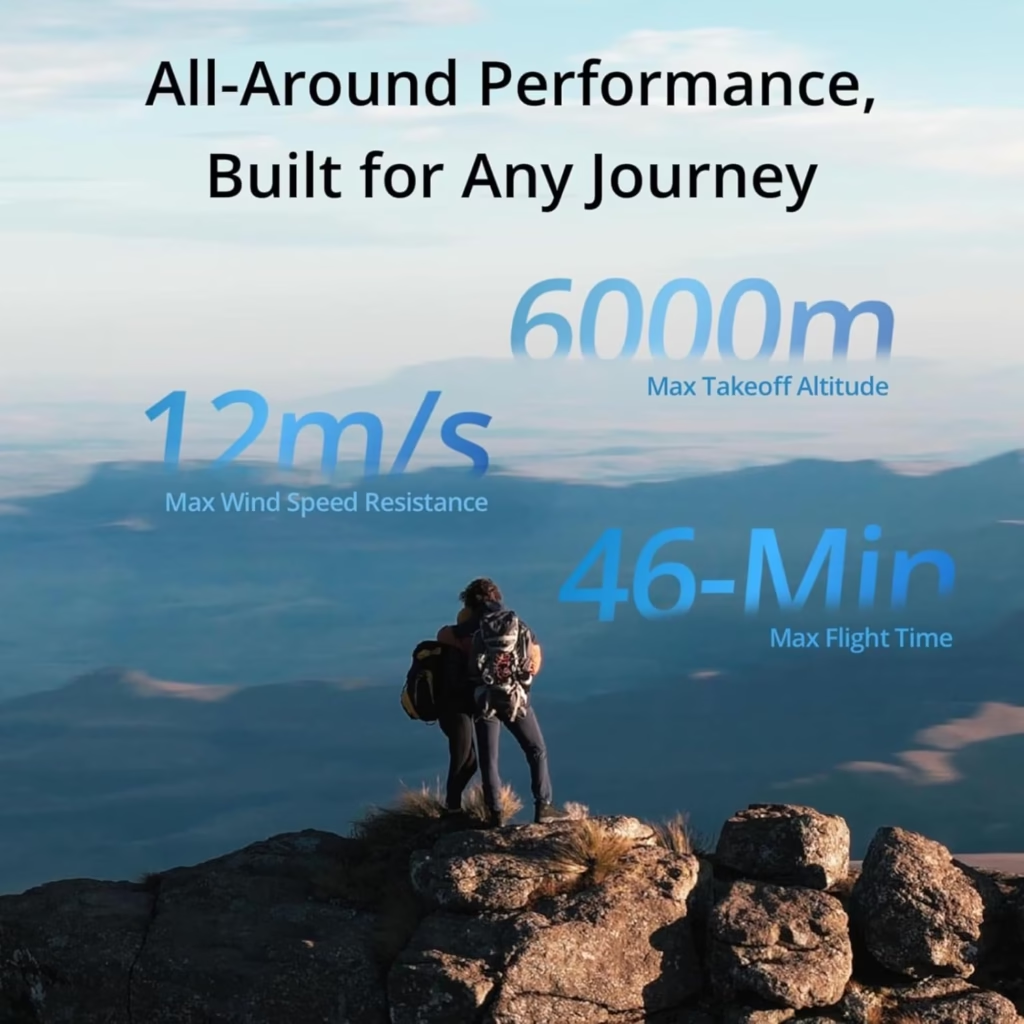
- The DJI Air 3 offers extended battery life, often exceeding 40 minutes in good conditions. This is perfect for filming long sequences without stress.
- The Autel EVO Lite+ offers similar battery life, sometimes a little less depending on the settings used. But honestly, you’ll have plenty of time to make your plans before needing to recharge.
In terms of flight, both are stable, even in windy conditions. However, DJI has a well-established reputation for stabilization and smoothness, which is reassuring for beginners and more experienced users alike.
Features and Application
Today, a drone isn’t just a flying camera: it also has to be smart. The good news is that both models are packed with useful features.
- The DJI Air 3 features ActiveTrack , a highly efficient automatic tracking feature. You can also enjoy numerous creative flight modes (QuickShots, Waypoints, etc.) and automatic return to home.
- The Autel EVO Lite+ also offers powerful subject tracking and similar smart modes. Its app is intuitive, clear, and pleasant to use.
Tip: If you want a complete and easy-to-use ecosystem, DJI often comes out on top thanks to its DJI Fly app. But Autel really has nothing to be ashamed of.
DJI Air 3 vs Autel EVO Lite+: Price and Availability
Let’s not lie to ourselves: price plays a huge role in the final decision.
- The DJI Air 3 is priced a bit higher, but it justifies this difference with its more advanced cameras and advanced features.
- The Autel EVO Lite+ is generally more affordable, yet still offers excellent quality. It’s a great alternative if you’re on a budget.
A useful reflex: before buying, compare the available packs (with or without accessories, additional batteries, etc.), because this can vary the final price.
DJI Air 3 vs Autel EVO Lite+ Comparison Chart
| Characteristic | DJI Air 3 | Autel EVO Lite+ |
|---|---|---|
| Design | Compact, foldable | Robust, foldable |
| Camera | Dual camera, larger main sensor | 1 inch sensor |
| Video | 4K/60fps, excellent in low light | 4K/60fps, very good quality |
| Autonomy | Up to 46 minutes | Up to 40 minutes |
| Flight stability | Excellent | Very good |
| Subject Tracking | Powerful ActiveTrack | Equivalent follow-up |
| Mobile application | DJI Fly, very intuitive | Sky Altar, clear and simple |
| Indicative price | Higher | More affordable |

Conclusion: which one to choose?
So, DJI Air 3 or Autel EVO Lite+? It all depends on your priorities:
- Do you want the best in image quality, solid battery life and an ultra-smooth application? The DJI Air 3 is made for you.
- Do you want a reliable drone with a great camera and a lower price? The Autel EVO Lite+ will be your best ally.
Don’t hesitate to think about your primary use: travel, content creation, leisure, or starting a career in video. Once that’s clear, all you have to do is choose. And there you have it, you’re ready to take off with the drone that suits you best!


Leave a Reply