
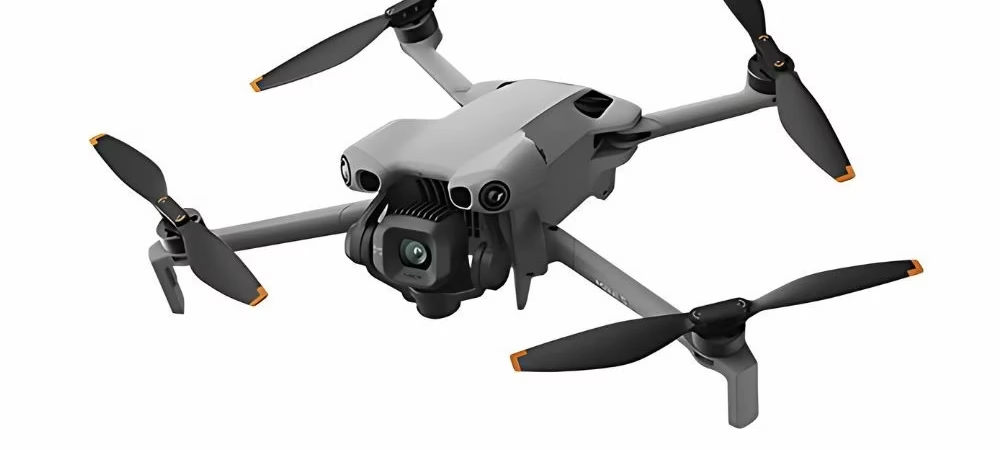
You might think that a lightweight drone exempts you from the 250g weight limit, but this misjudgment could cost you dearly. This article explains exactly what the DJI Mini 5 Pro allows you to do to fly legally without any hassle. Check out the freedoms offered by Class C0 and the hidden pitfalls to absolutely avoid.
- The mandatory procedures even for a lightweight
- The status of the DJI Mini 5 Pro: Class C0 and its implications
- The golden rules of flight: what you should always keep in mind
- Stealing in the city and near people: the grey areas to master
- Restricted areas and penalties: what you really risk
The mandatory procedures even for a lightweight
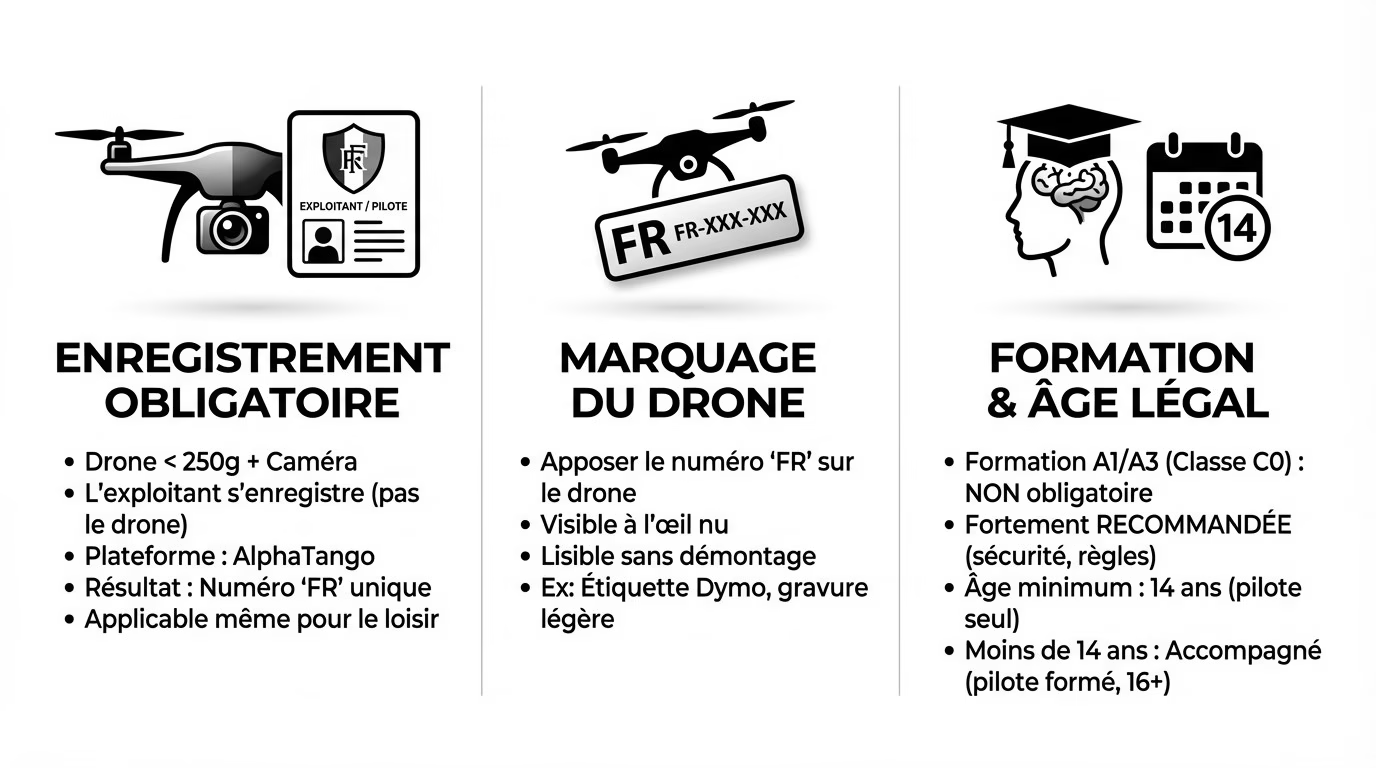
Many enthusiasts mistakenly believe that the DJI Mini 5 Pro’s light weight exempts them from all paperwork. Big mistake. What matters here is the camera. As soon as your device captures images, the 250g drone regulations require recording.
Registering as an operator: the essential first step
Don’t be fooled by the drone’s lightweight design; it doesn’t give you carte blanche. The golden rule concerns the presence of a video sensor. Since the drone can record personal data, you are required to register it.
Go to the AlphaTango portal to complete this simple process. Please note that you are not registering the drone itself, but rather yourself as the operator. At the end of the process, you will receive a unique number starting with “FR”.
This is a step you cannot ignore, even if you’re flying on a Sunday in an empty field. It’s your first responsibility as a pilot.
Drone marking: how to display your operator number
Once you have your “FR” number, it absolutely must not remain dormant in your inbox. You are required to physically affix it to your DJI Mini 5 Pro before your first flight.
The requirement is simple: this number must be legible to the naked eye during a quick inspection. Tip: a Dymo label works perfectly, but a simple self-adhesive label with neat writing in permanent marker is perfectly adequate.
Keep in mind that this marking must be visible without having to disassemble anything. There’s no need to hide it in the battery compartment.
Training and legal age: who can drive the Mini 5 Pro?
Let’s talk training: for a C0 class drone like yours, the A1/A3 theoretical certificate is not technically required by law. You could fly without it.
However, I strongly recommend you take it anyway. It’s free and it’s the only way to truly understand where you’re putting the propellers to avoid problems. It’s the reflex of a smart pilot.
Finally, please note the minimum age: you must be at least 14 years old to fly solo. For those under 14, a trained supervisor aged 16 or older is required.
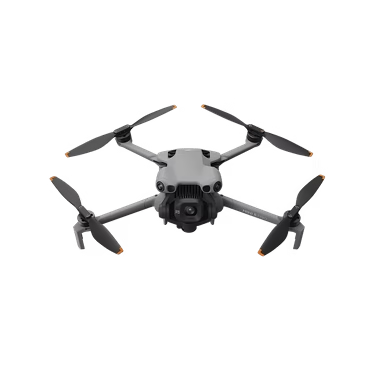
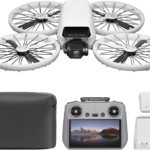
DJI Mini 5 Pro
The next generation ultra-compact drone from DJI. High-quality video, advanced stabilization, intelligent tracking and enhanced security — all in a lightweight and portable format.
Discover more on DJI →The status of the DJI Mini 5 Pro: Class C0 and its implications
Now that the administrative basics are in place, let’s see what the technical classification of the Mini 5 Pro actually changes on the ground.
Understanding class C0 of European regulations
You’ve probably noticed the CE marking on the box. This symbol defines the capabilities and limitations of your device. The DJI Mini 5 Pro falls into the lightest category: class C0.
In practical terms, C0 means that the drone weighs less than 250g and has a safe design. This specific classification allows it to fall under subcategory A1, the most permissive zone in the 250g drone regulations.
This is a major advantage compared to more complex models. It simplifies everything if you’re looking to understand the common European regulation (EASA) without stress.
The freedoms (and limitations) of category A1 flight
Class C0 places the Mini 5 Pro directly into category A1, known as “flight over people”. But be careful, this term can be misleading.
Flying over isolated individuals is tolerated, but under one strict condition: it must be unintentional and brief. If this happens, you must maneuver to move away quickly. This is a piloting flexibility, not an absolute right.
Here’s the line you must never cross: flying over gatherings of people is strictly prohibited. Whether it’s a market or a concert, you stay away. That’s the key difference to avoid trouble.
| Ruler | Class C0 drone (< 250g) like the DJI Mini 5 Pro | Class C1 drone (> 250g) |
|---|---|---|
| Operator registration | Required (if camera) | Mandatory |
| Online training A1/A3 | Recommended | Mandatory |
| Flyover of isolated individuals | Tolerated if unintentional and brief | Forbidden |
| Aerial view of gatherings | Strictly prohibited | Strictly prohibited |
| Remote ID | Not required | Required |
No “Remote ID”: one less thing for the pilot to worry about.
Have you heard of “Remote ID”? It’s an electronic identification system that broadcasts the drone’s identity and position in real time, a bit like a digital license plate.
Good news for you: C0 class drones, like the Mini 5 Pro, are completely exempt from this requirement. This is a significant technical and administrative simplification for flying light.
This is a tangible advantage that lightens your mental load. You don’t have to worry about the broadcast’s compliance before takeoff.
The golden rules of flight: what you should always keep in mind
Visual line-of-sight (VLOS): a non-negotiable constraint
The principle is simple in the 250g drone regulations: you must always be able to see your device with the naked eye. No binoculars, no intermediaries. If the drone disappears behind a tree or a building, you are technically breaking the law and putting the safety of others at risk.
Warning: the remote control screen is not a substitute for direct vision. Your gaze must constantly shift between the sky and the video feed to monitor your surroundings. This is the only reliable way to avoid a bird or another aircraft that might suddenly appear without warning.
This inevitably limits the flight distance, regardless of the theoretical range of the Mini 5 Pro’s O4 transmission. This is very different from first-person view (FPV) flight , which requires an observer next to you.
The ceiling of 120 meters: a height not to be exceeded
European regulations set a strict limit: a maximum height of 120 meters above the takeoff point or the ground. This measurement is calculated from the point closest to the Earth’s surface to allow a safety margin for manned aviation.
The key to understanding this is terrain following. If you fly your drone uphill, the 120 meters are measured from the ground directly below the drone. Therefore, you must adjust your altitude in real time and remain vigilant if the terrain suddenly rises or falls.
There is a micro-tolerance for flying over an artificial obstacle of more than 105 meters, but let’s be honest: this is an ultra-rare and complex case for standard recreational use.
The ban on night flights: a simple but strict rule
In the Open category, it’s a no-go: night flying is strictly prohibited in France. There’s no point in looking for a loophole or playing with fire; the rule is clear to ensure the overall safety of the airspace.
But be careful with the precise definition of “aeronautical night”. It’s not just when it’s dark. You’re allowed to fly 30 minutes before sunrise and 30 minutes after sunset, which gives you just enough time for the blue hour.
Even though the DJI Mini 5 Pro’s sensor performs exceptionally well in low light, it doesn’t change the law. Don’t be tempted by the device’s technical capabilities, because breaking the law here can be very costly.
- Keep the drone in sight at all times.
- Never exceed 120 meters in height.
- Fly only during the day (with twilight tolerance).
DJI Mini 5 Pro
The next generation ultra-compact drone from DJI. High-quality video, advanced stabilization, intelligent tracking and enhanced security — all in a lightweight and portable format.
Discover more on DJI →Stealing in the city and near people: the grey areas to master
General rules are one thing, but the reality on the ground, especially in populated areas, is often more complex.
The puzzle of theft in urban areas
In principle, flying over public spaces in urban areas is strictly prohibited in the Open category. Even with a very lightweight drone (<250g), the regulations do not grant you an exemption to film the street.
There is only one theoretical “exception”: flying over private land, while strictly remaining within the property boundaries. This is very restrictive and, let’s be honest, often impossible in practice if you want to get interesting shots.
For most urban scenarios, flying in the Open category is therefore not an option. You have to switch to the Specific category, which is a completely different story.
Respect for privacy: a legal and moral limit
The Mini 5 Pro’s camera is powerful. With this power comes the responsibility to respect the privacy of others, a golden rule never to be forgotten.
Here’s what’s prohibited: filming people in their gardens, peering through their windows, or capturing identifiable license plates without permission. The right to privacy and property rights apply here without exception.
A word of common sense: if you wouldn’t do it with a camera on the ground, don’t do it with a drone in the air.
Civil liability insurance: not mandatory, but essential
Let’s clarify the insurance status for recreational use with a drone weighing less than 250g: it is not legally required. You have the right to fly without it.
However, it’s madness to fly without insurance. An accident can happen quickly, like falling onto a car or damaging a veranda. The costs can be astronomical, and you’ll have to pay out of pocket.
Check your home insurance policy now. Often, civil liability coverage includes model aircraft flying, but it’s essential to confirm this in writing.
Restricted areas and penalties: what you really risk
Knowing how to fly is one thing, but knowing WHERE to fly (and especially where not to fly) is just as important to avoid big trouble.
Géoportail: the essential step to take before every takeoff
Forget about inaccurate maps. In France, the only reliable source for recreational pilots is Géoportail. It’s the official tool you absolutely must consult before even turning on your DJI Mini 5 Pro.
The color code is clear: if the zone is red, flying is prohibited. These restrictions protect sensitive sites, and in the Open category, no exceptions are possible. It’s a strict ban, regardless of the drone’s weight.
Don’t play innocent. In court, saying “I didn’t know” will never save you from conviction.
No-fly zones you need to know by heart
Sometimes, common sense is enough. Even without a map in front of you, some prohibitions are obvious and you should memorize them.
- Airports, airfields and military bases.
- Nuclear power plants and prison facilities.
- National parks and certain protected nature reserves.
- Temporary emergency response zones (fires, accidents).
Remember this: manned aircraft have absolute priority. If you hear a helicopter or airplane approaching, don’t hesitate. Land your drone immediately and as safely as possible.
The penalties: from fines to prison sentences
Drone regulations under 250g are no laughing matter. Violating the rules isn’t a simple administrative detail; it’s a crime that can cost you dearly.
It starts with a €750 fine just for a lack of registration or labeling. But if you fly in a restricted area through negligence, the penalty jumps to €15,000 and six months in prison. That’s a bit of a shock, isn’t it?
Finally, filming your neighbors can land you in criminal court. Your freedom to fly ends where their privacy begins. See the DJI Mini 5 Pro on Amazon or buy the DJI Mini 5 Pro on the official website
The DJI Mini 5 Pro offers incredible freedom, but its lightweight design doesn’t exempt you from the rules. Register on AlphaTango, respect the 120-meter distance, and always keep your drone within visual line of sight. Before each flight, be sure to consult Géoportail to avoid any problems. In short, fly responsibly and with common sense to fully enjoy your sessions.



Leave a Reply