
If you want the short answer, the GoPro 13 is the better pick if you care most about resolution and the GoPro ecosystem, while the DJI Osmo Action 6 is more appealing if you want stronger low-light performance, easier everyday use and very good value. This comparison focuses on the differences that really matter before you buy.
- GoPro 13 vs DJI Osmo Action 6: The duel of sensors and resolution
- Stabilization and fluidity in extreme conditions
- Low-light performance and creative modes
- Ergonomics and autonomy in everyday life
GoPro 13 vs DJI Osmo Action 6: The duel of sensors and resolution
Now that the scene is set, let’s get down to business. Let’s compare the technical inner workings of these two machines to see how they really perform in real-world conditions.
The raw power of the DJI sensor versus the resolution of GoPro
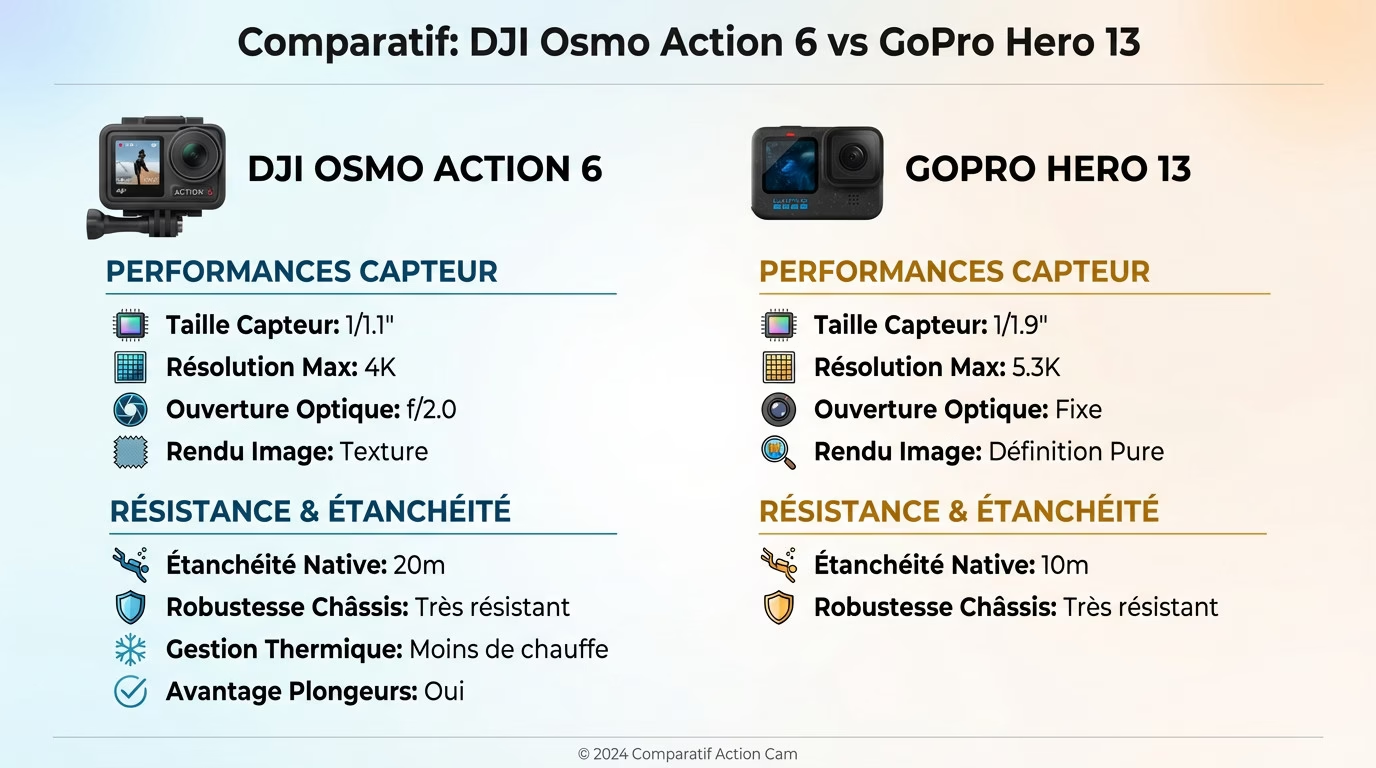
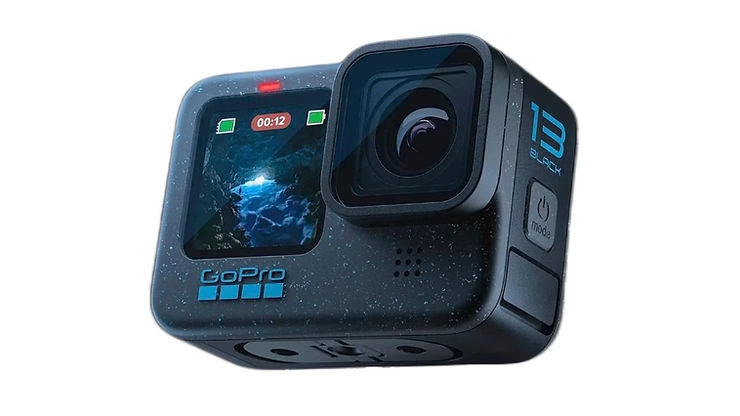
On the hardware side, DJI makes a strong statement with its enormous 1/1.1-inch sensor compared to the GoPro’s more modest 1/1.9-inch sensor . This difference is crucial for capturing as much light as possible. To fully grasp the impact, take a look at our GoPro Hero 13 Black vs. DJI Osmo Action 6 comparison .
However, GoPro maintains the advantage in resolution with its 5.3K. This offers incredible sharpness for cropping, whereas the DJI is limited to 4K. Let’s not forget the lens: DJI offers a very bright f/2.0 aperture, while GoPro only has a fixed aperture.
Brief, DJI focuses on texture and dynamics. GoPro, on the other hand, prioritizes pure definition.
Waterproofing and robustness: which can withstand it best?
Underwater, the DJI can descend to 20 meters without a housing. The GoPro only goes down to 10 meters, which limits the options. This is a major difference for demanding swimmers .
On land, whether mountain biking or surfing, both cameras are incredibly robust and virtually indistinguishable. However, heat management is a game-changer : the DJI Osmo Action 6 handles internal temperature much better. This is a crucial point to consider in our guide : DJI Osmo Action 6 vs GoPro Hero 13 Black: Which One to Choose?
For underwater durability, the DJI has the advantage . Divers will appreciate this freedom.
Want the short version before you buy?
GoPro stays ahead for action, FPV and reframing flexibility. DJI is the easier pick for travel, vlogging and low-light shooting.
Stabilization and fluidity in extreme conditions
HyperSmooth vs RockSteady: The Stability Match
It’s a clash of titans between DJI’s RockSteady and GoPro’s HyperSmooth. On a mountain bike handlebar during a downhill run, the two technologies go head-to-head. The result is undeniably impressive in terms of performance.
Be careful with the GoPro’s linear mode. You might notice some slight, rather annoying stuttering on the Hero 13. In contrast, the DJI Action 6 maintains consistent smoothness . This is a detail that can ruin a shot.
The 360-degree horizon lock is impressive on both models. The image remains perfectly straight even if the camera rotates completely.
Let’s take a closer look at the technologies embedded in these devices. Here are the systems that ensure this stability :
- RockSteady 3.0+ (DJI)
- HyperSmooth 6.0 (GoPro)
- HorizonSteady (DJI)
- Horizon Lock (GoPro)
Why GoPro’s 5.3K saves your FPV edits
Resolution is the key to success in FPV drones. With 5.3K, you can crop your image without losing a single pixel of quality . This is a real advantage for correcting framing in post-production.
The GoPro’s 8:7 aspect ratio is also a game-changer. This almost square sensor allows you to extract both vertical and horizontal content from the same shot . You save a ton of time when adapting your videos.
Let’s talk about the flexibility of the digital zoom. You can zoom in on the 5.3K image to get a perfectly clean 4K rendering. The DJI, with its native 4K sensor, quickly shows its limitations here. The image degrades if you zoom in too far .
For demanding editors, the verdict is clear. The GoPro offers far more creative freedom .
Choose by shooting profile
If you mostly shoot sport, MTB, moto or FPV, the GoPro Hero 13 Black remains the safer, more versatile choice.
Choose the GoPro Hero 13If you care more about travel footage, low-light scenes and everyday ease of use, the DJI is the better fit.
Choose the DJI Osmo Action 6Low-light performance and creative modes
While the GoPro shines in the sun, the situation changes drastically when darkness appears.
Nighttime vlogging: the advantage of the large DJI sensor
Digital noise often ruins everything on small cameras. Fortunately, the DJI’s massive 1/1.1-inch sensor captures a maximum amount of light. Your city footage therefore remains clean , even without studio lighting.
As for the GoPro, the situation is much worse. Its small 1/1.9-inch sensor struggles as soon as the sun sets, producing an unpleasant graininess. Forget this camera for your nighttime vlogs; the results are frankly disappointing .
DJI’s algorithm also works wonders in post-processing. It intelligently cleans up the image without turning your face into a smoothed-out pixel mess .
| Criteria | DJI Osmo Action 6 | GoPro Hero 13 Black |
|---|---|---|
| Sensor | 1/1.1″ | 1/1.9″ |
| Waterproofing | 20m | 10m |
| Maximum Resolution | 4K | 5.3K |
| Stabilization | Rocksteady | HyperSmooth |
| Low Light | Excellent | AVERAGE |
| Price | €399 | €449 |
Extreme slow motion and bursts of light: the GoPro’s playground
The Hero 13 makes a powerful statement with its new slow-motion burst mode. It achieves an incredible speed of 400 frames per second in 720p . This is unprecedented for a consumer action camera.
The DJI Osmo Action 6 doesn’t keep up with this pace. It uses AI interpolation to simulate smoothness, but the result sometimes looks artificial and less sharp than GoPro’s.
Imagine breaking down every millisecond of a skateboard jump. This mode becomes essential for precisely analyzing movement . The absolute fluidity transforms the action into a stunning cinematic sequence.
For pure, hardcore sport, the Hero 13 remains the undisputed queen . It captures the invisible.

Ergonomics and autonomy in everyday life
Fasteners and storage: the little details that make all the difference
DJI’s magnetic system is great for quickly changing mounts . GoPro keeps its classic rods but incorporates a welcome 1/4-20 thread. This is convenient for screwing directly onto a tripod without an adapter.
DJI’s 50GB internal storage is a major advantage. It’s a vital safety net if you forget your SD card or if it fills up mid-shoot. This prevents you from needlessly losing precious images .
DJI screens respond much better in the rain ; it’s noticeably improved. The Mimo app is also very stable for your transfers.
- Magnetic mount (DJI)
- 1/4-20 thread (GoPro)
- 50GB internal storage (DJI)
- Front touchscreen (Both)
Real-world endurance and battery management
The DJI battery has a capacity of 1950 mAh compared to 1900 mAh for the GoPro. The figures are close, but the internal optimization differs significantly . Don’t rely solely on the specifications.
The DJI battery lasts longer thanks to its more energy-efficient processor. Conversely, the GoPro consumes a lot of power in 5.3K mode. That’s the price to pay for that resolution.
GoPro remains compatible with years of existing mounts, which is reassuring for long-time users. DJI imposes its own magnetic accessories, but they are very well designed and quick to use. It’s a change of habit that takes some getting used to .
For long sessions, you absolutely must bring spare GoPro batteries . This is non-negotiable.
In this GoPro Hero 13 vs. DJI Osmo Action 6 comparison, the Hero 13 dominates for FPV drones and extreme slow-motion footage thanks to its 5.3K resolution. If you’re looking for pure action performance, order yours today and turn every outing into a memorable cinematic sequence.
Two excellent action cams, but not for the same kind of creator
Pick the GoPro Hero 13 Black if you want the more reassuring option for action, FPV and post-production flexibility. Pick the DJI Osmo Action 6 if you want the more forgiving camera for travel, low light and casual vlogging.
GoPro Hero 13 Black
Best if you mostly shoot action, faster motion and want the most room to crop and reframe in editing.
View GoPro Hero 13 on Amazon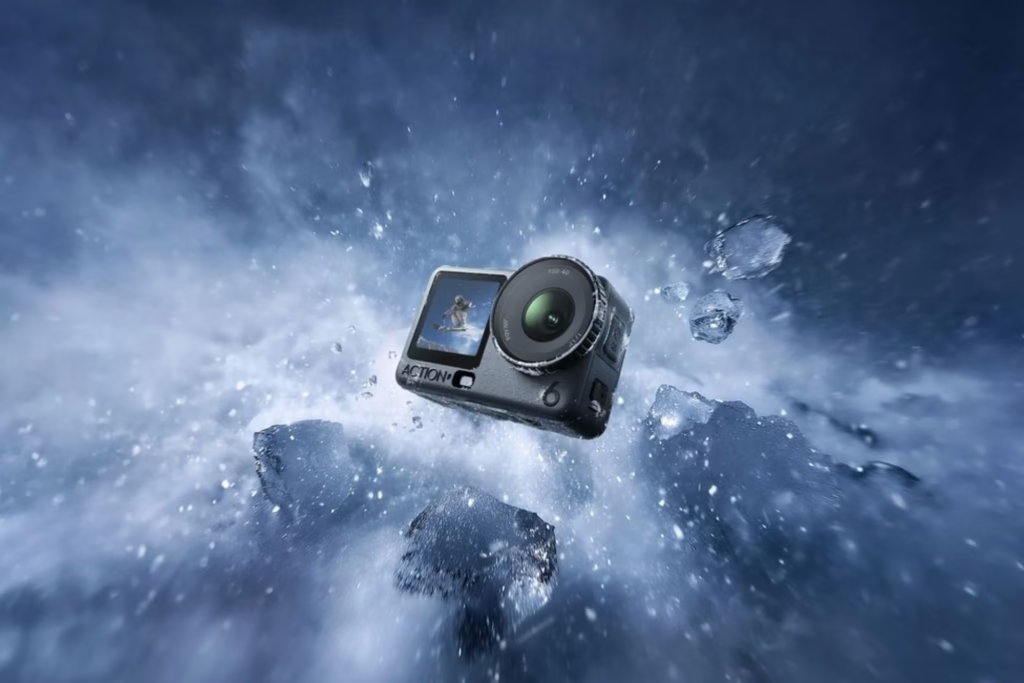
DJI Osmo Action 6
Best if you often shoot in cities, indoors or at the end of the day and want a more flattering image right away.
View DJI Osmo Action 6 on AmazonWhich camera should I choose for filming at night: the GoPro 13 or the DJI Action 6?
Why is the GoPro Hero 13 recommended for FPV drones?
What is the difference in waterproofing between the two models?
Does the DJI Osmo Action 6 really have internal memory?
Which one offers the best slow-motion footage for extreme sports?
Best choice by use case
Action and POV
Choose the GoPro 13 if you care most about aggressive stabilization, action use and cropping flexibility.
Travel and everyday filming
Pick the DJI Osmo Action 6 if you want an easier everyday camera with strong value and better low-light appeal.
Best value
If price matters as much as image quality, DJI often feels like the more balanced buy.
FAQ: GoPro 13 vs DJI Osmo Action 6
Which one is better for cycling, trail running or fast action?
The GoPro 13 is still the safer recommendation if your main focus is action footage, fast motion and rugged outdoor use.
Is the DJI Osmo Action 6 better in low light?
It can be more pleasing in everyday low-light scenes, especially if you want a camera that feels easier to live with outside pure sports use.
Which one should most travelers buy?
If you want a travel-friendly all-rounder, DJI is very compelling. If you want the classic action-cam reference, GoPro remains the benchmark.
Related guides





Leave a Reply