
China, as a world leader in drone manufacturing (notably with the giant DJI), has complex and constantly evolving legislation governing their use. Whether you’re a tourist wanting to capture memories or a professional working on a project, understanding these rules is crucial for flying legally and safely. The main authority in this area is the Civil Aviation Administration of China (CAAC) .
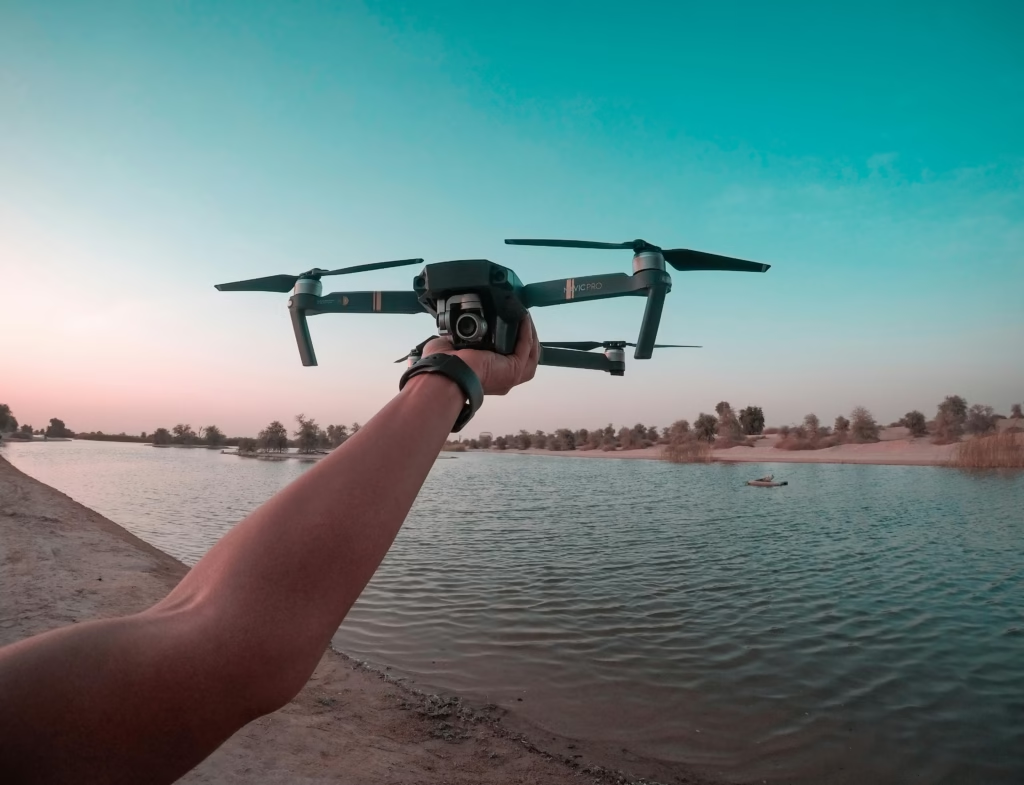
The Fundamental Principles of Chinese Regulation
Chinese legislation rests on a few fundamental pillars. The most important is undoubtedly the registration of almost all drones under their real names . This measure aims to hold pilots accountable and ensure traceability in the event of an incident.
- Mandatory registration: All civilian drones weighing more than 250 grams must be registered with the CAAC. Since most aerial photography drones exceed this weight, this step is almost always required.
- Pilot identification: Registration is done using a valid form of identification (national identity card for Chinese citizens, passport for foreigners).
- Drone marking: Once registration is validated, the owner receives a QR code which must be physically affixed to the drone in a visible manner.
Registration: A Mandatory Step
The registration procedure, although simple in theory, must be followed precisely. It is carried out entirely online on the CAAC platform.
- Account creation: The pilot must go to the CAAC website dedicated to drones (“UAS Cloud”) and create a personal account using their phone number and ID.
- Drone registration: Next, you need to enter the device-specific information, such as the manufacturer’s name, model, and serial number.
- Obtaining the QR code: After validation, a unique QR code is generated. It contains the registration information.
- Affixing to the device: The pilot must print this QR code and affix it to the drone’s fuselage. Failure to do so is an offense, even if the drone is registered online.
Flight Rules to Follow
Beyond registration, pilots must adhere to strict flight rules to ensure airspace safety. These rules are similar to those found in many other countries, but their application in China is particularly rigorous.
- Maximum altitude: Unless specially authorized, it is forbidden to fly above 120 meters above the ground.
- Visual line-of-sight flight (VLOS): The drone must remain constantly within the direct field of vision of its pilot.
- No-Fly Zones: It is strictly forbidden to fly over certain sensitive areas. These include, but are not limited to: airports (within a wide radius), national borders, military zones, government buildings, nuclear power plants, and gatherings of people. Major cities like Beijing and Shanghai have very extensive restrictions.
- Weather conditions: Flying is prohibited in conditions of low visibility, strong winds or precipitation.
- Respect for privacy: It is forbidden to film people or private property without their explicit consent.
Specifics for Foreign Pilots
Foreign tourists and business travelers are subject to the same requirements as Chinese citizens. Passport registration is mandatory. The main difficulty may be the language barrier, as the CAAC platform is primarily in Mandarin. Using online translation tools is often necessary. It is also recommended to familiarize yourself with the specific local regulations of the province or city you are visiting, as additional rules may apply.
Sanctions and Conclusion
Failure to comply with the law can have serious consequences, ranging from a simple fine to confiscation of equipment, or even legal action if public safety is endangered. China takes the security of its airspace very seriously. Therefore, preparation is essential . Before any takeoff, it is imperative to verify that your drone is properly registered, that the QR code is correctly displayed, and that the flight zone is authorized. By consulting flight zone mapping applications (such as DJI’s) and strictly adhering to the rules, it is entirely possible to legally enjoy the Chinese landscapes from the air.




Leave a Reply