
Need to film flawless footage, whether in bright sunlight or at dusk, without juggling formats for your social media? The new DJI Osmo Action 6 arrives with a bold promise: to put an end to this headache . It’s the very first action camera to integrate a variable aperture lens and a square sensor, game-changing innovations for quality and flexibility. Let’s break it down together, step by step, to see if this camera truly lives up to the hype and if it has what it takes to dethrone its competitors.
- The DJI Osmo Action 6 under the hood: more than just an update
- Variable aperture and square sensor: the duo that changes everything
- On-field performance: what the technical specifications don’t tell you
- Facing the competition: the DJI Osmo Action 6 vs GoPro and Insta360 showdown
- Weak points and compromises: what you need to know before buying
- Ecosystem and accessories: how to boost your Osmo Action 6
- Verdict: Who is the DJI Osmo Action 6 made for?

The DJI Osmo Action 6 under the hood: more than just an update
So, is a new action camera every year the norm? Not so fast. While we were expecting a new model from DJI, no one really anticipated what the DJI Osmo Action 6 brings to the table. Forget a simple annual refresh. This isn’t just an improved Action 5 with a few extra percentage points of performance. It’s a complete overhaul .
Two key features are game-changers: a variable aperture lens and a square sensor inherited from 360 technology. Far from being mere marketing gimmicks, these technical choices have a direct and tangible impact on image quality and flexibility. DJI is no longer simply following GoPro; the brand is trying to redefine the rules of the game for all content creators.
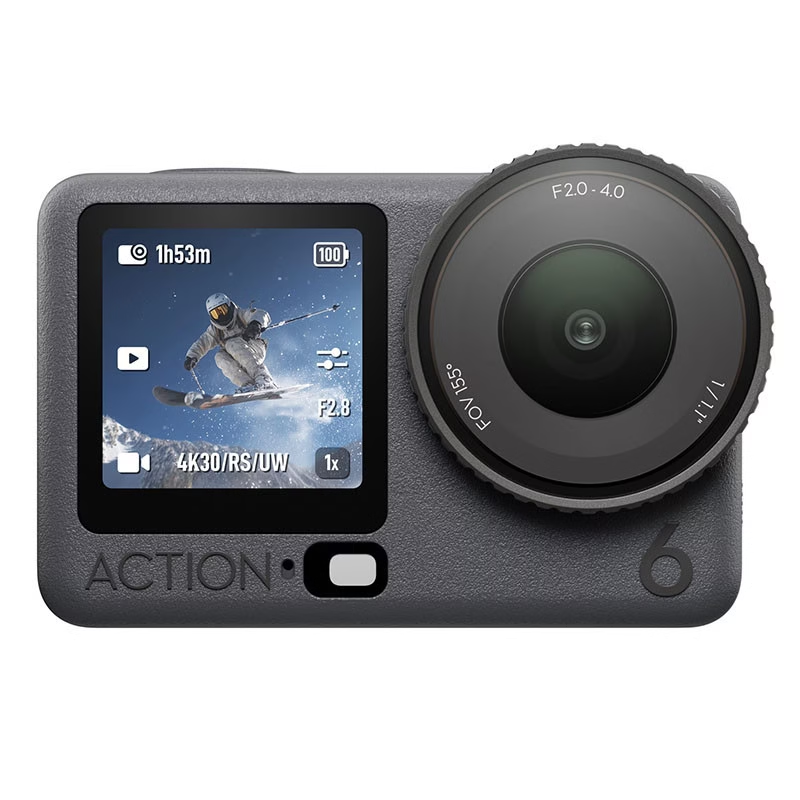
Variable aperture is a small revolution for this camera format. In practical terms, your camera can finally adapt intelligently and physically to the light. No more blown-out skies in bright sunlight or digital noise appearing as soon as the light drops. With an aperture range from f/2.0 to f/4.0, you regain creative control once reserved for larger cameras. The f/2.0 aperture captures maximum light for clean night scenes, while f/4.0 gives you impeccable sharpness across the entire frame on a sunny day, without needing to juggle ND filters.
And that square sensor? It’s not just about the shape. It’s a simple yet powerful promise: you film once, and then you can crop your video for YouTube (16:9 format) or TikTok (9:16 format) without any loss of quality . This advantage is based on a large 1/1.1-inch sensor with 40 megapixels, significantly larger than the previous generation’s. For creators who have to juggle multiple platforms, this represents a monumental gain in time and efficiency. No more choosing your format before filming.
By combining these two new features, the DJI Osmo Action 6 sets itself apart . It no longer competes solely on maximum resolution, but also on intelligent shooting and post-production versatility. Now, let’s see how it performs in real-world situations.
Variable aperture and square sensor: the duo that changes everything
DJI makes a powerful statement with two major advantages that truly set the Osmo Action 6 apart from the competition. Forget the usual compromises. Here, we’re talking about real control over your image , regardless of the conditions. It’s simple, but it radically changes the game in the field.
Variable aperture (f/2.0 – f/4.0): finally, versatility
You know the problem with most action cameras, right? They have a fixed aperture. The result: in bright sunlight, your image is often “blown out,” completely overexposed. And as soon as the light drops, it quickly becomes a pixelated mess. A frustrating, never-ending in-between state .
Good news: the DJI Osmo Action 6 puts an end to this dilemma. Its secret? An adaptive aperture . At f/2.0, the camera lets in as much light as possible, ideal for late afternoon or indoor sessions. Conversely, by switching to f/4.0, it limits the amount of light entering the camera, preventing overexposure in bright sunlight and increasing overall sharpness. No more juggling ND filters. You’re back in control.
This control also becomes creative. You can let the camera manage the aperture on its own, or take the reins in manual mode. This opens up new possibilities, like creating a slight background blur (bokeh) when you’re filming yourself in vlog mode. An effect almost impossible to achieve on competing models. And there you have it!
The 1/1.1-inch square sensor: shoot once, publish everywhere
This is every creator’s dilemma. Should you film horizontally for YouTube? Or switch to vertically for Reels, Shorts, and TikToks? The Osmo Action 6 has a clear answer
The principle is simple and remarkably effective. The camera records a nearly square image at full resolution. Then, in the DJI Mimo app, you choose your aspect ratio. Want 16:9 for YouTube? No problem. Need a 9:16 clip for Instagram? Done. All this without any dramatic loss of quality. This is the “Open Gate” or “Custom 4K” mode. Incredible time savings and flexibility .
Add to that the sensor size (a large 1/1.1 inch) with its large 2.4 μm pixels. The direct result is much better low-light performance and an extended dynamic range that can reach 13.5 stops. The icing on the cake for purists? The 10-bit D-Log M color profile, which gives you immense latitude to fine-tune your colors during editing.
On-field performance: what the technical specifications don’t tell you
Technical specifications are all well and good. But real-world experience is better. So, how does the DJI Osmo Action 6 really perform out of the box? We tested its promising specs for you, and there are some pleasant surprises .
Video and photo quality: is 4K at its peak?
The first thing that strikes you is the video quality. DJI confirms its expertise with 4K at up to 120 frames per second. It’s perfect for creating ultra-smooth slow-motion footage with an impressive level of detail. You can even push it up to 240 fps in 1080p. A smart choice: rather than chasing 5K or 8K, DJI preferred to refine its 4K . And it shows.
On the photography front, it doesn’t disappoint. The 40MP sensor produces highly detailed 7296 x 5472 pixel images . Good news for editing enthusiasts: RAW (DNG) format is included. This is a real plus for those who like to refine their images in post-production without losing quality.
So, what does that mean in practice?
- For vloggers: The variable aperture is a great feature for isolating your face from the background. The dual touchscreen, still as convenient as ever, lets you frame yourself effortlessly.
- For athletes (mountain biking, skiing): The stabilization is simply amazing . The camera absorbs even the most violent shocks without the image shaking. A real tank.
- For the traveler: The flexibility of the square sensor is fantastic. You film a landscape and later easily crop it for your stories or YouTube videos , without sacrificing quality.
Stabilization and horizon: it hasn’t budged an inch.
DJI is back with its proprietary stabilization technologies, RockSteady 3.0+ and HorizonSteady, which are even more refined. The game-changer? HorizonSteady, which keeps the horizon perfectly straight even during loops, now works in 4K at up to 60 fps. This is a major advantage that puts it in a tight race against its competitors .
Autonomy and robustness: ready for adventure?
Need a camera that can go the distance? The 1950 mAh battery promises up to 4 hours of recording in 1080p/24fps. Of course, this number decreases if you push the resolution to 4K/120fps, but the battery life remains very solid . Bonus: it’s also cold-resistant, operating down to -20°C.
Weighing in at 149g, the camera is compact yet feels incredibly robust. Waterproofing has been improved . You can now dive to 20 meters without a housing, 2 meters deeper than the previous version. For deeper explorations, the official housing takes you to 60m. One small detail that makes a difference: the new color temperature sensor on the front adjusts the white balance for more accurate colors, especially underwater.
Facing the competition: the DJI Osmo Action 6 vs GoPro and Insta360 showdown
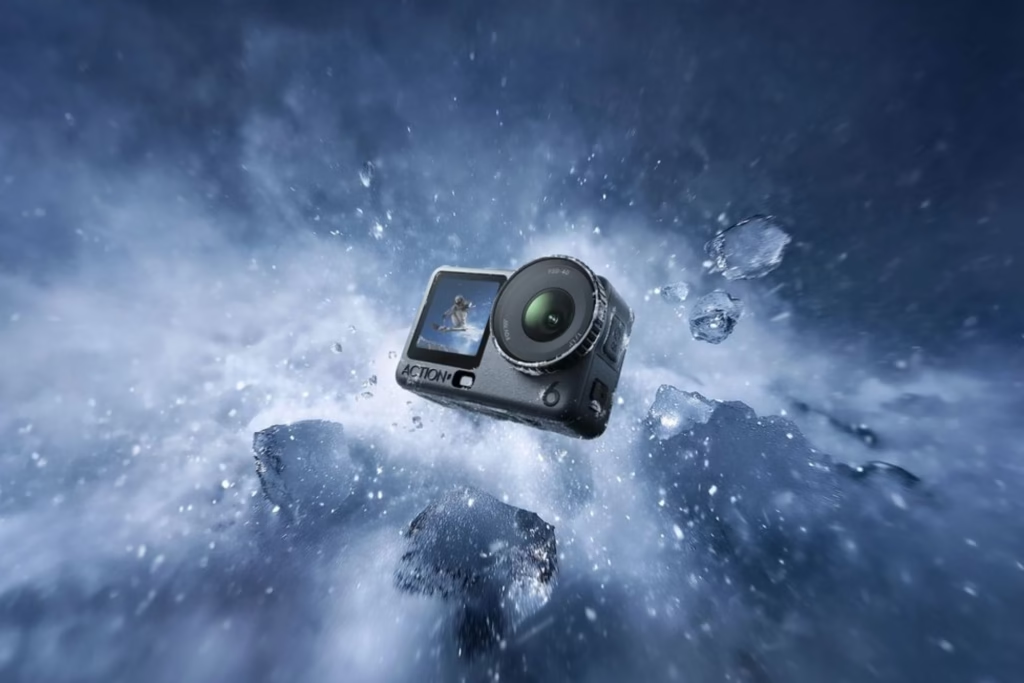
Facing off against industry giants, the DJI Osmo Action 6 isn’t simply trying to imitate them. No. It’s forging its own path. Its strategy? To focus heavily on optical quality , with its variable aperture, and on post-production flexibility thanks to its square sensor. This approach is clever. Meanwhile, GoPro seems to be continuing its pursuit of pure resolution, while Insta360 remains the champion of modularity and creative effects.
So how do we find our way around? There’s nothing like a technical head-to-head to get a clearer picture and understand where each brand is positioning itself.
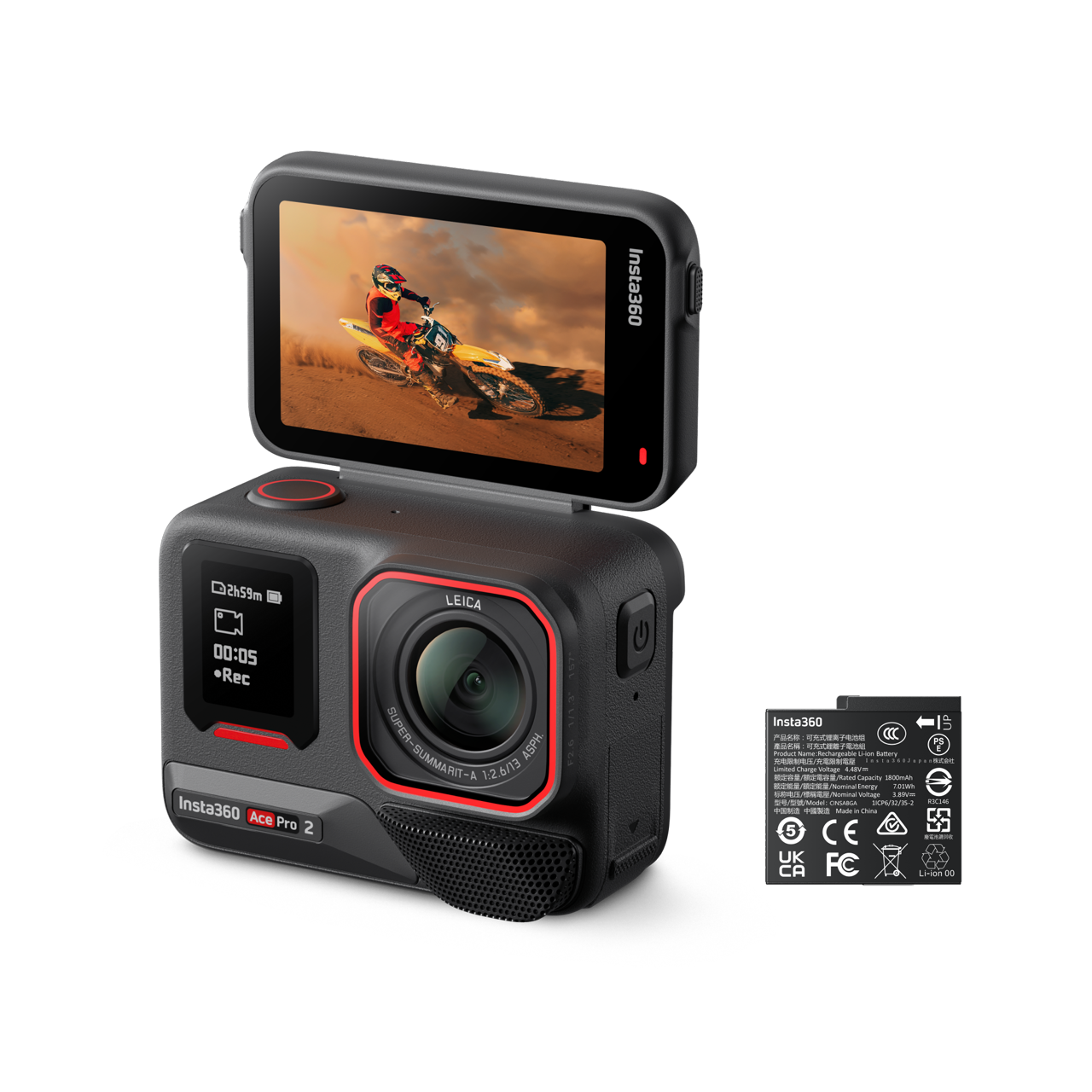
| Characteristic | DJI Osmo Action 6 | GoPro Hero 13 Black | Insta360 Ace Pro 2 |
|---|---|---|---|
| Sensor | 1/1.1″ (≈40 MP) | ~1/1.9” | 1/1.3” |
| Opening | Variable f/2.0 – f/4.0 | f/2.5 (fixed) | f/2.6 (fixed) |
| Max Video Resolution | 4K 120 fps | 5.3K 60 fps | 8K 30 fps |
| Photo resolution | 38 MP | 27 MP | 50 MP |
| Stabilization | RockSteady 3.0+ + HorizonSteady | HyperSmooth 6.0 + Horizon Lock | FlowState + Horizon Lock |
| Internal storage | 50 GB | No | No |
| microSD card | Yes (up to 1 TB) | Yes (up to 1 TB) | Yes (up to 1 TB) |
| Sealing without casing | 20 m | 10 m | 12 m |
| Waterproofing with a casing | 60 m | 60 m | 60 m |
| Autonomy | Up to 240 min (1080p/24) | Approximately 120 min (5.3K/30 estimated) | Up to 180 min (1080p/24) |
| Battery capacity | 1950 mAh | 1720 mAh | 1800 mAh |
| Weight | 149 g | 154 g | 177.2 g |
| Maximum video bitrate | 120 Mbps | ~120 Mbps | 180 Mbps |
| Colorimetric profiles | Standard / D-Cinelike | Flat / Natural / Vivid | I-Log / Leica Vivid / Leica Natural / Film / Portrait |
| Screens | Dual screen 800 nits | Front & rear screen | Tilting screen |
| Operating temperature | -20°C to +45°C | -10°C to +35°C | -20°C to +45°C |
| Introductory price | €379 | $399.99 (~€370) | €449 (depending on region) |
The DJI’s strengths . The variable aperture is a world first in this segment. It’s a real plus for adapting to all lighting conditions, from a dark undergrowth to a sunny beach. The 50GB internal storage is incredibly convenient. No more worrying about a full memory card in the middle of an action. And its superior waterproofing to 20 meters without a housing makes it more rugged right out of the box, although choosing the right SD card remains crucial for the safety of your footage.
However, fairness is key. GoPro maintains its lead with its comprehensive accessory ecosystem and highly mature software, a reliable choice for many. Insta360, on the other hand, reigns supreme in terms of AI-powered creative features and modularity. The final choice therefore depends on your priorities . If you’re looking for versatility for social media and consistent image quality regardless of lighting conditions, the DJI has compelling arguments. But for those hesitating between a 360 model and a 360 camera, a comparison of 360° cameras can help clarify the decision and demonstrate that each camera has its own strengths.
Weak points and compromises: what you need to know before buying
Let’s be clear. The DJI Osmo Action 6 is a fantastic action camera, but it’s not perfect. Before taking the plunge, it’s essential to understand its few drawbacks and the compromises it requires. This section is here to ensure you know exactly what you’re getting into, without any unpleasant surprises.
First, let’s talk about those small ergonomic details that can be annoying on a daily basis. These minor inconveniences make all the difference in practice. We’ve noted a few recurring points in user feedback.
- Accessing the microSD card : The slot can be a little difficult to reach. A minor annoyance when you need to quickly change cards in the middle of the action.
- The On/Off button : Some find it a bit stiff. It lacks the smoothness one expects from a button that is frequently used, sometimes while wearing gloves.
- The DJI Mimo app : A point of contention for Android users. The app isn’t always available on the Google Play Store, requiring users to download an APK file from the DJI website. This somewhat detracts from the ease of installation.
Beyond ergonomics, there are hardware and software shortcomings to consider. These omissions aren’t flaws in themselves, but design choices that could be crucial depending on your intended use.
- Lack of internal GPS : Unlike some GoPros, the Action 6 doesn’t have a built-in GPS chip. To overlay your speed or route onto your motorsports videos, you’ll need an external accessory. A shame.
- No micro-HDMI output : It is not possible to connect the camera directly to an external monitor. An accessory will be required for a simple and direct video feed.
- InvisiStick mode: The feature that erases the selfie stick is indeed present. Good news! But its quality could be improved . The effect isn’t always perfect and can leave a watermark.
Finally, let’s address the “compromise” of the square sensor. The “Open Gate” mode, which allows cropping for all formats, is a great idea. But there’s a technical drawback: the raw image is square . To obtain a 16:9 or 9:16 video format, cropping is unavoidable. Even if it’s slight, it’s not a “true” native 16:9. It’s a detail for purists, but a detail that matters.
Ecosystem and accessories: how to boost your Osmo Action 6
No matter how good an action camera is, it only reveals its full potential with the right tools. DJI understands this perfectly. The DJI Osmo Action 6 isn’t just a standalone device; it’s the heart of a system designed to exponentially increase your creative possibilities. Thinking about the ecosystem means anticipating your future shoots.
Need to know what can really make a difference? Good news, DJI offers a range of official accessories designed for specific uses that transform the experience.
- Wireless audio: A major advantage for vloggers. The camera connects directly to DJI Mic wireless microphones. No more complicated cables and adapters. Thanks to the OsmoAudio ecosystem, you get clear, professional sound effortlessly .
- Interchangeable lenses : The Action 6 becomes even more versatile. A macro lens is available for extreme close-ups, ideal for capturing striking details. For action shots, an ultra-wide-angle lens expands the field of view to 182°.
- The Adventure Pack: Heading out for a long day? This pack is for you. It usually includes extra batteries, a charging case, and a selfie stick. The idea is simple: never run out of power at the crucial moment.
It’s undeniable: these accessories are game-changers. A wireless microphone transforms your camera into a mobile interview kit. A macro lens opens up a whole new creative avenue. This is a crucial point to consider in your overall budget, because this ecosystem is what will take your videos to the next level .
Verdict: Who is the DJI Osmo Action 6 made for?
The DJI Osmo Action 6 isn’t a camera for everyone, and that’s a good thing. It makes bold technical choices. In short: it sacrifices the race for maximum resolution for superior image quality and versatility in real-world conditions. A daring gamble, but one that pays off.
So, it’s a big YES if you recognize yourself in these profiles:
- You’re a multi-platform content creator: The square sensor is made for you. Filming once, publishing on YouTube and TikTok without any hassle – that’s a luxury.
- You film in changing lighting conditions: Variable aperture will change your life. No more blown-out or noisy footage when moving from a forest to a sunny plain.
- Audio quality is a priority : Native compatibility with DJI microphones is a major selling point for vloggers and interviewers.
- You want a camera ready to use : The 50GB internal storage and 20m waterproofing without a case make it very practical.
On the other hand, move along if…
- You’re obsessed with maximum resolution: If nothing matters to you below 5K, a newer GoPro will probably be more suitable . The Action 6 focuses on perfect 4K.
- You need a built-in GPS: To overlay your speed stats or route, the lack of a native GPS will be a hindrance . You’ll need an external accessory.
- Your budget is very tight: With a launch price of €379 (and €479 for the Adventure pack), it’s positioned at the high end of the market . Cheaper alternatives exist.
My final verdict? The DJI Osmo Action 6 is the smartest action camera on the market right now. It’s changing the game rather than relying on the same tactics as its competitors. For those who prioritize true image quality and flexibility over simply chasing numbers, this is the camera of the future.
The DJI Osmo Action 6 isn’t just an update; it’s a fundamental shift in philosophy . By focusing on a flexible square sensor and a unique variable aperture, it prioritizes true image quality and versatility over chasing numbers. This smart choice makes it a must-have .








Leave a Reply